Water bath
A tank of water held at a constant set temperature, used to warm, incubate or melt samples gently and evenly.
- Pharmaceutical
- Microbiology
- Food & dairy
- Clinical laboratories
- Research
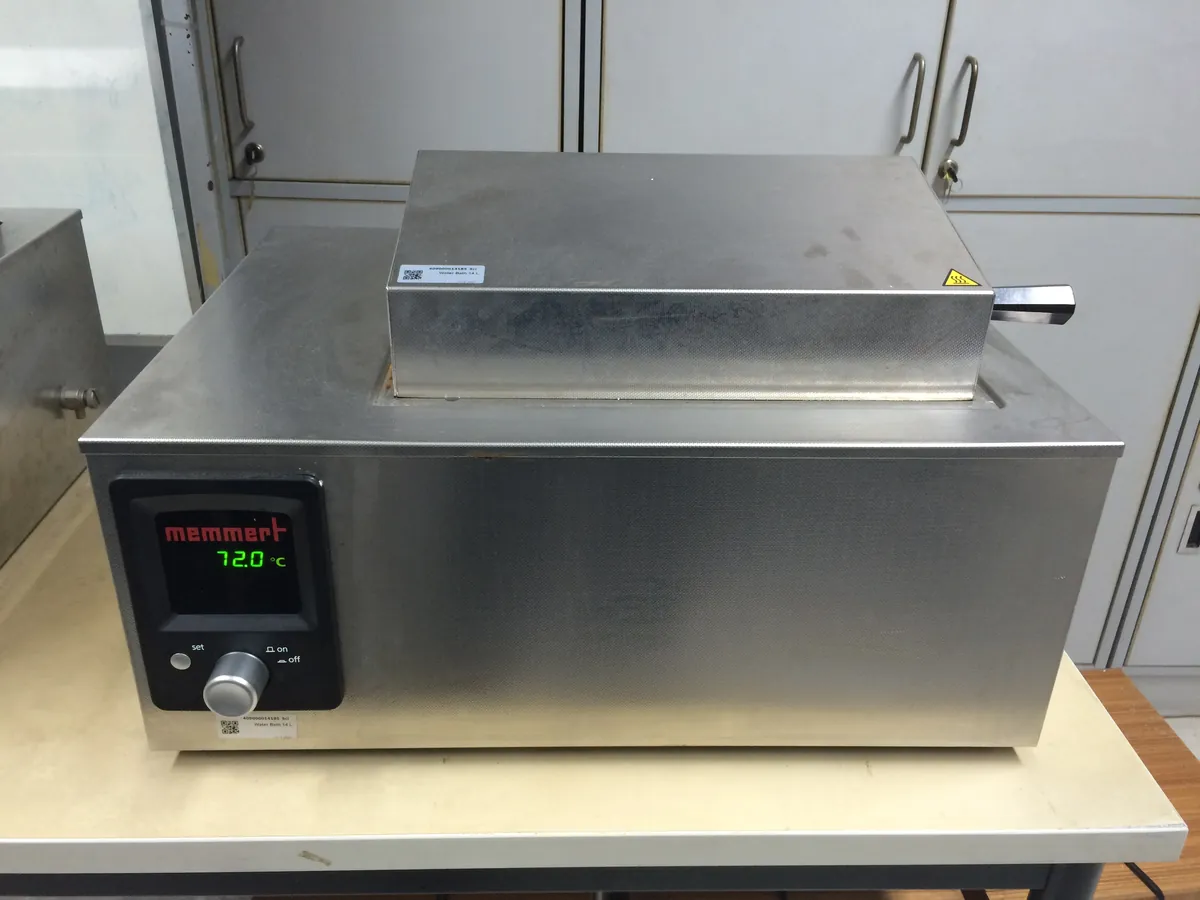
What is Water bath?
A water bath is an insulated tank of water with a heater, a temperature sensor and a controller. Water transfers heat evenly and gently, so flasks and tubes reach the set temperature without local hot spots.
In QC labs it is used to warm media and reagents, melt or soften semi-solid samples, keep agar molten at about 45–50 °C before pouring plates, and incubate tests at controlled temperatures. Shaking models add gentle agitation; circulating models pump water for better uniformity.
Because some tests depend on a set temperature, the bath's temperature accuracy and uniformity are calibrated against a reference thermometer.
Used for
- Keeping melted agar at about 45–50 °C before pouring plates
- Warming culture media, reagents and diluents
- Melting suppositories, ointments and waxy samples
- Incubating enzymatic or other temperature-dependent tests
- Thawing frozen samples under control
How it works
- 01
Set
The user enters the set temperature.
- 02
Heat
The immersion heater warms the water.
- 03
Sense
A sensor (often a Pt100 or thermistor) measures the water temperature.
- 04
Control
The controller adjusts heater power to hold the set point.
- 05
Distribute
Convection, a pump or stirring keeps the water uniform.
Advantages
- Gentle, even heating
- Simple and inexpensive
- Suitable for many container sizes
- Easy to verify with a thermometer
Limitations
- Limited to below about 100 °C (oil baths are used for higher temperatures)
- Evaporation lowers the water level
- Standing water can grow algae and bacteria
- Without circulation, uniformity can be poor
1 calibration procedure
Methods that use Water bath
Keep every Water bath in control: usage logs, calibration and maintenance schedules, and automatic blocking of overdue instruments.