Water bath
A tank of water held at a constant set temperature, used to warm, incubate or melt samples gently and evenly.
- Pharmaceutical
- Microbiology
- Food & dairy
- Clinical laboratories
- Research
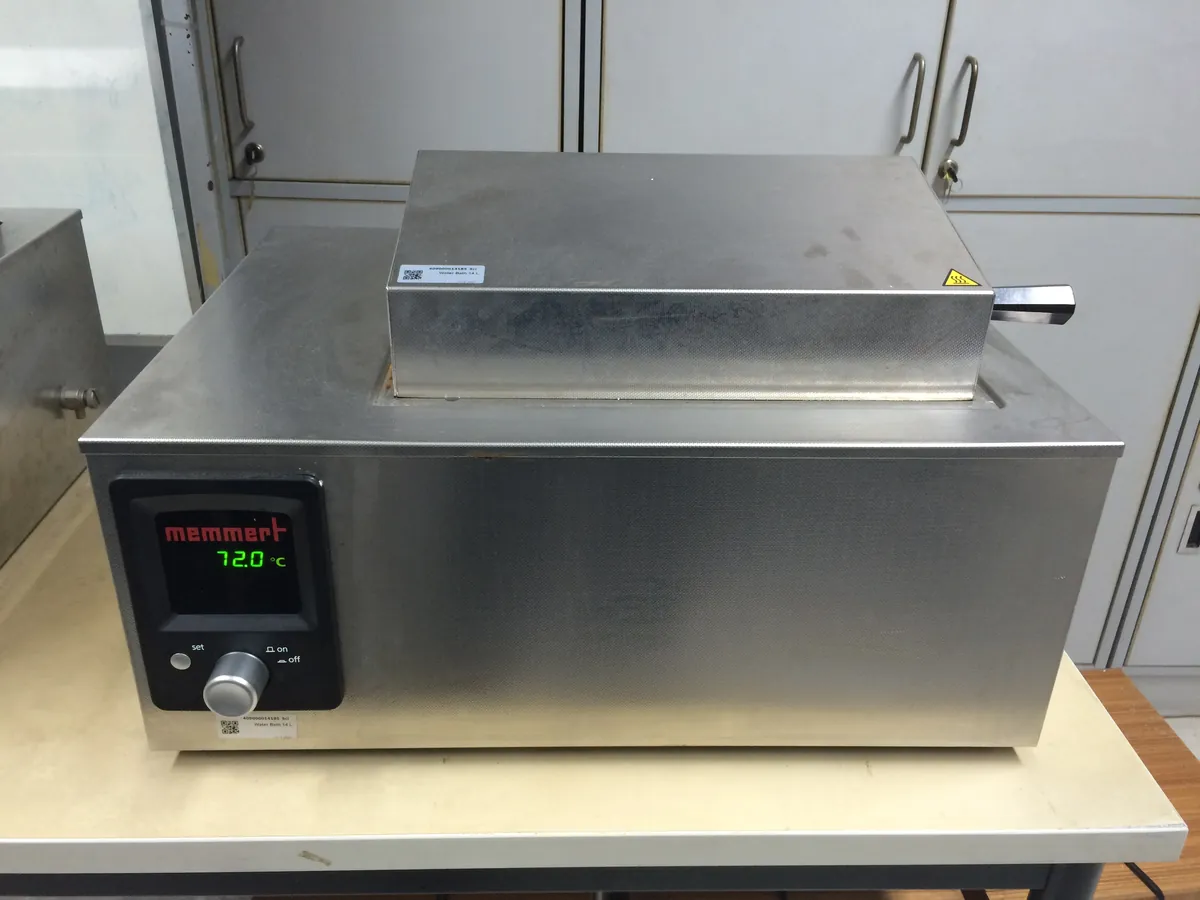
How Water bath works
An immersion heater warms the water, and a sensor feeds the temperature to a controller that switches the heater on and off (or modulates it) to hold the set point. Convection or a stirrer spreads the heat so that the whole tank is uniform.
The path of a sample
- 01
Set
The user enters the set temperature.
- 02
Heat
The immersion heater warms the water.
- 03
Sense
A sensor (often a Pt100 or thermistor) measures the water temperature.
- 04
Control
The controller adjusts heater power to hold the set point.
- 05
Distribute
Convection, a pump or stirring keeps the water uniform.
Main parts and what they do
Tank
Stainless-steel or plastic container for the water.
Immersion heater
Heats the water.
Temperature sensor and controller
Measure and hold the set temperature; display the reading.
Circulator or shaker (optional)
Improves uniformity or agitates samples.
Lid (gabled or flat)
Reduces evaporation and heat loss; a gabled lid stops condensation dripping on samples.
Racks and platforms
Hold tubes and flasks at the right depth.
Over-temperature cut-out and low-level protection
Switch off the heater if it overheats or the water is too low.
Terms every analyst should know
Accuracy
How close the actual water temperature is to the set point, measured with a calibrated reference thermometer.
Uniformity
The difference between the warmest and coolest positions in the bath at the same time.
Stability
How much the temperature at one point varies over time.
Water quality
Purified water reduces scale; an approved antimicrobial additive limits growth.
Keep every Water bath in control: usage logs, calibration and maintenance schedules, and automatic blocking of overdue instruments.