Viscosity of Oral Liquids (Rotational Viscometer)
The sample is brought to a controlled temperature and its viscosity is measured with a rotational viscometer using the spindle and speed given in the STP, with the reading taken at a fixed time and within the reliable torque range.
- Rotational viscometry
- Viscometer
- Water bath
Reference: Typical method based on USP <912> and Ph. Eur. 2.2.10. Spindle, speed, temperature and limits come from the approved product specification and STP.
Why this method works
A spindle turns in the sample at a set speed. The liquid resists the motion and the instrument measures the torque needed. Viscosity is calculated from the torque using a factor for that spindle and speed: viscosity = % torque × full-scale range ÷ 100. Syrups are often close to Newtonian, but suspensions and emulsions are usually shear-thinning, so the result is an apparent viscosity that is only valid for the stated spindle, speed, temperature and time.
Instruments used
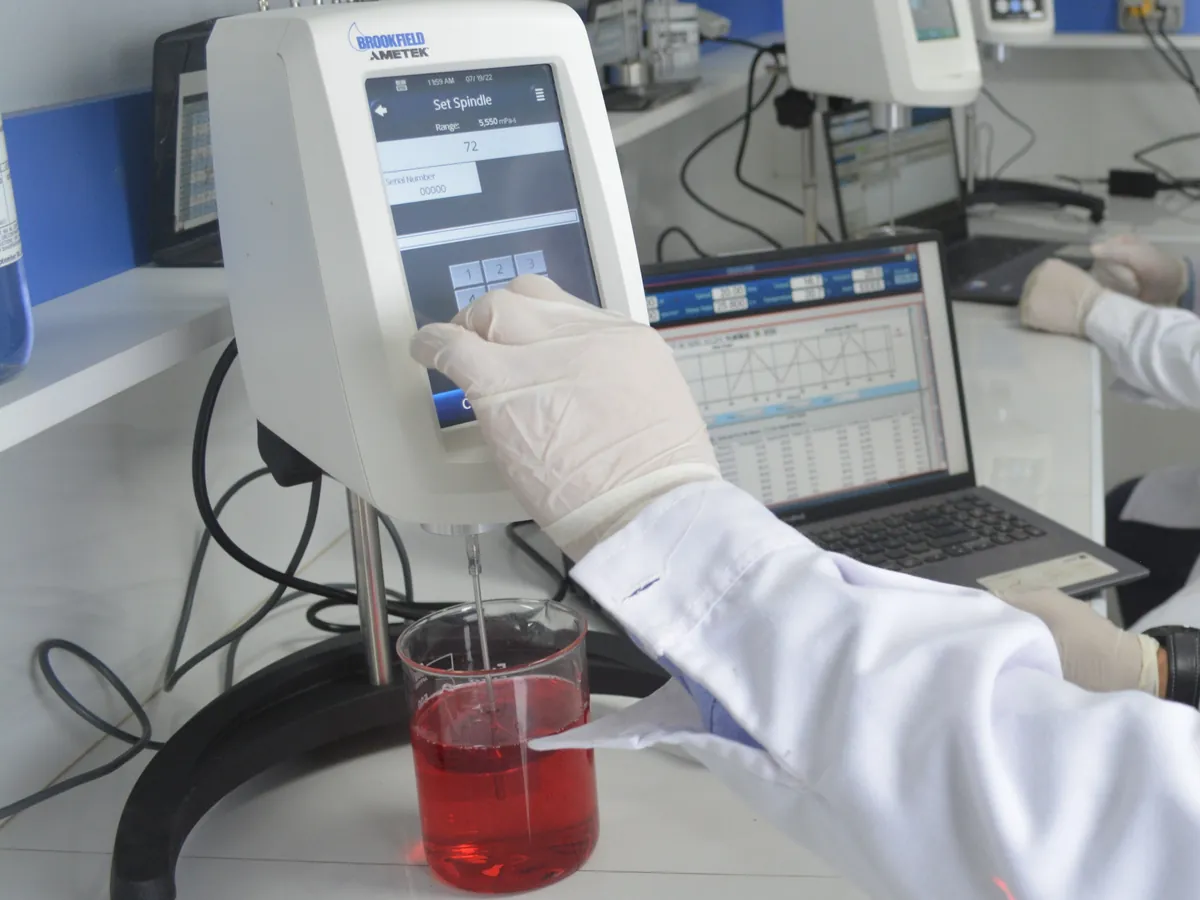
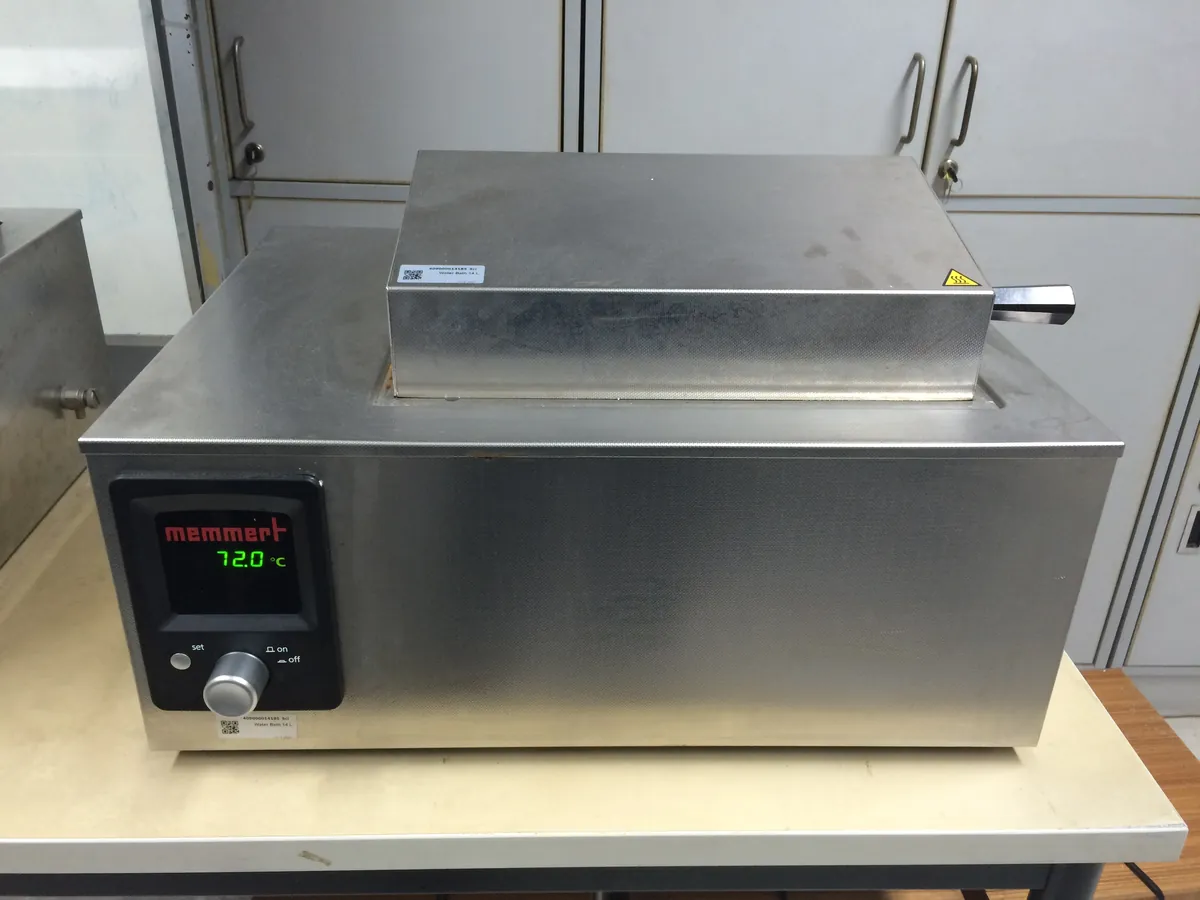
Reagents & standards
| Reagent | Grade / specification |
|---|---|
| Viscosity standard | Certified Newtonian standard close to the expected viscosity, for the system check (if required by your SOP) |
| Cleaning | Purified water and a suitable solvent for the spindle |
Preparing the sample
- 01
Mix
Mix the product as the STP says (for example, invert the bottle 10 times for a suspension).
- 02
Transfer
Pour into the specified container (for example a 600 mL low-form beaker) to the stated level, avoiding bubbles.
- 03
Thermostat
Hold the beaker in the water bath at 25.0 ± 0.5 °C (or as stated) until the sample reaches temperature.
- 04
Set up
Fit the stated spindle and immerse it to the mark.
- 05
Measure
Rotate at the stated speed and read at the stated time.
Procedure
- 1Check the viscometer is level and auto-zeroed.
- 2Mix the sample exactly as the STP describes; do not shake more than stated, because pre-shear changes the result of shear-thinning products.
- 3Transfer about 500 mL (or the stated volume) into the container and place it in the water bath. Check the temperature with a calibrated probe.
- 4Insert the spindle at an angle to avoid trapping air, attach it and lower it until the liquid reaches the immersion mark.
- 5Start rotation at the stated speed. Read the viscosity and % torque after the stated time, for example 60 seconds.
- 6Check the % torque is within the range allowed by your SOP. If it is not, change spindle or speed only as the STP permits, and record the change.
- 7Measure duplicate portions if your SOP requires and report the mean.
Standard preparation
- 1If a system check is required, measure a certified viscosity standard at its certificate temperature using a spindle and speed that give mid-range torque, and confirm the result is within the combined tolerance.
Notes for analysts
- For non-Newtonian products, viscosity depends on spindle, speed, temperature and time; never compare results obtained under different conditions.
- Thixotropic suspensions thin when sheared and recover on standing; control how long the sample stands after mixing.
- Viscosity falls as temperature rises, often by several percent per °C, so temperature control is critical.
Method parameters (typical)
| Instrument | Rotational viscometer (spindle type) |
|---|---|
| Spindle / speed | As stated in the STP, e.g. spindle 2 at 60 rpm for a syrup |
| Temperature | 25.0 ± 0.5 °C (or as stated) |
| Container | As stated, e.g. 600 mL low-form beaker, with guard leg if specified |
| Reading time | Fixed, e.g. after 60 seconds of rotation |
| Torque range | Typically 10–100% of full scale; many SOPs prefer roughly 20–80% for better precision |
System suitability & sequence
| Parameter | Limit |
|---|---|
| Viscosity standard (if used) | Within the combined tolerance of instrument accuracy and certificate |
| Temperature | Sample within the stated range at the time of reading |
| % torque | Within the range stated in your SOP |
Typical sequence
- 1Auto-zero and level check
- 2Viscosity standard (if required)
- 3Sample portion 1
- 4Sample portion 2 (if required)
Calculation with a worked example
Where
- η
- Dynamic (apparent) viscosity, mPa·s (cP)
- % torque
- Torque reading as a percentage of the instrument's maximum
- FSR
- Full-scale range for the spindle/speed combination, mPa·s, from the manufacturer's table
Given
- Spindle / speed
- Spindle 2 at 60 rpm
- FSR for this combination
- 500 mPa·s
- % torque after 60 s
- 46.8%
- Temperature
- 25.1 °C
Working
- % torque = 46.8%, which is inside the 10–100% range
- η = 46.8 × 500 ÷ 100 = 234 mPa·s
Viscosity = 234 mPa·s (spindle 2, 60 rpm, 25 °C, 60 s). Compare with the product specification.
What result passes
- Viscosity within the range in the approved product specification (for example 150–300 mPa·s — illustrative only).
- % torque within the range allowed by your SOP; results outside this range are not valid.
- Always report the spindle, speed, temperature and reading time with the result.
Validation parameters (ICH Q2(R2))
| Parameter | Typical requirement |
|---|---|
| Precision | Repeatability of replicate portions within the limit in your SOP |
| Robustness | Effect of temperature, mixing and reading time studied during development |
| Specificity | Not applicable (physical property) |
| Instrument accuracy | Shown by viscosity standard checks and speed calibration |
Run this method in LimsPulse: specifications and STPs under version control, results calculated and checked against limits, and a signed Certificate of Analysis.