Vicat Apparatus
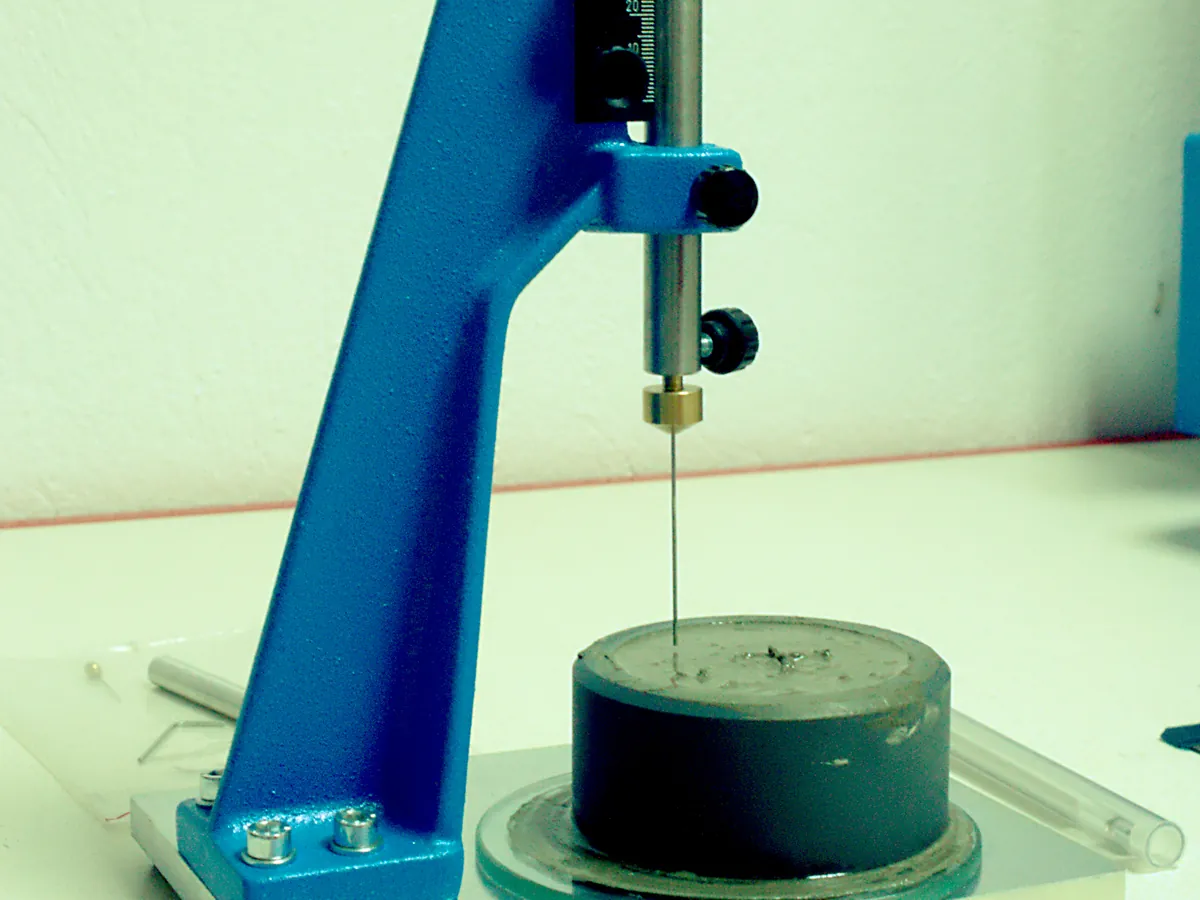
A weighted sliding rod with interchangeable plunger and needles used to find the standard consistency of cement paste and its initial and final setting times.
- Cement manufacturing
- Construction materials testing
- Ready-mix concrete
- Admixture manufacturers
- Academic labs
What is Vicat?
The Vicat apparatus is a simple frame holding a vertical rod that slides freely through a bearing. The rod and its attachment have a fixed total mass (typically 300 g), so when released it sinks into a cement paste under its own weight. A pointer on the rod moves over a millimetre scale to show how far it has penetrated.
Three attachments are used. A 10 mm diameter plunger is used to find standard consistency: the amount of water that gives a paste of a defined stiffness. A fine needle of about 1 mm section is used for initial setting time, and a needle with a small annular collar is used for final setting time.
Under IS 4031 Part 4 the paste is at standard consistency when the plunger stops about 5 to 7 mm from the bottom of the mould. Setting times (IS 4031 Part 5) are then measured on a paste made with 0.85 times that water. For ordinary Portland cement, IS 269 typically requires an initial setting time of not less than 30 minutes and a final setting time of not more than 600 minutes.
Used for
- Standard (normal) consistency of cement paste (IS 4031 Part 4 / ASTM C187)
- Initial and final setting time of cement (IS 4031 Part 5 / ASTM C191)
- Setting behaviour of blended cements, gypsum and lime pastes
- Effect of admixtures on setting of cement paste
- Water demand needed before soundness and mortar cube tests
How it works
- 01
Paste preparation
A weighed cement sample (typically 400 g under IS) is gauged with a known volume of water for a fixed gauging time.
- 02
Filling the mould
The paste fills the Vicat mould resting on a non-porous plate; the surface is struck off level.
- 03
Consistency trial
The 10 mm plunger is lowered to touch the surface and released; the penetration is read. Trials are repeated with different water contents until the target is met.
- 04
Initial setting
Using 0.85 × the standard-consistency water, the 1 mm needle is released at intervals. Initial set is when it fails to pierce beyond about 5 ± 0.5 mm from the bottom.
- 05
Final setting
With the annular-collar needle, final set is when the needle marks the surface but the collar does not.
- 06
Reporting
Times are counted from when water was added to the cement, and reported in minutes.
Advantages
- Simple, inexpensive and needs no power
- Internationally standardised; results are comparable between labs
- Same frame does consistency and both setting times by changing attachments
- Automatic Vicat instruments can log penetrations unattended
Limitations
- Operator-sensitive: release technique, timing and needle cleanliness affect results
- Strongly affected by room temperature and humidity
- Setting time is an arbitrary index of stiffening, not a measure of strength gain
- Bent or worn needles give wrong results unless dimensions are checked regularly
1 calibration procedure
Methods that use Vicat
Keep every Vicat in control: usage logs, calibration and maintenance schedules, and automatic blocking of overdue instruments.