Vicat Apparatus
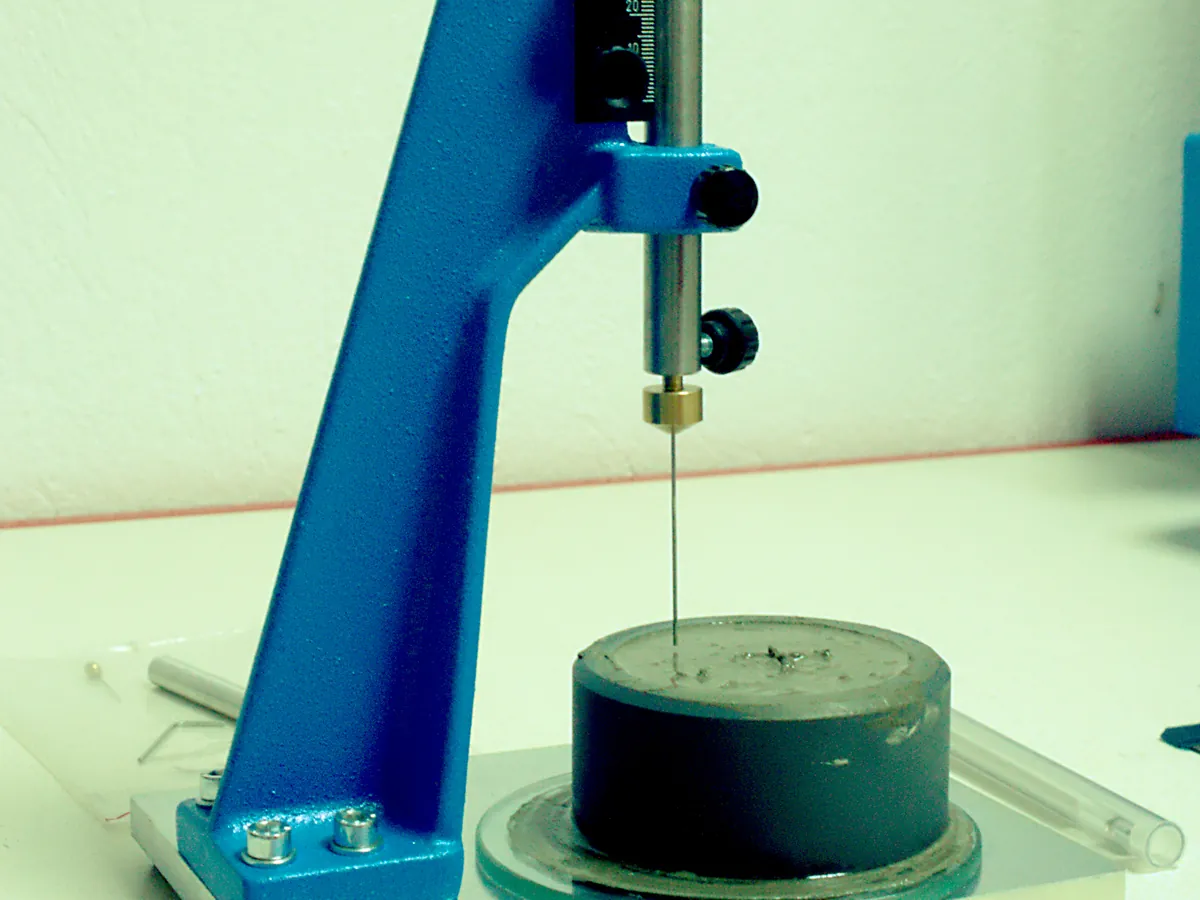
A weighted sliding rod with interchangeable plunger and needles used to find the standard consistency of cement paste and its initial and final setting times.
- Cement manufacturing
- Construction materials testing
- Ready-mix concrete
- Admixture manufacturers
- Academic labs
How Vicat works
A rod of fixed mass, ending in a plunger or needle of fixed size, is released onto cement paste. How far it penetrates depends on the stiffness of the paste. Consistency is defined by the plunger stopping at a set depth; setting times are defined by when the needle can no longer penetrate beyond a set depth (initial) or only leaves a mark (final).
The path of a sample
- 01
Paste preparation
A weighed cement sample (typically 400 g under IS) is gauged with a known volume of water for a fixed gauging time.
- 02
Filling the mould
The paste fills the Vicat mould resting on a non-porous plate; the surface is struck off level.
- 03
Consistency trial
The 10 mm plunger is lowered to touch the surface and released; the penetration is read. Trials are repeated with different water contents until the target is met.
- 04
Initial setting
Using 0.85 × the standard-consistency water, the 1 mm needle is released at intervals. Initial set is when it fails to pierce beyond about 5 ± 0.5 mm from the bottom.
- 05
Final setting
With the annular-collar needle, final set is when the needle marks the surface but the collar does not.
- 06
Reporting
Times are counted from when water was added to the cement, and reported in minutes.
Main parts and what they do
Frame and bearing
Holds the moving rod vertical and lets it slide with very little friction.
Moving rod with pointer
Carries the attachments; the pointer reads penetration on the scale.
Graduated scale
Millimetre scale (typically 0–40 or 0–50 mm) against which penetration is read.
Consistency plunger
Polished cylinder about 10 mm in diameter and about 50 mm long, used for standard consistency.
Initial setting needle
Fine needle of about 1 mm square (IS) or 1 mm diameter (ASTM) section, used for initial setting time.
Final setting needle
1 mm needle with an annular metal collar (about 5 mm diameter) set so the needle tip projects about 0.5 mm.
Vicat mould
Split or one-piece frustum about 40 mm high, resting on a glass or non-porous base plate.
Release screw
Clamps the rod in position; releasing it lets the rod fall without a push.
Terms every analyst should know
Standard consistency (P)
Water, as % by mass of cement, that gives the plunger penetration defined in the standard. It is the base for setting-time and soundness pastes.
Gauging time
The time from adding water to starting to fill the mould, typically 3 to 5 minutes under IS 4031.
Moving mass
Rod plus attachment have a fixed total mass (typically 300 g). If the mass changes, penetration changes.
Hydration and stiffening
Setting reflects early hydration of tricalcium aluminate and silicate; gypsum is added to cement to control it.
Temperature sensitivity
Higher temperature speeds setting. IS 4031 requires the room at about 27 ± 2 °C and controlled humidity during the test.
Keep every Vicat in control: usage logs, calibration and maintenance schedules, and automatic blocking of overdue instruments.