Normal consistency of cement (Vicat plunger)
Finds the amount of water, as a percentage of the mass of dry cement, that gives a cement paste of a standard stiffness. This value, called P, is then used to set the water content for the setting time, soundness and mortar strength tests.
- Construction materials
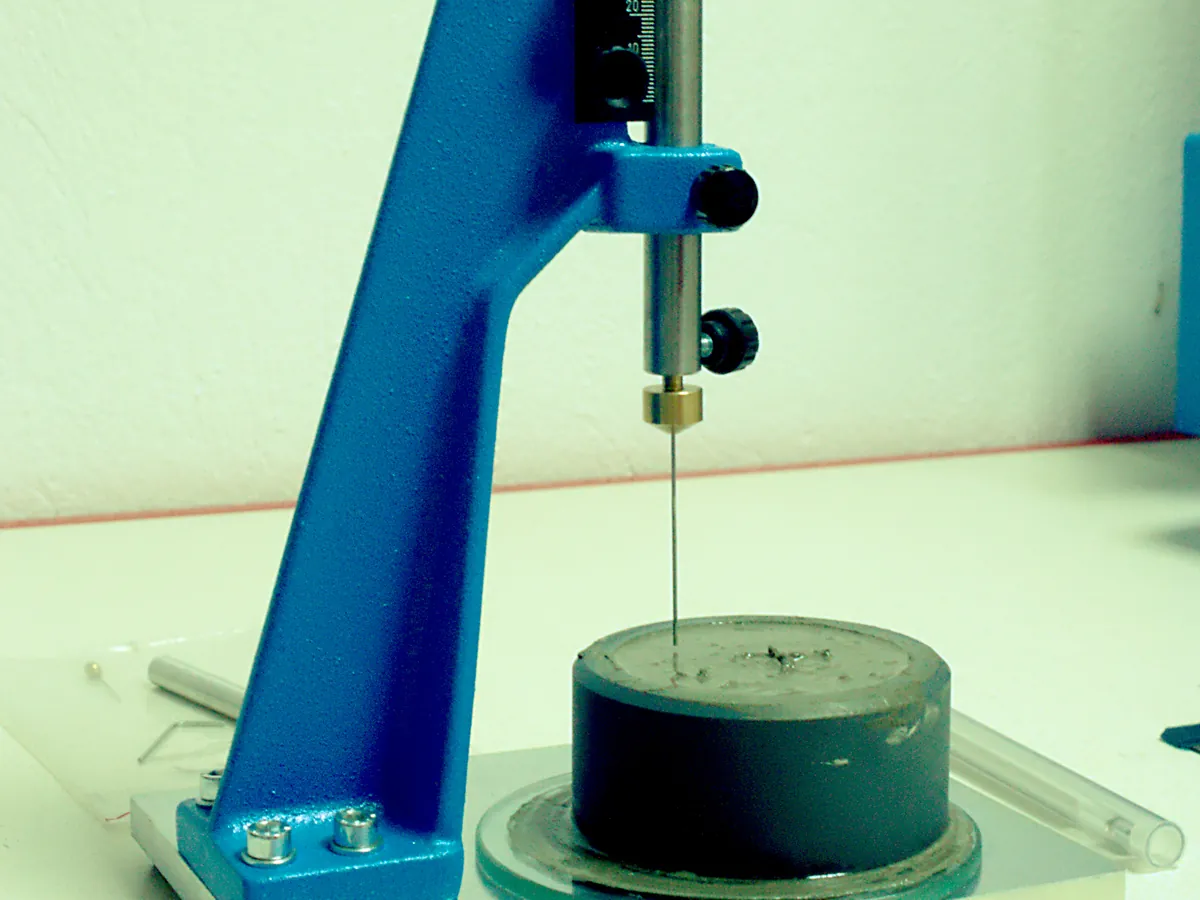
- Vicat apparatus with 10 mm plunger
- Vicat
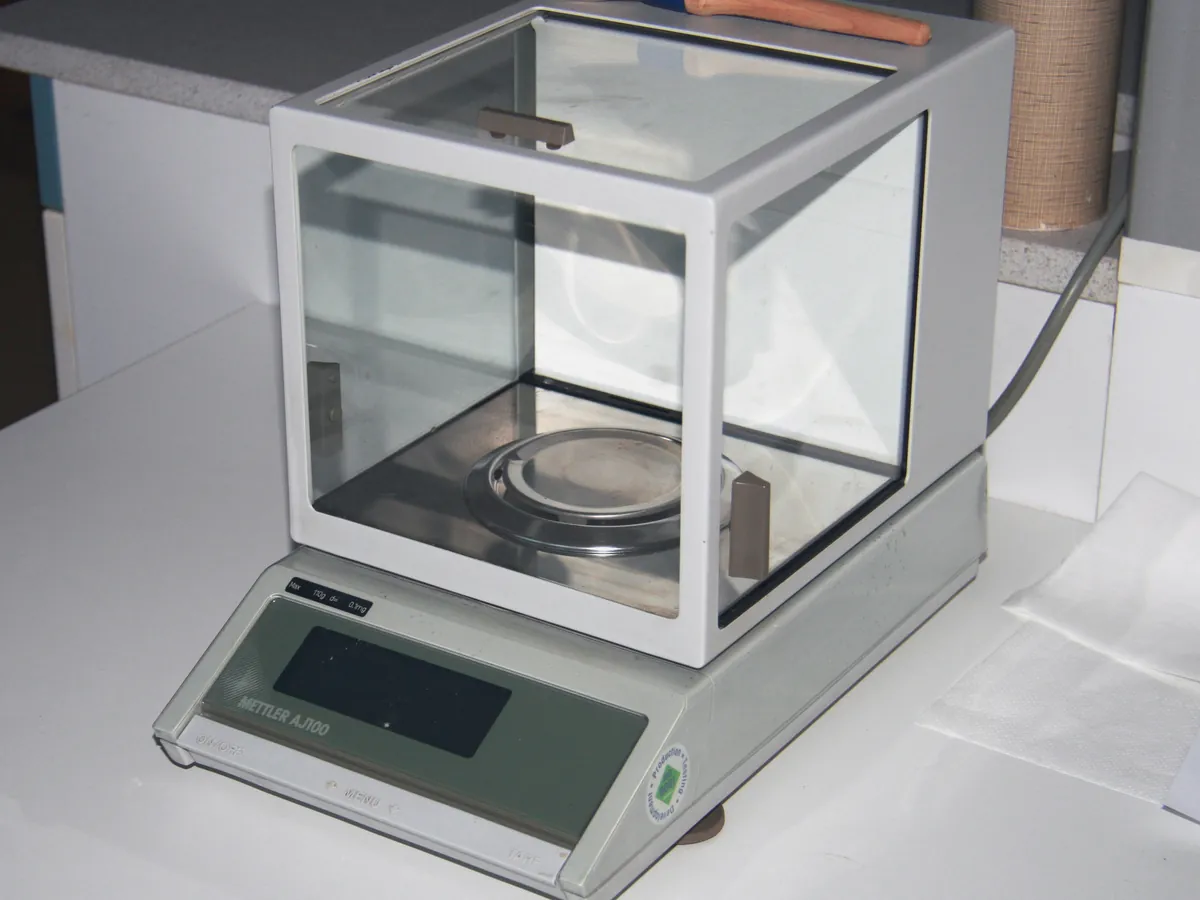
- Analytical balance
Reference: Based on IS 4031 (Part 4) and ASTM C187. Follow the current edition and your laboratory SOP.
Why this method works
A heavy, flat-ended plunger (10 mm diameter) is released onto a freshly gauged cement paste held in the Vicat mould. A stiff paste resists the plunger and a wet paste lets it sink almost to the base plate. The paste has normal (standard) consistency when the plunger stops at a set distance from the bottom of the mould — under IS 4031 (Part 4) this is when it penetrates to a point 5 to 7 mm from the bottom, which for the usual 40 mm deep mould means a penetration of about 33 to 35 mm. Trial pastes with different water contents are made until this condition is met.
Instruments used
Reagents & standards
| Reagent | Grade / specification |
|---|---|
| Cement sample | Representative sample, passed through a 850 µm (or as specified) sieve to break lumps, at laboratory temperature |
| Water | Clean potable or distilled water, at laboratory temperature |
| Light oil | Thin film on the mould and base plate to stop the paste sticking |
Preparing the sample
- 01
Condition
Bring cement, water and tools to 27 ± 2 °C.
- 02
Weigh
Weigh about 400 g of cement on a non-porous plate.
- 03
Add water
Add a trial amount of water, often starting near 26–28%.
- 04
Gauge
Mix with trowels for 3 to 5 minutes from adding water.
- 05
Fill mould
Fill the Vicat mould, smooth the top level with the rim.
- 06
Plunge
Lower the plunger gently, release it and read the penetration.
Procedure
- 1Check that the moulding room is at 27 ± 2 °C with relative humidity of at least about 65%, as in the IS 4031 general conditions.
- 2Weigh about 400 g of cement and place it on a clean, non-porous surface. Form a crater in the centre.
- 3Add a measured quantity of water and start a stopwatch at the moment water is added.
- 4Gauge (mix) the paste thoroughly with two trowels. The gauging time — from adding water to starting to fill the mould — must be not less than 3 and not more than 5 minutes.
- 5Fill the Vicat mould, resting on a non-porous plate, completely with paste. Smooth the surface level with the top of the mould. The mould may be shaken slightly to expel air.
- 6Place the mould under the rod carrying the 10 mm plunger. Lower the plunger gently until it just touches the surface, then release it quickly so it sinks into the paste.
- 7Read the scale once the plunger has stopped. Record the penetration or the distance of the plunger from the bottom of the mould.
- 8If the plunger stops above the 5–7 mm band, the paste is too stiff: repeat with fresh cement and more water. If it goes lower, repeat with less water. Change the water in steps of about 0.5–1% of the cement mass.
- 9Report the water content (as a percentage of the dry cement mass) that brings the plunger to 5–7 mm from the bottom. Use fresh cement for every trial; do not re-mix a paste.
Notes for analysts
- Always start each trial with fresh cement. Re-tempering a paste gives a false (too wet) result.
- Older textbooks quote the end point as a plunger penetration of 33–35 mm; this is the same condition expressed from the top of a 40 mm mould.
- Store the cement sample in an airtight container. Cement that has picked up moisture needs more water and sets differently.
Method parameters (typical)
| Cement mass per trial | About 400 g |
|---|---|
| Plunger | 10 mm diameter, 50 mm long; moving parts about 300 g total |
| Mould | Vicat ring, typically 40 mm high, about 60–70 mm internal diameter at the base |
| Gauging time | Not less than 3 min and not more than 5 min |
| Moulding room | 27 ± 2 °C, RH typically not less than 65% |
| End point | Plunger stops 5 to 7 mm from the bottom of the mould (about 33–35 mm penetration in a 40 mm mould) |
| Typical P for OPC | About 26–33% |
System suitability & sequence
| Parameter | Limit |
|---|---|
| Vicat apparatus | Plunger diameter, moving mass and scale zero checked as per calibration schedule |
| Free movement | Rod falls freely with no friction in its guide |
| Balance | Within calibration; readability 0.1 g or better for cement and water |
Typical sequence
- 1Trial 1 at an estimated water content (e.g. 27%)
- 2Trial 2 adjusted up or down by 0.5–1%
- 3Further trials until the end point is bracketed and met
Calculation with a worked example
Where
- P
- Water for normal consistency (% by mass of dry cement)
- W
- Mass of water added in the trial that met the end point (g)
- C
- Mass of cement used in that trial (g)
Given
- Trial 1
- 108 g water — plunger stopped 12 mm from bottom (too stiff)
- Trial 2
- 116 g water — plunger stopped 6 mm from bottom (within 5–7 mm)
- C
- 400 g
Working
- 1
Trial 2 meets the end point, so W = 116 g.
- 2
P = (116 / 400) × 100
- 3
P = 0.29 × 100 = 29.0%
Normal consistency P = 29.0%. This P is used for the setting time (0.85P), soundness (0.78P) and mortar strength (P/4 + 3.0) tests.
What result passes
- There is no pass/fail limit for normal consistency. It is a reference property used to fix water content in other tests.
- Report P to the nearest 0.5% (or as stated in your SOP). Typical OPC values lie around 26–33%; a value well outside this range should be checked (cement age, fineness, lumps, temperature).
Validation parameters (ICH Q2(R2))
| Parameter | Typical requirement |
|---|---|
| Repeatability | Duplicate determinations by one operator should typically agree within about 1% water |
| Temperature | Results are sensitive to paste temperature; record room and water temperature |
| Operator technique | Consistent gauging time and filling technique are the main sources of variation |
Run this method in LimsPulse: specifications and STPs under version control, results calculated and checked against limits, and a signed Certificate of Analysis.