Sieve Shaker (Analytical Sieving)
Shakes a stack of test sieves so a powder or granule separates into size fractions. Weighing each sieve gives the particle size distribution by mass.
- Pharmaceutical
- Food & beverage
- Chemicals
- Mining and construction
- Agriculture
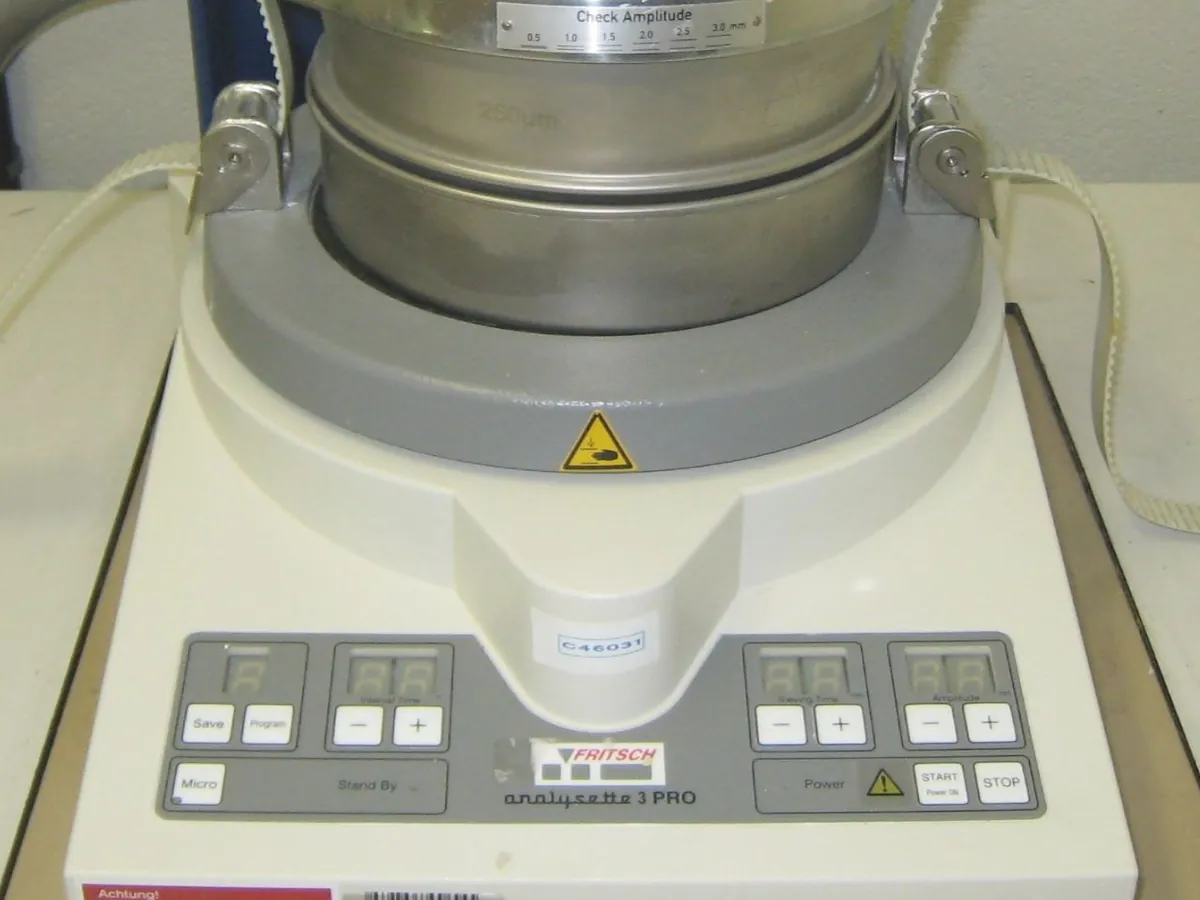
What is Sieve shaker?
Analytical sieving is the oldest and simplest way to measure particle size. A stack of woven-wire test sieves is arranged with the largest aperture on top and a collecting pan at the bottom. The sample goes on the top sieve and the shaker vibrates or taps the stack for a set time.
Particles smaller than an aperture pass through it; larger ones stay on top. At the end each sieve is weighed, and the mass retained on each gives the size distribution by weight.
Sieving suits particles larger than about 75 µm, so it is used mainly for granules, coarse excipients and some APIs. Air-jet sieving extends the range to finer powders. A single sieve is also used as a simple pass/fail check (for example 'not less than 95% passes a 250 µm sieve').
Used for
- Granule size distribution after wet or dry granulation
- Coarse excipient grading (e.g. sugar, lactose, MCC grades)
- Single-sieve limit tests on APIs and excipients
- Checking milling performance
- Removing lumps before other tests
How it works
- 01
Select sieves
Choose a set of sieves with apertures in a geometric series (often a √2 progression) covering the expected range.
- 02
Tare and stack
Weigh each clean sieve and the pan, then stack them with the largest opening at the top.
- 03
Load
Place an accurately weighed sample on the top sieve and fit the lid.
- 04
Shake
Run the shaker at the stated amplitude for the stated time.
- 05
Weigh
Weigh each sieve and the pan with its retained material.
- 06
Calculate
Work out % retained on each sieve and cumulative % passing; check mass balance.
Advantages
- Simple, cheap and easy to understand
- Gives a mass-based distribution directly
- Large sample sizes give representative results
- Pharmacopoeial and ISO methods are well established
Limitations
- Not suitable for fine (below about 75 µm) or cohesive powders without air-jet sieving
- Elongated particles can pass end-on and appear smaller
- Fragile granules can break during shaking (attrition)
- Sieves wear and blind (clog), changing results
- Low resolution: only as many size classes as there are sieves
2 calibration procedures
Methods that use Sieve shaker
Keep every Sieve shaker in control: usage logs, calibration and maintenance schedules, and automatic blocking of overdue instruments.