Sieve shaker · Calibration procedure
Amplitude and timer check
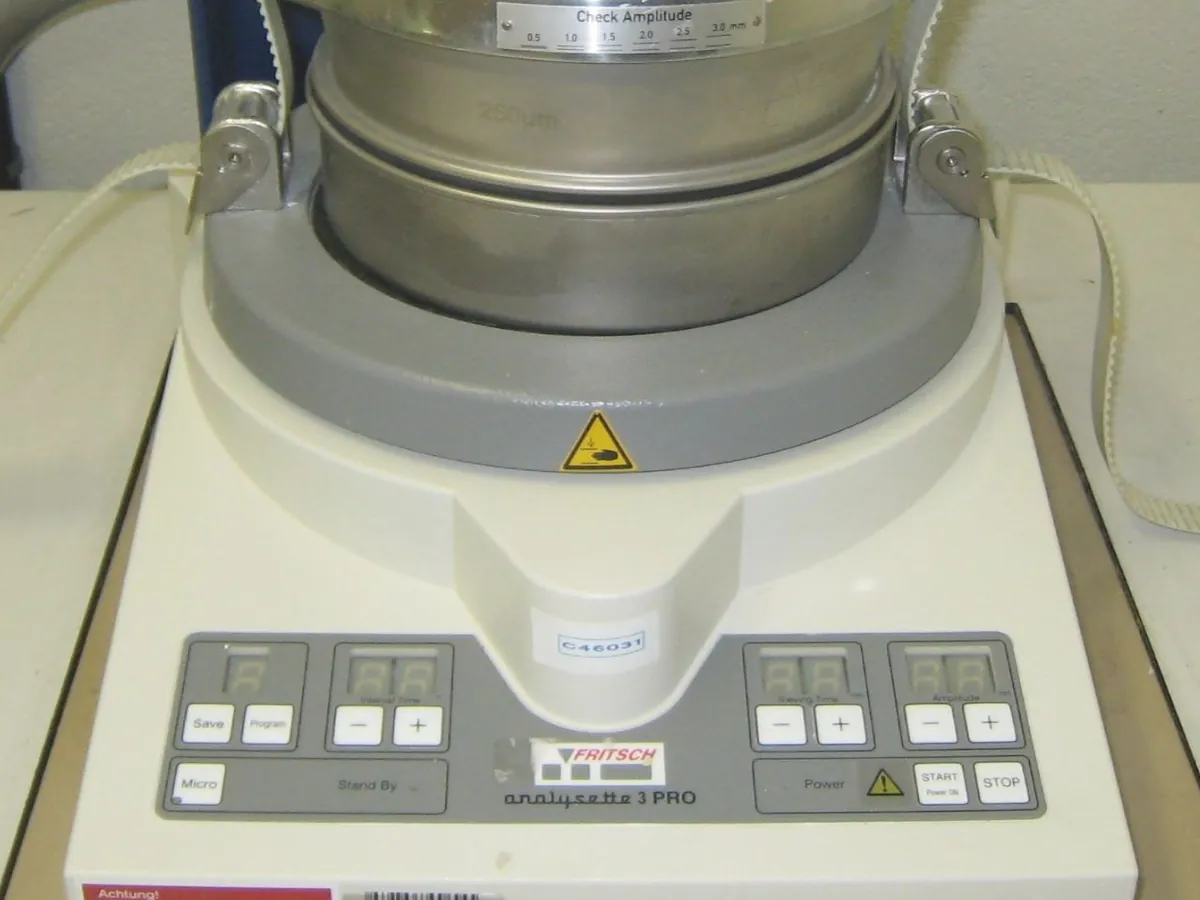
Verifies that the shaker vibrates at the set amplitude and that its timer runs for the set time.
PURPOSE
Why this is checked
Sieving results depend on how hard and how long the stack is shaken. If amplitude or time is wrong, particles may not reach the end-point, or fragile granules may break.
Frequency
Typically every 6 months or annually, as defined in your calibration SOP.
Learn how the Sieve shaker worksYOU WILL NEED
Standards & tools
- Calibrated stopwatch
- Amplitude gauge (optical amplitude scale fixed to the sieve frame) or calibrated vibration meter
BEFORE YOU START
Prerequisites
- Shaker loaded with an empty sieve stack and clamped as in normal use
PROCEDURE
Step by step
- 1Set the amplitude to a value used in methods (e.g. 1.5 mm).
- 2Run the shaker and read the amplitude from the gauge or vibration meter.
- 3Repeat at a low and a high setting.
- 4Set the timer (e.g. 10 minutes), start the shaker and the stopwatch together, and stop the stopwatch when the shaker stops.
- 5Record the results and calculate the % error.
RECORD
Example observation table
| Check | Set | Observed | % error |
|---|---|---|---|
| Amplitude | 1.5 mm | 1.5 mm | 0.0 |
| Amplitude | 2.0 mm | 2.0 mm | 0.0 |
| Timer | 600 s (10 min) | 603 s | +0.5 |
CALCULATION
How to calculate the result
% error = (Observed − Set) ÷ Set × 100
- Timer set 600 s; stopwatch 603 s
- % error = (603 − 600) ÷ 600 × 100 = +0.5%
ACCEPTANCE CRITERIA
Pass if
- Amplitude and timer within the tolerances in your SOP (based on the manufacturer's specification).
IF IT FAILS
What to do
- Label the shaker 'Out of calibration' and have it serviced.
- Assess sieve results produced since the last passing check.
MORE
Other Sieve shaker calibrations
In LimsPulse · Calibration Management
LimsPulse schedules this calibration, records the result against limits, and blocks the instrument everywhere if it fails or goes overdue.