Sieve Shaker (Analytical Sieving)
Shakes a stack of test sieves so a powder or granule separates into size fractions. Weighing each sieve gives the particle size distribution by mass.
- Pharmaceutical
- Food & beverage
- Chemicals
- Mining and construction
- Agriculture
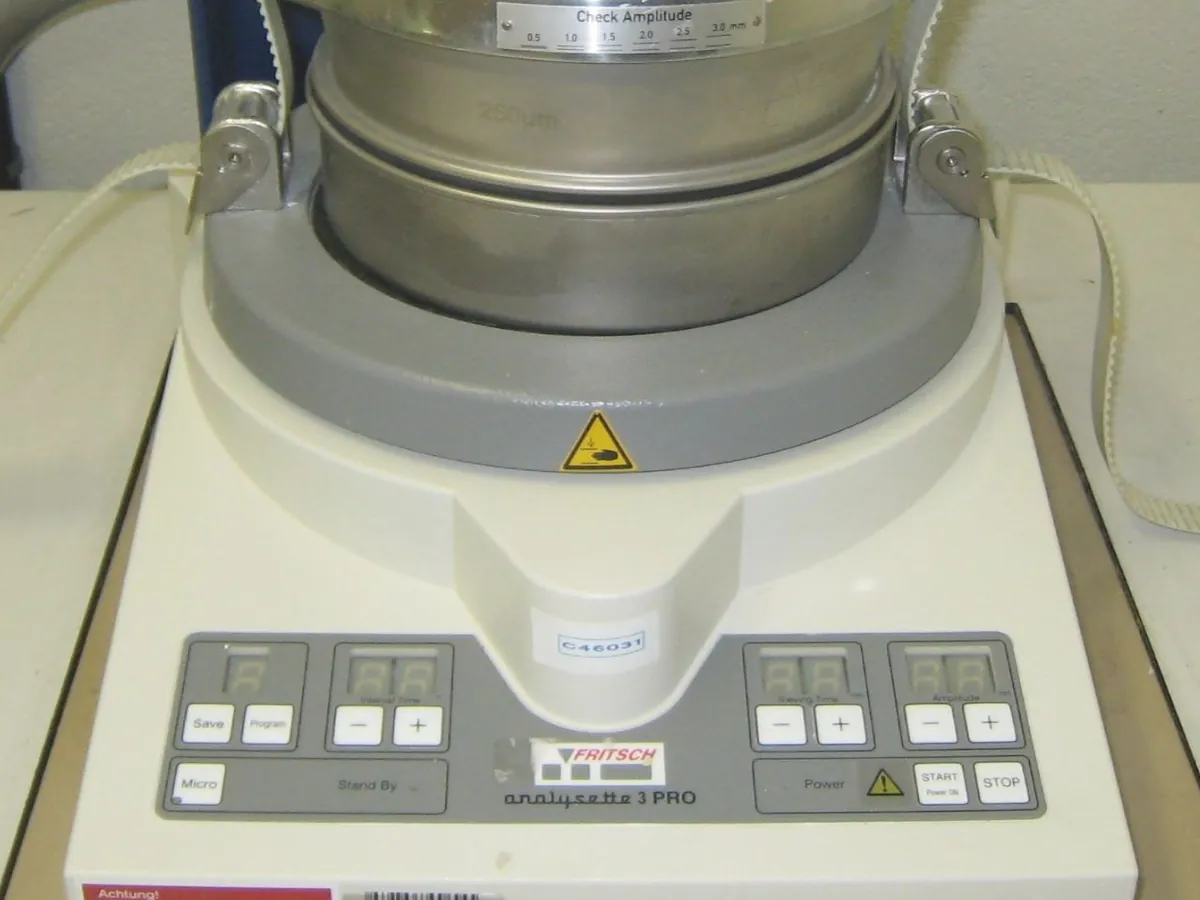
How Sieve shaker works
Each sieve acts as a gate. A particle passes if its second-smallest dimension is smaller than the square mesh opening. Shaking gives every particle many chances to find an opening, so after enough time the mass on each sieve becomes constant.
The path of a sample
- 01
Select sieves
Choose a set of sieves with apertures in a geometric series (often a √2 progression) covering the expected range.
- 02
Tare and stack
Weigh each clean sieve and the pan, then stack them with the largest opening at the top.
- 03
Load
Place an accurately weighed sample on the top sieve and fit the lid.
- 04
Shake
Run the shaker at the stated amplitude for the stated time.
- 05
Weigh
Weigh each sieve and the pan with its retained material.
- 06
Calculate
Work out % retained on each sieve and cumulative % passing; check mass balance.
Main parts and what they do
Test sieves
Woven-wire mesh in a stainless-steel or brass frame, usually 200 mm diameter, each with a certified nominal aperture.
Receiver pan and lid
The pan collects the finest fraction; the lid stops dust escaping.
Shaker drive
Electromagnetic (vibratory) or mechanical (tapping/rotary) motion that agitates the stack.
Clamping system
Holds the stack firmly on the shaker.
Controller and timer
Sets amplitude, interval mode and shaking time.
Terms every analyst should know
Sieve aperture
The nominal width of the square opening in the mesh, e.g. 250 µm. Real openings vary within tolerances set in ISO 3310-1 / ASTM E11.
Sieving end-point
Shaking is long enough when the mass on any sieve changes by no more than a small amount (e.g. 5% or 0.1 g) after a further period.
Blinding
Particles stuck in the openings, which reduces the open area and makes results coarser.
Amplitude
The vertical movement of the stack in vibratory shakers; it controls how energetically particles are thrown.
Mass balance
The total of all fractions should match the starting mass within a small loss (commonly within about 2%).
Keep every Sieve shaker in control: usage logs, calibration and maintenance schedules, and automatic blocking of overdue instruments.