Proctor Compaction Apparatus
A cylindrical mould and a rammer of fixed mass and drop height used to compact soil at different water contents and find its maximum dry density (MDD) and optimum moisture content (OMC).
- Geotechnical testing
- Road and highway construction
- Railways and airports
- Dams and embankments
- Construction materials testing
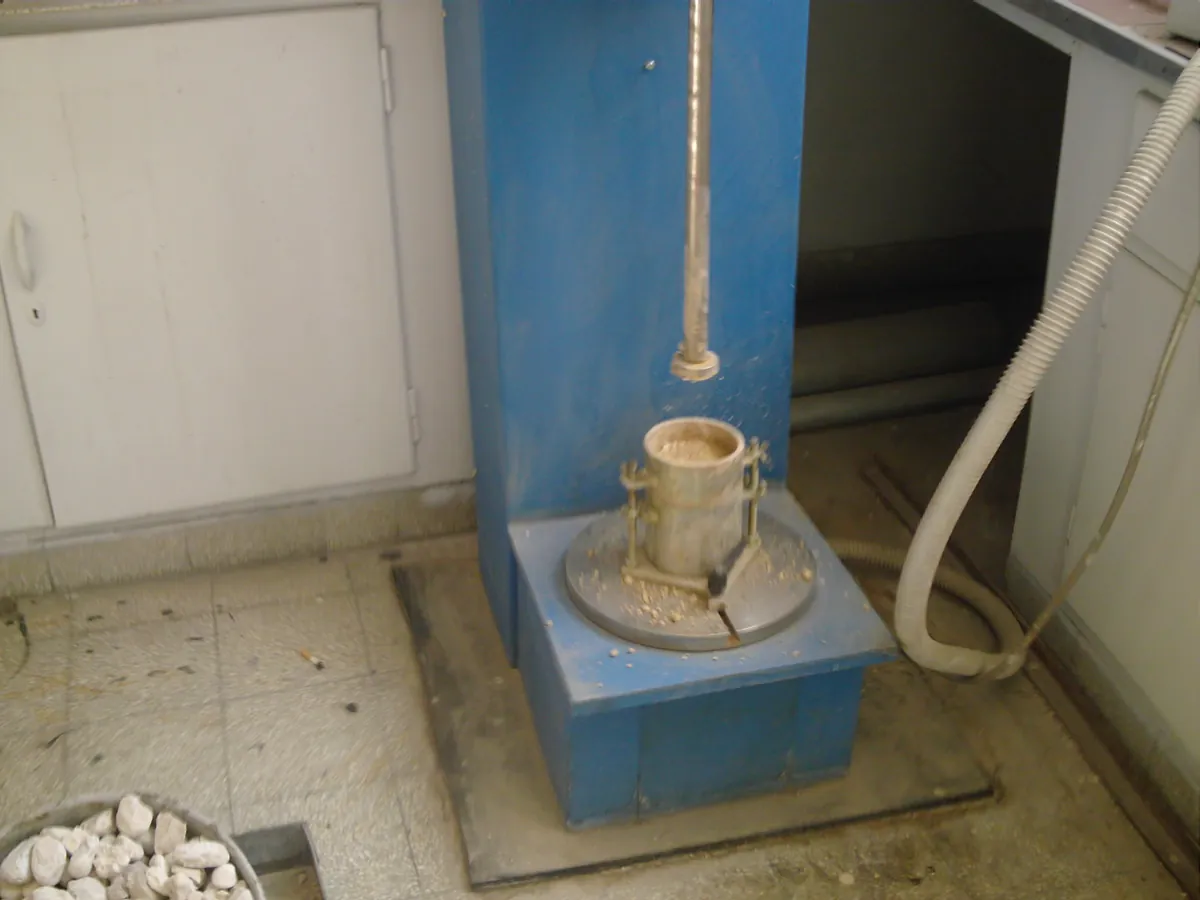
What is Proctor apparatus?
Soils used in embankments, subgrades and backfill must be compacted to a specified density in the field. The Proctor test tells engineers what density is achievable and at what water content. Soil is compacted into a mould in layers, each receiving a set number of blows from a rammer of fixed mass falling a fixed height, so the compactive energy per unit volume is standardised.
Under IS 2720 Part 7 (light compaction, similar to standard Proctor, ASTM D698) the rammer is 2.6 kg with a 310 mm drop, and soil is compacted in three layers of 25 blows each in a 1000 cm³ mould. Under IS 2720 Part 8 (heavy compaction, similar to modified Proctor, ASTM D1557) the rammer is 4.9 kg (often quoted as 4.89 kg) with a 450 mm drop, and soil is compacted in five layers of 25 blows. The heavy test applies about 4.5 times more energy.
The test is repeated at several water contents. Dry density is plotted against water content; the peak of the curve gives MDD and OMC. Field compaction is then checked as a percentage of MDD (for example 95% or 97%, as the specification requires).
Used for
- Maximum dry density and optimum moisture content of soils (IS 2720 Part 7 / Part 8)
- Specification and control of field compaction for embankments and subgrades
- Preparing CBR specimens at a target density and moisture
- Compaction characteristics of granular sub-base, stabilised soils and fly ash
How it works
- 01
Prepare soil
Air-dried soil passing the specified sieve (e.g. 19 mm or 4.75 mm) is mixed with a known amount of water and left to mature.
- 02
Compact in layers
Soil is placed in the mould with its collar in three (light) or five (heavy) equal layers, each given 25 evenly spread blows.
- 03
Trim and weigh
The collar is removed, the soil trimmed level with the mould top, and the mould plus soil weighed.
- 04
Moisture content
A sample from the middle of the specimen is oven-dried to find water content.
- 05
Repeat
The test is repeated at increasing water contents until the wet mass starts to fall.
- 06
Plot
Dry density = bulk density ÷ (1 + w) is plotted against w; the peak gives MDD and OMC.
Advantages
- Simple, inexpensive and universally specified
- Standardised energy makes results comparable
- Automatic compactors improve repeatability and reduce operator fatigue
- Same mould is used for CBR specimen preparation (with a different mould for CBR)
Limitations
- Laborious: one curve needs five or more compaction points
- Manual rammer technique (free fall, vertical drop, blow distribution) affects results
- Not ideal for free-draining granular soils, where vibratory methods suit better
- Oversize particles must be removed or corrected for, which changes the material tested
1 calibration procedure
Methods that use Proctor apparatus
Keep every Proctor apparatus in control: usage logs, calibration and maintenance schedules, and automatic blocking of overdue instruments.