Proctor apparatus · Calibration procedure
Rammer mass and drop height check
Weighs the light and heavy rammers, measures their free-fall height and face diameter, and checks mould volume, so that the compactive energy matches the standard.
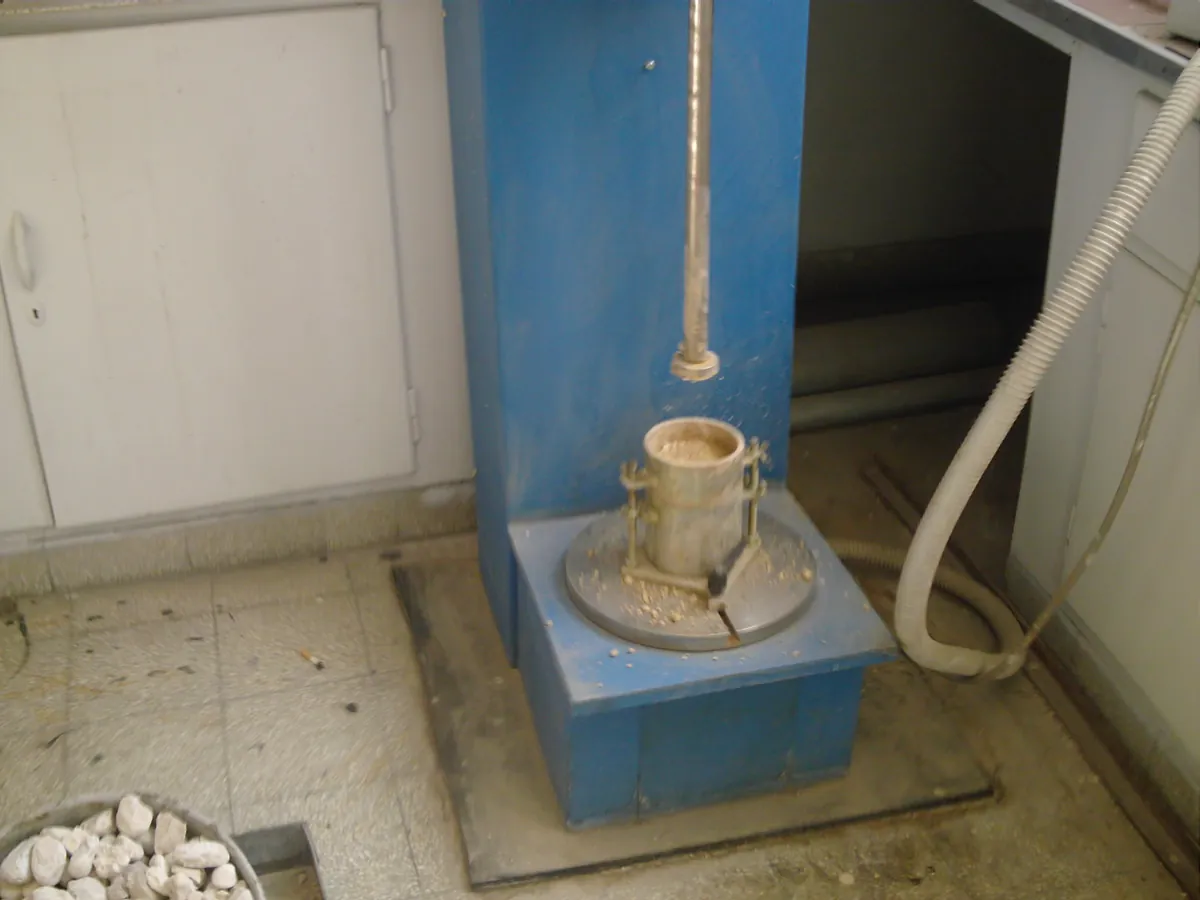
PURPOSE
Why this is checked
MDD depends directly on compactive energy. A light rammer, a short drop or a blocked guide sleeve reduces the energy and gives a lower MDD and a higher OMC than the standard test.
Frequency
Typically every 12 months and after repair; automatic compactors also after any adjustment, as defined in your SOP.
Learn how the Proctor apparatus worksYOU WILL NEED
Standards & tools
- Calibrated balance (capacity ≥ 10 kg, resolution 1 g or better)
- Calibrated steel rule or depth gauge (1 mm or better)
- Calibrated vernier calliper
BEFORE YOU START
Prerequisites
- Rammer and sleeve clean; vent holes clear
PROCEDURE
Step by step
- 1Weigh the rammer (falling part only).
- 2Measure the rammer face diameter in two directions.
- 3Measure the free fall: the distance the rammer face travels from the top stop to the point of impact on a surface at the level of a compacted layer.
- 4Check the rammer falls freely and the vent holes are open.
- 5Measure mould internal diameter and height and calculate its volume.
- 6Calculate energy per blow and compactive energy and compare with nominal.
RECORD
Example observation table
| Item | Specified (typical) | Measured | Result |
|---|---|---|---|
| Light rammer mass (IS 2720 Part 7) | 2.6 kg | 2.596 kg | Check against SOP tolerance |
| Light rammer drop | 310 mm | 308 mm | Check against SOP tolerance |
| Heavy rammer mass (IS 2720 Part 8) | 4.9 kg (often quoted 4.89 kg) | 4.893 kg | Pass |
| Heavy rammer drop | 450 mm | 450 mm | Pass |
| Rammer face diameter | 50 mm | 50.1 mm | Pass |
| Mould volume (100 mm × 127.3 mm) | 1000 cm³ | 999.8 cm³ | Pass |
CALCULATION
How to calculate the result
Formula
Energy per blow = m × g × h; Compactive energy = m × g × h × layers × blows per layer ÷ mould volume
Worked example
- 1Nominal light: 2.6 × 9.81 × 0.310 = 7.907 J per blow; × 3 layers × 25 blows = 593.0 J; ÷ 0.001 m³ = 593 kJ/m³
- 2Measured light rammer: 2.596 × 9.81 × 0.308 × 75 ÷ 0.001 = 588.3 kJ/m³, which is 0.8% below nominal
- 3Nominal heavy: 4.9 × 9.81 × 0.450 × 5 × 25 ÷ 0.001 = 2704 kJ/m³ (4.89 kg gives 2698 kJ/m³)
- 4Mould volume: π ÷ 4 × 10.0² × 12.73 = 999.8 cm³
- 5
A 0.8% energy shortfall is small, but a 2 mm short drop is easily corrected by adjusting the sleeve; correct it and recheck.
ACCEPTANCE CRITERIA
Pass if
- Light compaction: rammer about 2.6 kg with 310 mm free fall (IS 2720 Part 7); heavy: about 4.9 kg with 450 mm free fall (IS 2720 Part 8); tolerances as in your SOP or the apparatus standard.
- ASTM D698 rammer is about 2.5 kg (5.5 lb) with about 305 mm drop, and ASTM D1557 about 4.5 kg (10 lb) with about 457 mm drop, with tight tolerances given in the standards.
- Rammer falls freely; face diameter about 50 mm; mould volume within tolerance.
- Mechanical (automatic) compactors calibrated against the manual rammer, e.g. using ASTM D2168.
IF IT FAILS
What to do
- Adjust the guide sleeve to correct drop height; clear vent holes.
- Replace a rammer outside the mass tolerance or with a worn face.
- Repeat the check; review MDD / OMC results since the last good check.
In LimsPulse · Calibration Management
LimsPulse schedules this calibration, records the result against limits, and blocks the instrument everywhere if it fails or goes overdue.