Proctor Compaction Test (OMC and MDD)
Soil is compacted in a standard mould at a series of water contents. For each point the dry density is calculated. The peak of the dry density versus water content curve gives the maximum dry density (MDD) and the optimum moisture content (OMC).
- Construction materials
- Laboratory compaction with a standard rammer at several water contents
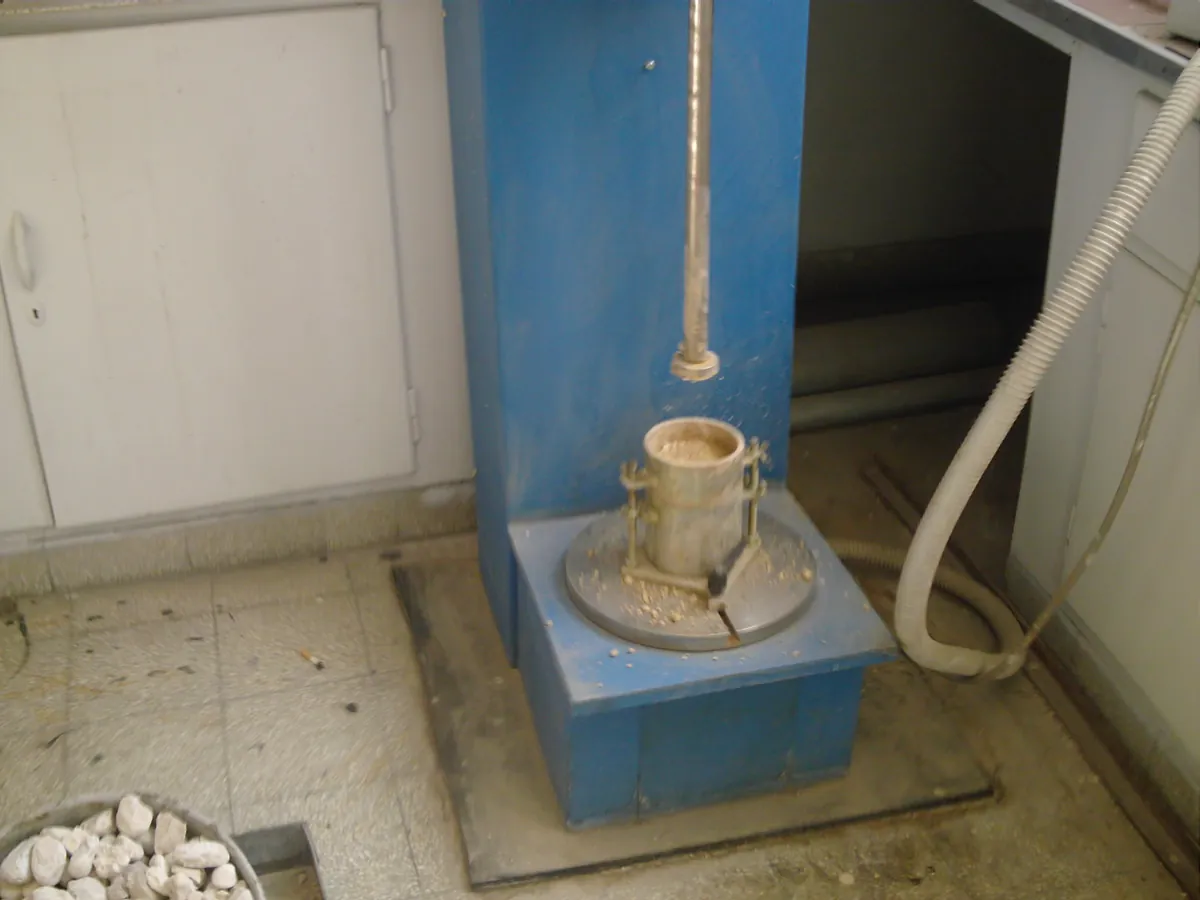
- Proctor apparatus
- Analytical balance
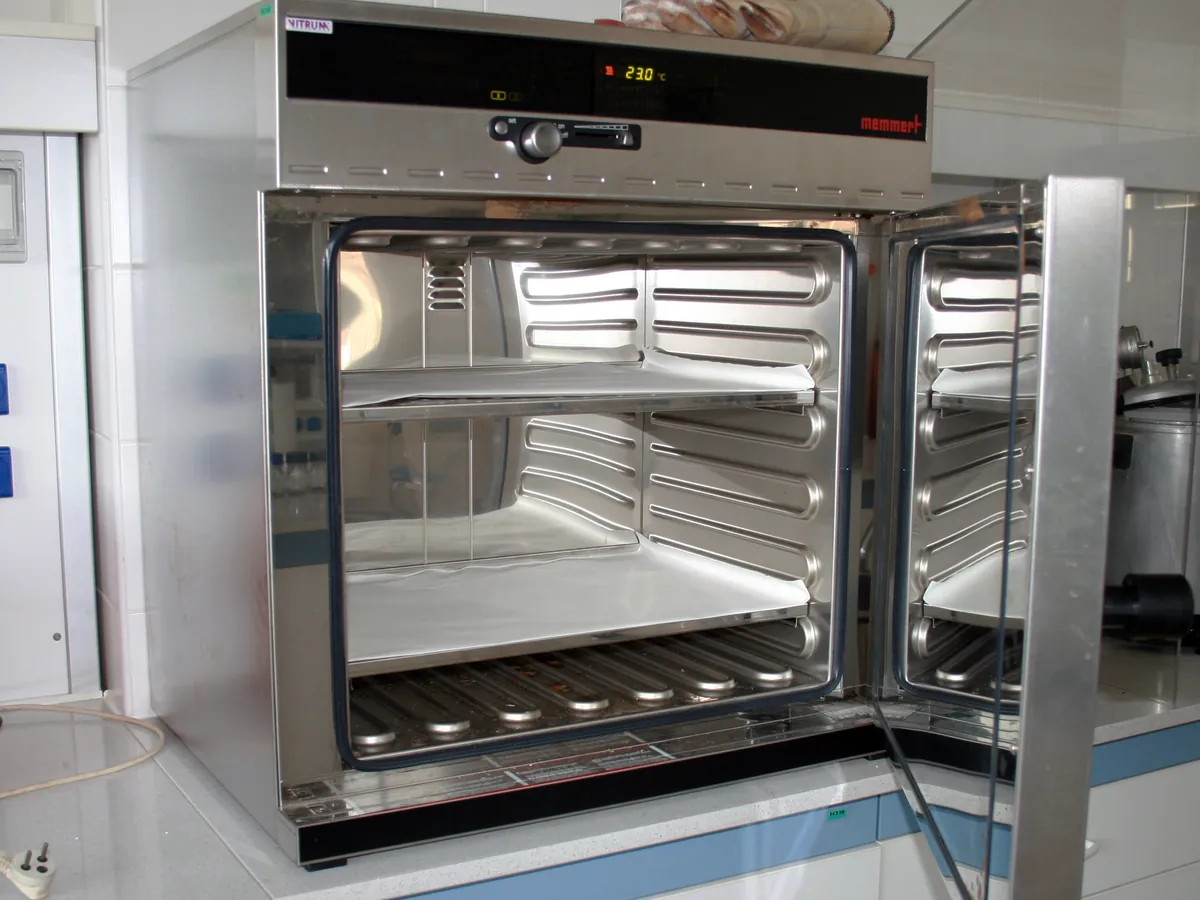
- Hot air oven
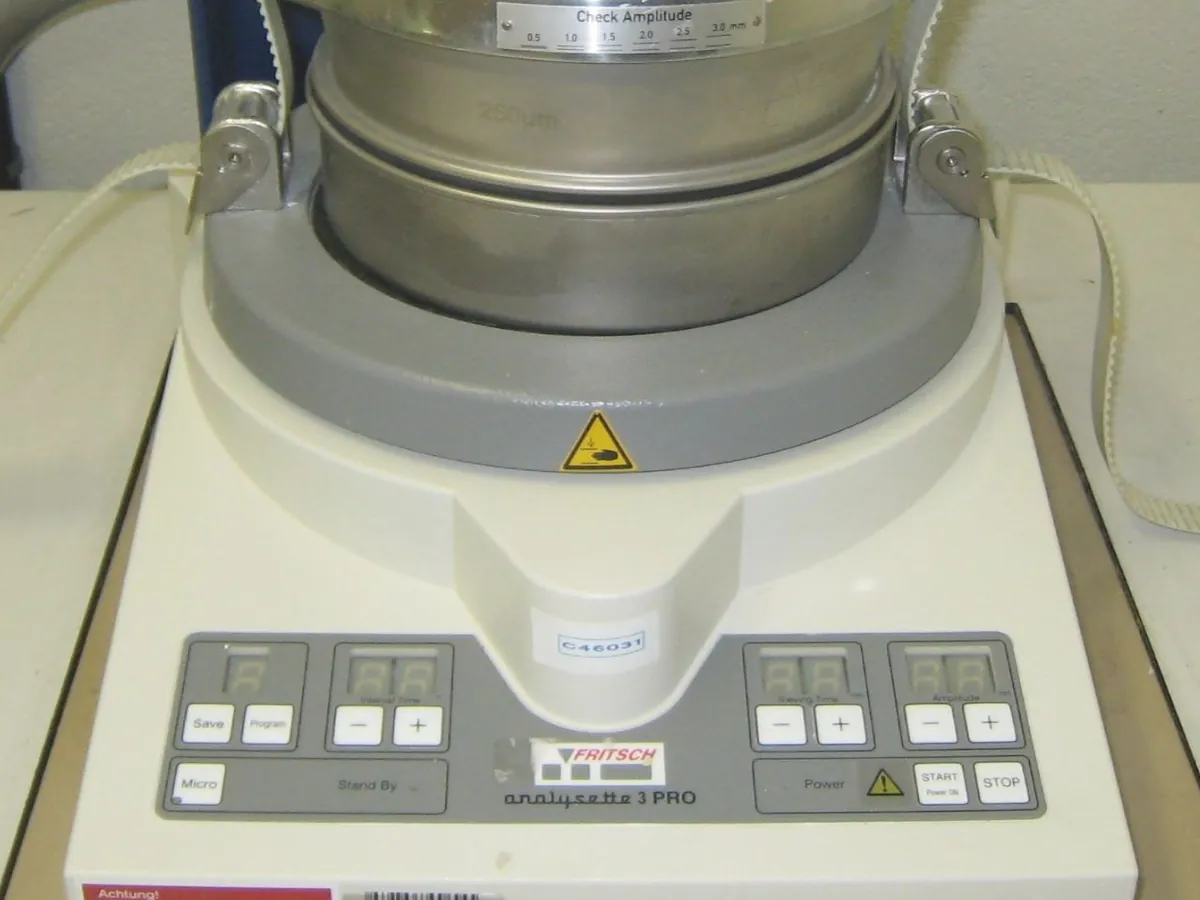
- Sieve shaker
Reference: Typical method based on IS 2720 (Part 7) light compaction and IS 2720 (Part 8) heavy compaction; ASTM D698 / D1557 are similar. Always follow the current editions and your approved SOP.
Why this method works
Compaction squeezes air out of soil and packs the particles closer. At low water content the particles resist sliding, so density is low. Adding water lubricates them and density rises. Beyond a certain point the water itself fills the space and pushes particles apart, so dry density falls. The peak of this curve is the MDD, reached at the OMC, for that compactive effort. Light (standard) compaction uses a smaller rammer and lower drop; heavy (modified) compaction uses more energy and gives a higher MDD at a lower OMC. Field compaction is then controlled as a percentage of the laboratory MDD.
Instruments used

Reagents & standards
| Reagent | Grade / specification |
|---|---|
| Water | Clean potable water for mixing |
| Moisture containers | Non-corrodible tins with lids for water content samples |
| Sieves | 4.75 mm (and 19 mm for the larger mould) |
Preparing the sample
- 01
Prepare soil
Air-dry, break up lumps and sieve through 4.75 mm.
- 02
Add water
Mix a portion at a starting water content and cure.
- 03
Compact
Fill the mould in layers with the set number of blows.
- 04
Weigh
Trim, weigh mould + soil; take a water content sample.
- 05
Repeat
Repeat at higher water contents, past the peak.
- 06
Plot
Plot dry density against water content; read OMC and MDD.
Procedure
- 1Air-dry the soil, break up the lumps without crushing particles, and sieve it. For the 1000 cm³ mould use soil passing 4.75 mm; for coarser soils use the larger mould (about 2250 cm³) with soil passing 19 mm, as the standard states.
- 2Take about 2.5–3 kg of soil for the 1000 cm³ mould. Mix it thoroughly with water to a starting water content (for sandy soils about 4–6%, for clays about 8–10% below the expected OMC). Store it covered for the curing time in your SOP so that water spreads evenly.
- 3Weigh the empty mould with base plate (W1). Fit the collar.
- 4Light compaction (IS 2720 Part 7): compact the soil in 3 equal layers, each with 25 blows of a 2.6 kg rammer falling 310 mm. Heavy compaction (IS 2720 Part 8): 5 layers, each with 25 blows of a 4.9 kg rammer falling 450 mm. The larger mould uses 56 blows per layer.
- 5Spread blows evenly over the surface. The last layer should project only a little into the collar.
- 6Remove the collar, trim the soil level with the top of the mould and weigh the mould + soil (W2).
- 7Extrude the soil and take a representative water content sample from the middle. Dry it in the oven at 105–110 °C to constant mass.
- 8Break up the soil, add more water (typically 1–3% steps) and repeat. Continue until the mass of compacted soil falls for at least one or two points after the peak. Aim for at least 5 points.
Standard preparation
- 1Check the rammer mass and free drop height within the calibration interval.
- 2Measure the internal dimensions of the mould and calculate its volume, or verify it by filling with water.
Notes for analysts
- Zero-air-voids dry density = G ρw ÷ (1 + w G / 100), where G is the specific gravity of soil solids. For G = 2.65 at 12% water content it is about 2.01 g/cm³, above the measured 1.90 g/cm³, as expected.
- Do not reuse soil that has been compacted many times if it contains particles that break down; use fresh portions for each point where your SOP requires it.
- Heavy compaction is used for highway and airfield work where heavy rollers are used in the field.
Method parameters (typical)
| Mould (small) | About 1000 cm³ (100 mm diameter × 127.3 mm high), soil passing 4.75 mm |
|---|---|
| Light compaction (Part 7) | 2.6 kg rammer, 310 mm drop, 3 layers × 25 blows |
| Heavy compaction (Part 8) | 4.9 kg rammer, 450 mm drop, 5 layers × 25 blows |
| Large mould | About 2250 cm³, soil passing 19 mm, 56 blows per layer |
| Water content drying | 105–110 °C to constant mass |
| Number of points | At least 5, spanning both sides of the peak |
System suitability & sequence
| Parameter | Limit |
|---|---|
| Curve shape | Clear peak with points on both the dry and wet sides |
| Zero air voids check | All points lie below the zero-air-voids line for the soil's specific gravity |
Typical sequence
- 1Prepare and sieve the soil
- 2Point 1 at low water content: compact, weigh, water content
- 3Points 2–5+ at increasing water content
- 4Calculate bulk and dry density for each point
- 5Plot the curve; read OMC and MDD
Calculation with a worked example
Where
- W1
- Mass of mould + base plate (g)
- W2
- Mass of mould + base plate + compacted soil (g)
- V
- Volume of the mould (cm³)
- w
- Water content (%)
- ρd
- Dry density (g/cm³)
Given
- Mould volume V
- 1000 cm³
- W1 / W2 (point 3)
- 4200 g / 6330 g
- Water content tin (point 3)
- Empty 25.00 g; wet soil + tin 110.20 g; dry soil + tin 101.07 g
- All points (w %, bulk density g/cm³)
- 8, 1.95; 10, 2.07; 12, 2.13; 14, 2.11; 16, 2.05
Working
- 1Point 3: water = 110.20 − 101.07 = 9.13 g; dry soil = 101.07 − 25.00 = 76.07 g; w = 9.13 ÷ 76.07 × 100 = 12.0%
- 2Point 3: bulk density = (6330 − 4200) ÷ 1000 = 2.130 g/cm³
- 3Point 3: dry density = 2.130 ÷ 1.12 = 1.902 g/cm³
- 4All points: dry densities = 1.95 ÷ 1.08 = 1.806; 2.07 ÷ 1.10 = 1.882; 2.13 ÷ 1.12 = 1.902; 2.11 ÷ 1.14 = 1.851; 2.05 ÷ 1.16 = 1.767 g/cm³
- 5
The peak of the dry density curve is at about 12% water content
Maximum dry density ≈ 1.90 g/cm³ at an optimum moisture content of ≈ 12% (light compaction).
What result passes
- The test gives reference values (OMC and MDD) rather than a pass/fail result.
- Field compaction is usually specified as a minimum relative compaction, for example 95–98% of the laboratory MDD (light or heavy, as the contract states), at a water content near the OMC. Use the project specification.
- Report the compaction type (light or heavy), mould size, fraction tested and the full curve.
Validation parameters (ICH Q2(R2))
| Parameter | Typical requirement |
|---|---|
| Approach | Standard method; competence shown by repeat tests and proficiency testing |
| Check | Points should lie below the zero-air-voids line; a point above it shows an error in mass, volume or water content |
| Equipment control | Rammer mass, drop height and mould volume verified periodically |
Run this method in LimsPulse: specifications and STPs under version control, results calculated and checked against limits, and a signed Certificate of Analysis.