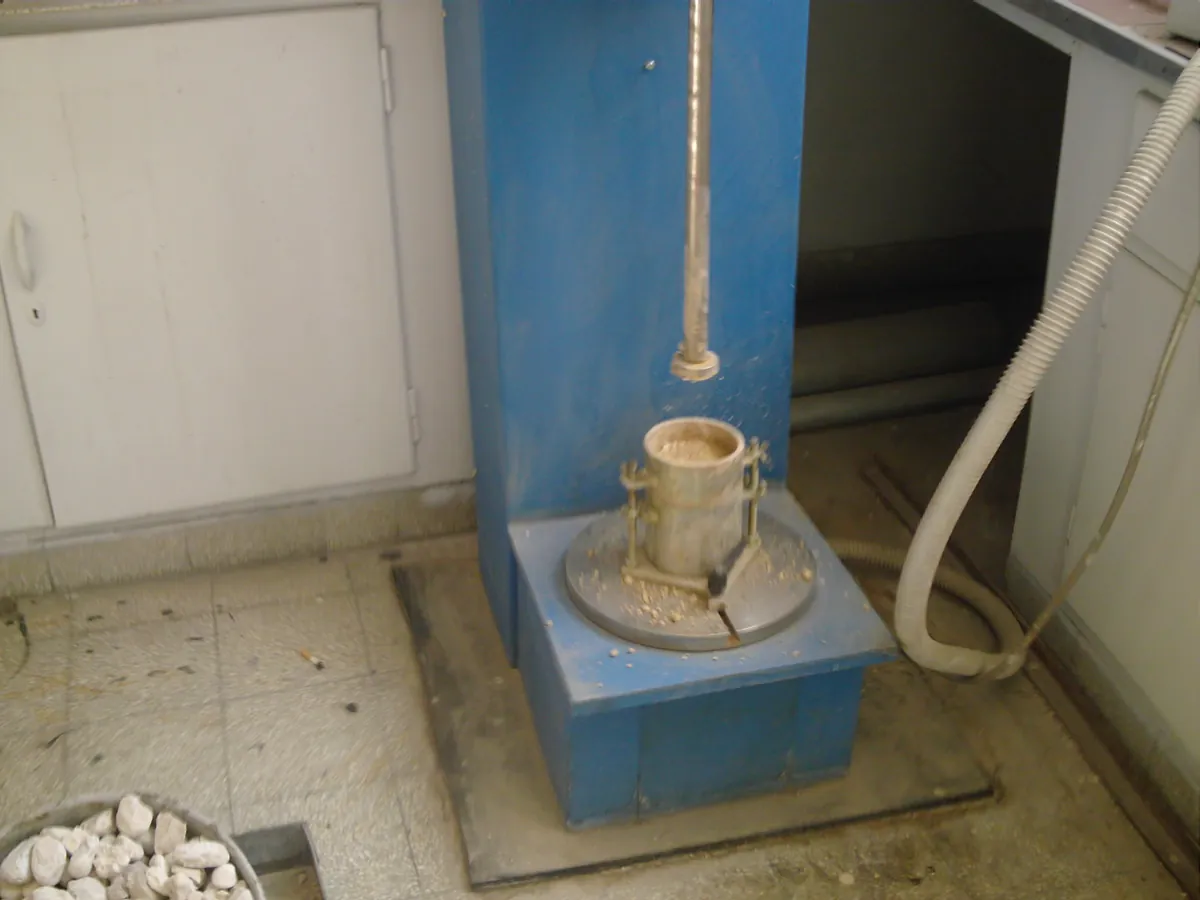
Proctor Compaction Apparatus
A cylindrical mould and a rammer of fixed mass and drop height used to compact soil at different water contents and find its maximum dry density (MDD) and optimum moisture content (OMC).
- Geotechnical testing
- Road and highway construction
- Railways and airports
- Dams and embankments
- Construction materials testing
Test your Proctor apparatus knowledge
Multiple-choice questions
Pick an answer to see whether you are right and why.
Q1. What rammer mass and drop height are used in IS 2720 Part 7 (light compaction)?
basicQ2. What two results are obtained from a Proctor compaction test?
basicQ3. Wet soil in a 1000 cm³ mould weighs 2040 g and its water content is 12%. What is its dry density?
intermediateQ4. Compared with light compaction, heavy compaction typically gives:
intermediateQ5. What is the approximate compactive energy of IS light compaction (2.6 kg, 0.31 m, 3 × 25 blows, 1000 cm³)?
intermediateQ6. The vent holes in the rammer's guide sleeve are blocked. What is the likely effect?
advanced
Viva questions
Think of your answer first, then open it to compare.
1. Explain the shape of the compaction curve.
At low water content, adding water lubricates particles so they pack more densely and dry density rises. Beyond the optimum, extra water fills voids and pushes particles apart, so dry density falls. The peak is MDD at OMC.
2. What is checked in a rammer mass and drop height check, and why?
Rammer mass (2.6 kg light, about 4.9 kg heavy), free-fall height (310 mm / 450 mm), face diameter (50 mm), free fall and vent holes, and mould volume. These fix the compactive energy, which controls MDD and OMC.
3. How is the Proctor result used in the field?
Field dry density (e.g. by sand replacement or core cutter) is compared with lab MDD to give relative compaction. Specifications typically require a minimum, such as 95% or 97% of MDD, with water content near OMC.
Keep every Proctor apparatus in control: usage logs, calibration and maintenance schedules, and automatic blocking of overdue instruments.