Airborne particle counter
Counts and sizes airborne particles, typically at ≥0.5 µm and ≥5.0 µm, by measuring light scattered as each particle passes through a laser beam. Used to classify clean rooms and to monitor non-viable particles in Grades A–D.
- Pharmaceutical
- Biotech
- Medical devices
- Semiconductors
- Hospitals
- Aerospace
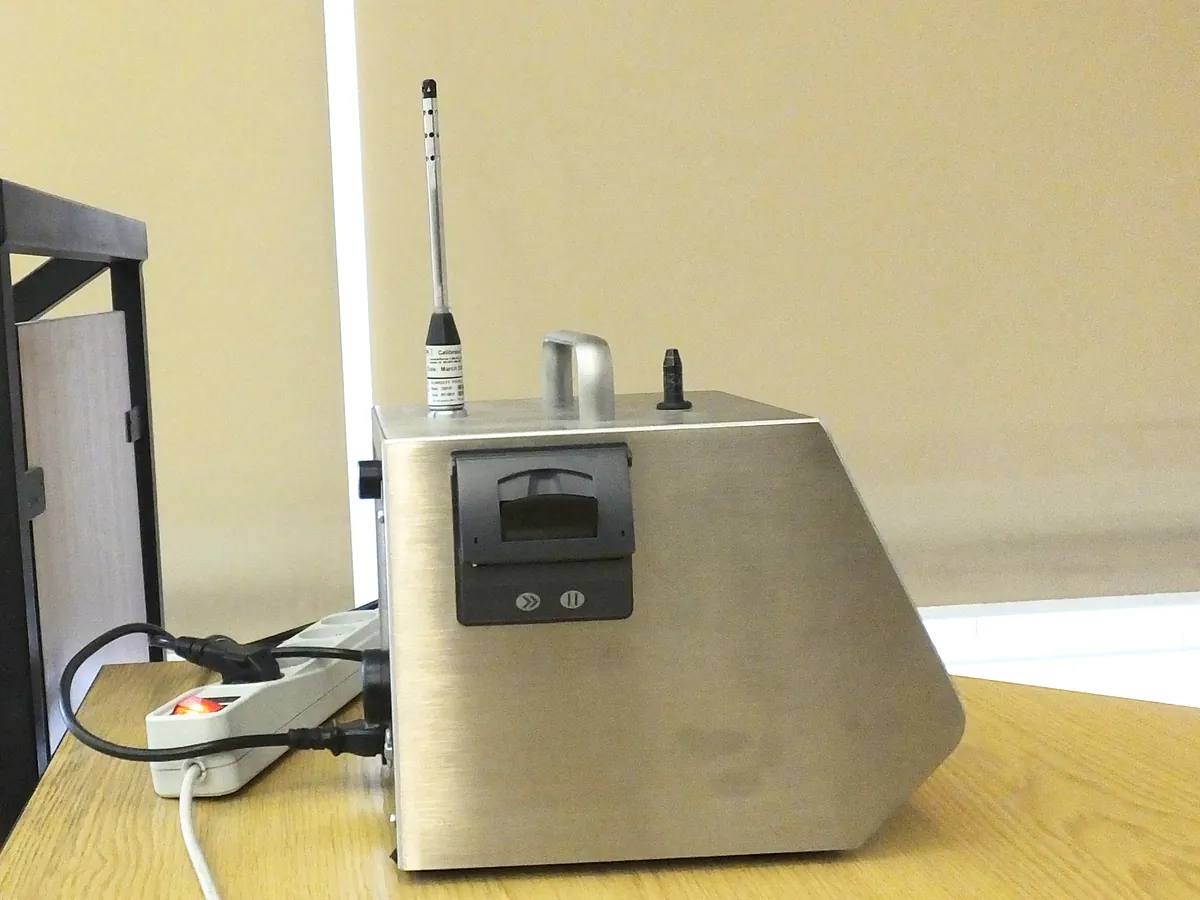
What is Particle counter?
Clean rooms are graded by how many particles they contain per cubic metre of air. A particle counter draws air at a fixed flow rate, often 28.3 L/min (1 cubic foot per minute), 50 L/min or 100 L/min, through a sensor. A laser beam lights the sample stream; each particle that crosses it scatters a short pulse of light. The size of the pulse indicates the size of the particle, and the number of pulses is the count.
Portable counters are used for classification under ISO 14644-1 and for periodic monitoring. Fixed remote sensors connected to a facility monitoring system give continuous monitoring in Grade A, as EU GMP Annex 1 expects for critical operations. Counts are reported for particle size channels, most often ≥0.5 µm and ≥5.0 µm.
A particle counter does not tell living from non-living particles, but particle data respond in real time and complement viable monitoring. Its accuracy depends on the flow rate and the sizing calibration, which are checked against ISO 21501-4 at least yearly.
Used for
- Clean room classification (ISO 14644-1) at rest and in operation
- Routine non-viable monitoring of Grades A–D, including continuous monitoring in Grade A
- Qualification of LAF units, biosafety cabinets and isolators
- Clean-up (recovery) time testing after particle challenge
- Investigations of contamination events and HVAC failures
How it works
- 01
Sample inlet
An isokinetic probe takes air at the same speed as the surrounding unidirectional flow.
- 02
Flow control
A pump and flow sensor hold the sample flow at the nominal rate, e.g. 28.3 L/min.
- 03
Illumination
Particles pass one at a time through a laser beam in the sensor.
- 04
Scatter detection
Scattered light is collected onto a photodetector and turned into pulses.
- 05
Sizing & counting
Pulse heights are sorted into size channels using thresholds set with PSL spheres.
- 06
Report
Counts are converted to particles per m³ and compared with grade limits.
Advantages
- Real-time results: excursions are seen immediately
- Counts several size channels at once
- Portable units are easy to move between locations
- Fixed systems give continuous data and alarms
Limitations
- Does not distinguish viable from non-viable particles
- Long or bent sample tubing loses large particles (≥5.0 µm)
- Coincidence errors at very high concentrations
- Sizing is relative to polystyrene latex spheres; real particles may scatter differently
- Needs annual calibration by a qualified provider
1 calibration procedure
Methods that use Particle counter
Keep every Particle counter in control: usage logs, calibration and maintenance schedules, and automatic blocking of overdue instruments.