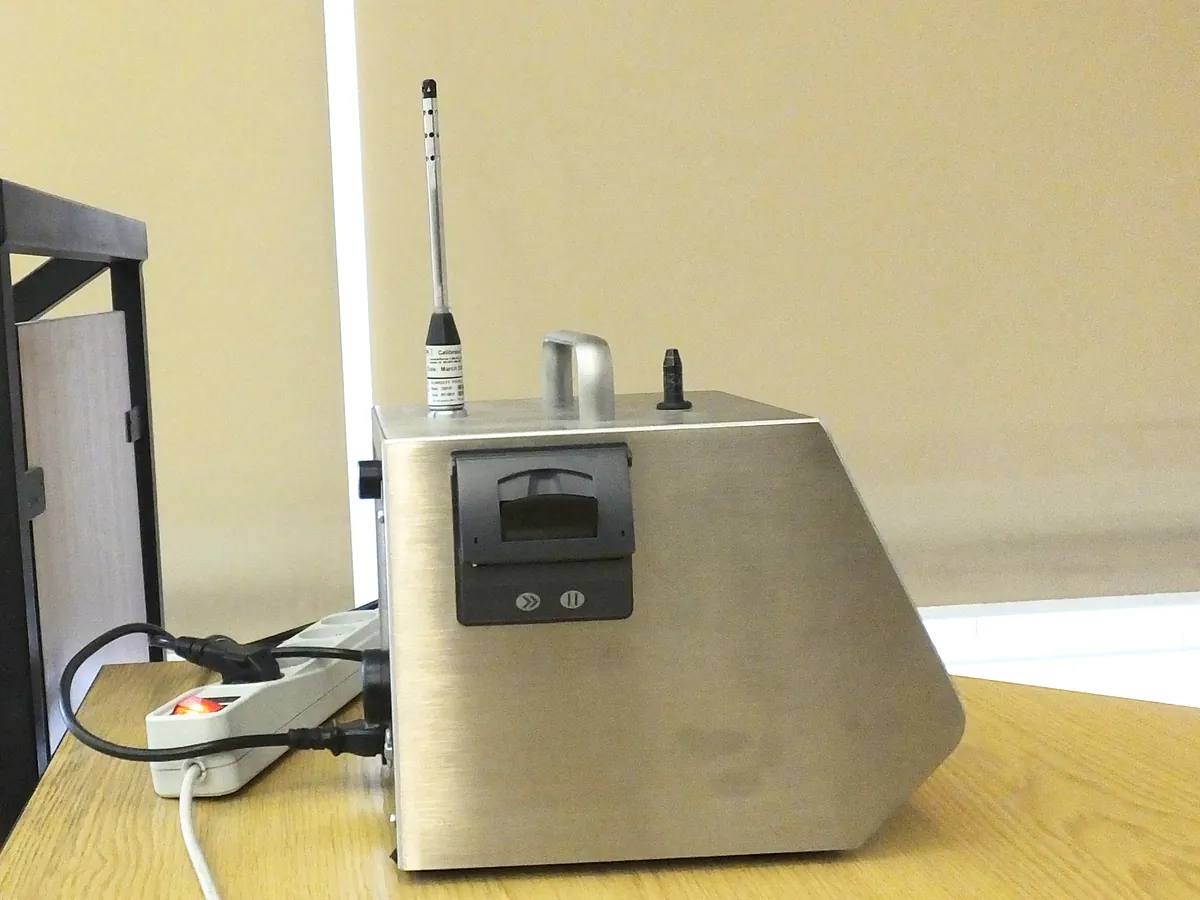
Airborne particle counter
Counts and sizes airborne particles, typically at ≥0.5 µm and ≥5.0 µm, by measuring light scattered as each particle passes through a laser beam. Used to classify clean rooms and to monitor non-viable particles in Grades A–D.
- Pharmaceutical
- Biotech
- Medical devices
- Semiconductors
- Hospitals
- Aerospace
Test your Particle counter knowledge
Multiple-choice questions
Pick an answer to see whether you are right and why.
Q1. How does an airborne particle counter detect particles?
basicQ2. What is the ISO 5 / Grade A limit for particles ≥0.5 µm?
basicQ3. What is used to calibrate the size channels of a particle counter?
intermediateQ4. Why should sample tubing on a particle counter be short and straight?
intermediateQ5. What does a zero count with a HEPA filter on the inlet check?
intermediateQ6. ISO 21501-4 typically expects the counting efficiency at the minimum detectable size to be about:
advancedQ7. What does 'isokinetic' sampling mean?
basic
Viva questions
Think of your answer first, then open it to compare.
1. Why are non-viable particle counts useful in an aseptic area if they do not detect microorganisms?
Particle counts are real time, so they show at once when an intervention, filter leak or HVAC failure has made the air dirtier. Microorganisms travel on particles, so high particle counts mean a higher risk of contamination. Viable results take days.
2. Which properties are checked when a particle counter is calibrated to ISO 21501-4?
Sample flow rate, size setting with PSL spheres, counting efficiency at the minimum detectable size and at a larger size, size resolution, and zero (false) count, with as-found and as-left results recorded.
3. Why is 1 m³ commonly sampled per location for Grade A classification?
ISO 14644-1 requires a volume large enough to count at least 20 particles at the class limit for the largest size considered. With Vs = 20 ÷ Cn,m × 1000 L, applying a limit of 29 per m³ at ≥5.0 µm (the Annex 1 monitoring limit for Grade A) gives 20 ÷ 29 × 1000 ≈ 690 L, so 1 m³ is commonly sampled. See the current Annex 1 and ISO 14644-1.
Keep every Particle counter in control: usage logs, calibration and maintenance schedules, and automatic blocking of overdue instruments.