Micropipette (Piston-Operated Pipette)
A hand-held, piston-operated device that measures and dispenses small liquid volumes, typically 0.1 µL to 10 mL, using disposable tips. Used for standards, dilutions, microbiology and bioassays.
- Pharmaceutical
- Biotech
- Clinical diagnostics
- Universities
- Food & beverage
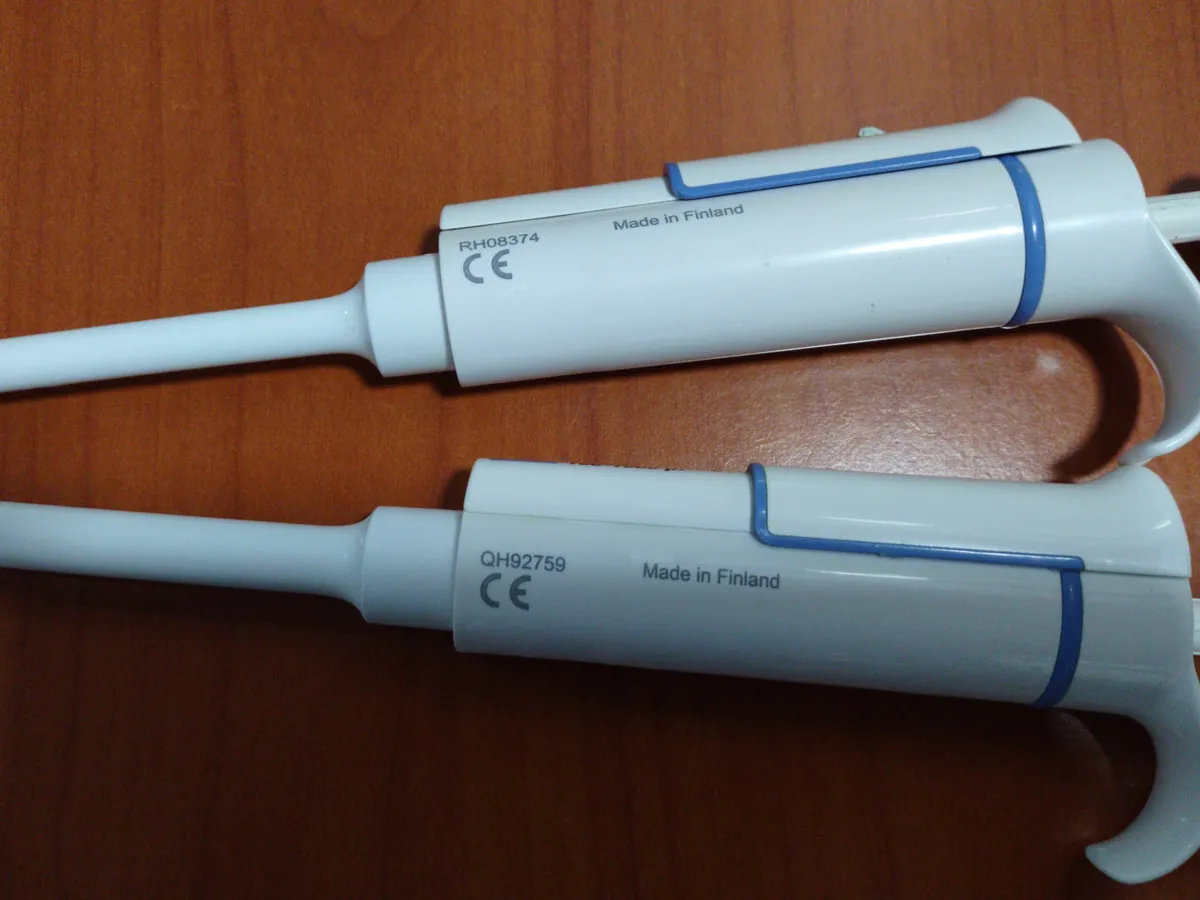
What is Micropipette?
A micropipette works like a precise syringe. Pressing the plunger moves a piston, which pushes air out of the tip. Releasing the plunger draws a set volume of liquid into the tip. Pressing again dispenses it. The liquid only touches the disposable tip, not the pipette itself.
Most lab pipettes are air-displacement pipettes, where a cushion of air sits between the piston and the liquid. Positive-displacement pipettes have a piston that touches the liquid directly and are better for viscous, volatile or dense liquids. Pipettes may be fixed-volume or variable-volume, single-channel or multichannel.
Because small volume errors become large percentage errors, pipettes are checked gravimetrically against ISO 8655. Good technique (pre-wetting, vertical aspiration, correct immersion depth, consistent rhythm) is just as important as calibration.
Used for
- Preparing standard and sample dilutions
- Dispensing reagents in assays and bioassays
- Microbiology: inoculum preparation and serial dilutions
- Endotoxin (LAL) testing
- Spiking solutions in validation studies
How it works
- 01
Set volume
Turn the volume adjuster to the required volume and lock it if possible.
- 02
Fit tip
Press on a compatible tip firmly to make an air-tight seal.
- 03
Aspirate
Press to the first stop, immerse the tip to the correct depth and release slowly.
- 04
Dispense
Touch the tip to the vessel wall and press to the first stop, then to the second stop (blow-out).
- 05
Eject tip
Remove the tip with the ejector and discard it.
Advantages
- Fast, accurate dispensing of small volumes
- Disposable tips prevent cross-contamination
- Adjustable volumes cover a wide range with one device
- Easy to check gravimetrically in the lab
Limitations
- Accuracy depends strongly on operator technique
- Air-displacement pipettes are affected by liquid viscosity, volatility, density and temperature
- Wear of seals and pistons causes leaks and loss of accuracy
- Tips from different makers may not fit or seal correctly
1 calibration procedure
Methods that use Micropipette
Keep every Micropipette in control: usage logs, calibration and maintenance schedules, and automatic blocking of overdue instruments.