Osmolality of Parenterals (Freezing-Point Depression)
A small, exact volume of the product is supercooled and frozen in a calibrated freezing-point osmometer. The instrument measures the freezing point depression and reports osmolality in mOsm/kg.
- Freezing-point osmometry
- Osmometer
- Micropipette
Reference: Typical method based on USP <785> and Ph. Eur. 2.2.35. Limits come from the approved product specification.
Why this method works
Dissolved particles lower the freezing point of water. One osmole of particles per kilogram of water lowers it by about 1.86 °C. The osmometer measures the freezing point of the sample and calculates osmolality from the depression, using a calibration made with certified sodium chloride standards that bracket the expected value. Typical isotonic products are around 280–300 mOsm/kg, similar to body fluids.
Instruments used
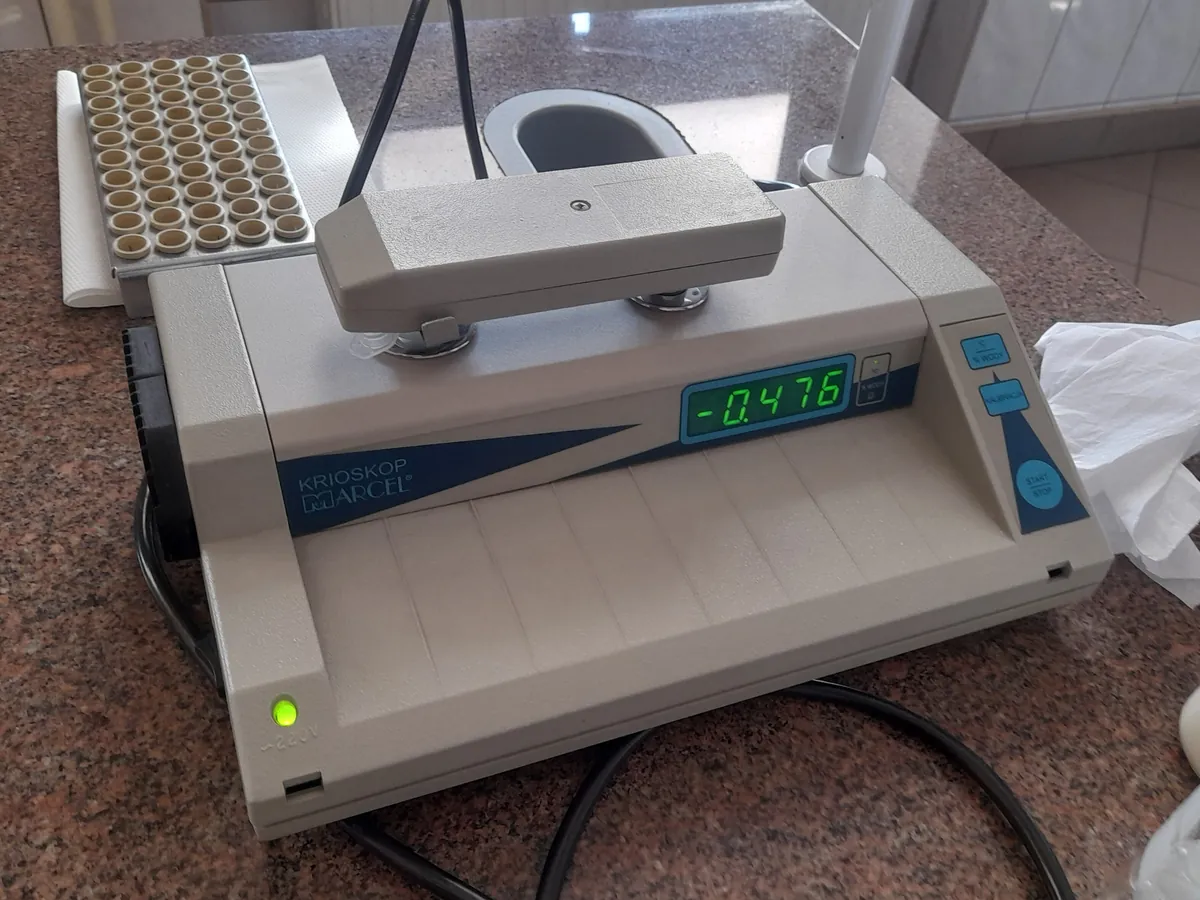
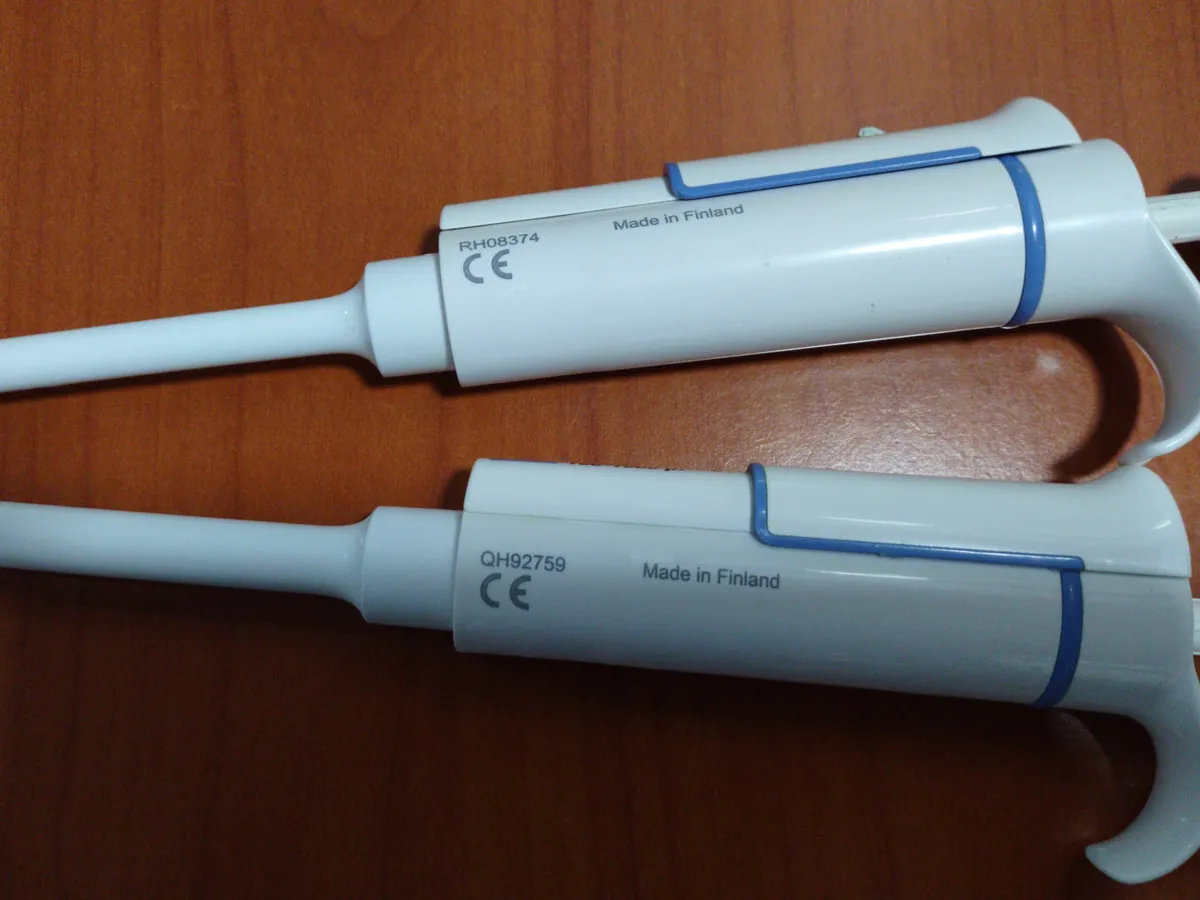
Reagents & standards
| Reagent | Grade / specification |
|---|---|
| Calibration standards | Certified osmolality standards bracketing the expected value, e.g. 100 and 500 mOsm/kg |
| Reference solution | 290 mOsm/kg check solution (or as the manufacturer supplies) |
| Purified water | For cleaning the probe |
Preparing the sample
- 01
Check
Confirm the osmometer calibration and run the reference solution.
- 02
Mix
Mix the product gently; do not dilute unless the monograph says so.
- 03
Pipette
Pipette the exact volume required into a new sample tube.
- 04
Freeze
Run the freezing cycle and read mOsm/kg.
- 05
Repeat
Measure replicate portions and report the mean.
Procedure
- 1Run the 290 mOsm/kg reference solution and confirm it is within limits.
- 2Open the container aseptically or as the STP describes and mix gently.
- 3Pipette the exact sample volume (e.g. 50 µL, as the instrument requires) into a clean tube without bubbles.
- 4Place the tube on the probe, start the cycle and record the result.
- 5Clean and dry the probe, then repeat with fresh portions to obtain three results (or as your SOP requires).
- 6If the expected osmolality is above the highest standard, dilute only as the monograph allows and correct for the dilution, or recalibrate with a higher standard.
Standard preparation
- 1Use certified standards straight from freshly opened ampoules; do not store opened standards.
- 2Calibrate with standards that bracket the expected sample osmolality.
Notes for analysts
- Osmolality (per kg water) is measured; osmolarity (per litre of solution) is often quoted on labels and is calculated. They are close but not identical.
- 0.9% sodium chloride typically measures about 286 mOsm/kg.
- Measure promptly after pipetting; evaporation from small volumes raises the result.
- Volatile solutes such as ethanol raise measured osmolality but cross cell membranes, so they contribute little to tonicity.
Method parameters (typical)
| Principle | Freezing-point depression |
|---|---|
| Sample volume | As the instrument requires, typically 20–250 µL (e.g. 50 µL) |
| Calibration range | Standards bracketing the expected value, e.g. 100–500 mOsm/kg for isotonic products |
| Replicates | Three portions (or as your SOP requires); report the mean |
System suitability & sequence
| Parameter | Limit |
|---|---|
| Reference solution (290 mOsm/kg) | Within the limit in your SOP, e.g. about ±2 mOsm/kg |
| Replicate agreement | Within the repeatability limit in your SOP |
Typical sequence
- 1Reference solution 290 mOsm/kg
- 2Sample portion 1
- 3Sample portion 2
- 4Sample portion 3
- 5Reference solution at the end of a long series (if your SOP requires)
Calculation with a worked example
Where
- ΔTf
- Freezing point depression of the sample compared with pure water, °C
- 1.86
- Cryoscopic constant of water, °C per osmol/kg
Given
- Measured freezing point
- −0.543 °C
- Freezing point of pure water
- 0.000 °C
- Replicate results shown by the instrument
- 291, 293, 292 mOsm/kg
Working
- ΔTf = 0.000 − (−0.543) = 0.543 °C
- Osmolality = 0.543 ÷ 1.86 = 0.2919 osmol/kg = 291.9 mOsm/kg
- Mean of replicates = (291 + 293 + 292) ÷ 3 = 292 mOsm/kg
Osmolality = 292 mOsm/kg. This is within the typical isotonic region (about 280–300 mOsm/kg); compare with the product specification.
What result passes
- Osmolality within the range in the approved product specification (for an isotonic injection this is typically set around 270–330 mOsm/kg or as justified — illustrative only).
- Reference solution within its limit before and, if required, after the samples.
Validation parameters (ICH Q2(R2))
| Parameter | Typical requirement |
|---|---|
| Approach | Pharmacopoeial method; verify suitability for the product |
| Accuracy | Shown by certified standards and the reference solution |
| Precision | Repeatability of replicate portions |
| Range | Calibration standards bracket the expected sample values |
Run this method in LimsPulse: specifications and STPs under version control, results calculated and checked against limits, and a signed Certificate of Analysis.