Micropipette (Piston-Operated Pipette)
A hand-held, piston-operated device that measures and dispenses small liquid volumes, typically 0.1 µL to 10 mL, using disposable tips. Used for standards, dilutions, microbiology and bioassays.
- Pharmaceutical
- Biotech
- Clinical diagnostics
- Universities
- Food & beverage
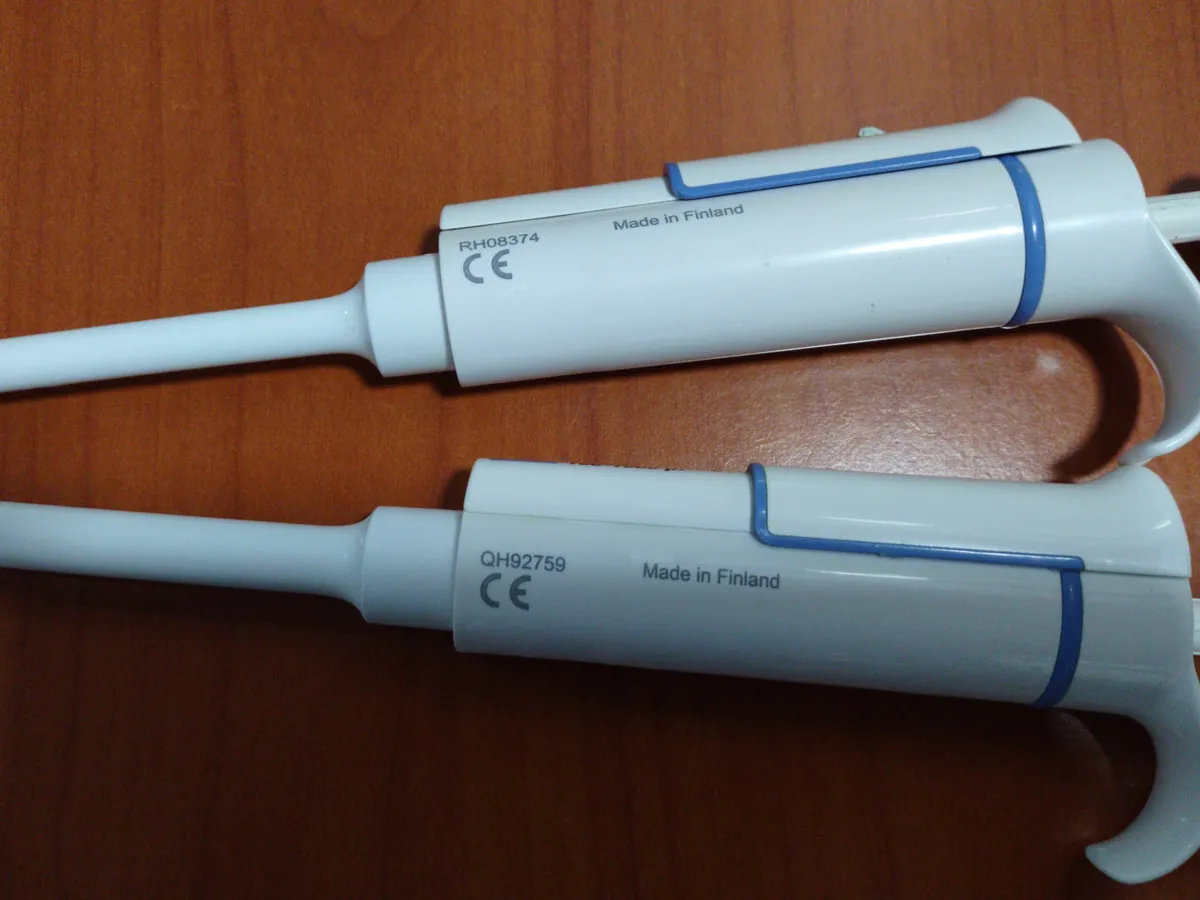
How Micropipette works
The plunger moves a piston a set distance, which changes the volume of the air cushion. The air cushion transmits the change to the liquid, so the same volume of liquid is drawn into the tip. Accuracy depends on a tight seal, the correct tip and conditions (temperature, liquid properties) close to those used during calibration.
The path of a sample
- 01
Set volume
Turn the volume adjuster to the required volume and lock it if possible.
- 02
Fit tip
Press on a compatible tip firmly to make an air-tight seal.
- 03
Aspirate
Press to the first stop, immerse the tip to the correct depth and release slowly.
- 04
Dispense
Touch the tip to the vessel wall and press to the first stop, then to the second stop (blow-out).
- 05
Eject tip
Remove the tip with the ejector and discard it.
Main parts and what they do
Plunger button
Operated by the thumb; has a first stop (measured volume) and second stop (blow-out).
Volume adjustment and display
Sets and shows the volume on variable-volume pipettes.
Piston and seal
Move a fixed volume of air; a worn seal causes leaks.
Tip cone (shaft)
Holds the disposable tip with an air-tight fit.
Tip ejector
Removes the used tip without touching it.
Disposable tip
Holds the liquid; may include a filter to protect the pipette from aerosols.
Terms every analyst should know
Air-displacement versus positive-displacement
Air-displacement pipettes have an air cushion and suit aqueous liquids. Positive-displacement pipettes have a piston in direct contact with the liquid and suit viscous or volatile liquids.
Systematic error (accuracy)
The difference between the mean delivered volume and the set volume. It shows bias.
Random error (precision)
The scatter of repeated deliveries, expressed as a standard deviation or coefficient of variation.
Pre-wetting
Aspirating and dispensing the liquid a few times before the real delivery saturates the air cushion with vapour and improves accuracy.
Forward and reverse pipetting
Forward pipetting is standard for aqueous solutions. Reverse pipetting (aspirate to the second stop, dispense to the first) is better for viscous or foaming liquids.
Keep every Micropipette in control: usage logs, calibration and maintenance schedules, and automatic blocking of overdue instruments.