Micropipette · Calibration procedure
Gravimetric accuracy & precision
Weighs repeated deliveries of water from the pipette, converts mass to volume with a Z factor, and calculates systematic and random error as in ISO 8655-6.
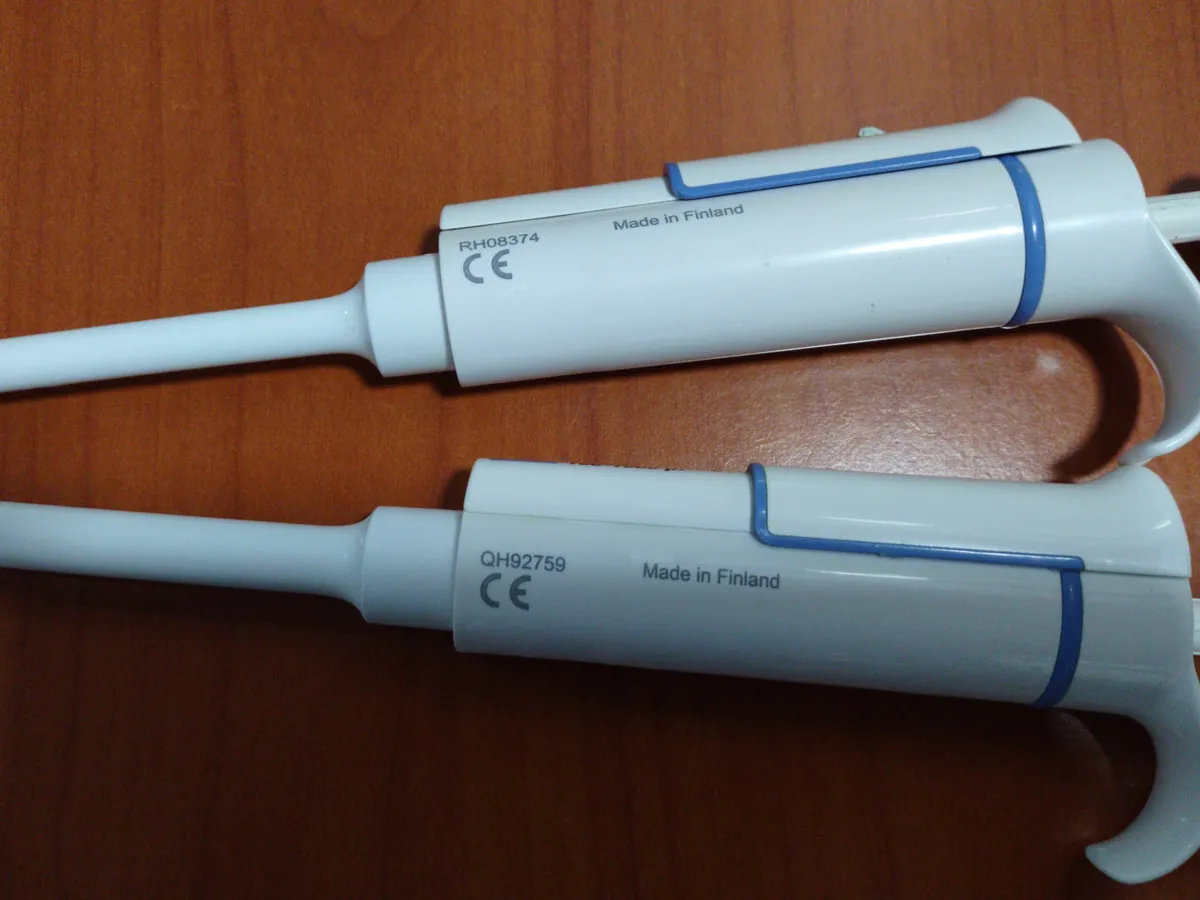
PURPOSE
Why this is checked
Pipette volumes cannot be read directly, so they are measured by weighing water. The mean shows the systematic error (accuracy) and the scatter shows the random error (precision). Both are compared with ISO 8655-2 limits or tighter in-house limits.
Frequency
Typically every 6–12 months, after repair or if the pipette is dropped, with quick checks in between as defined in your SOP.
Learn how the Micropipette worksYOU WILL NEED
Standards & tools
- Calibrated analytical balance or microbalance with readability suited to the volume (for example 0.01 mg for volumes below 10 µL, 0.1 mg for 100 µL to 1 mL)
- Degassed distilled or deionised water (ISO 3696 grade 3 or better)
- Calibrated thermometer and barometer (or hygrometer for humidity)
- Z factor table from ISO 8655-6
- Evaporation trap or weighing vessel with a lid
BEFORE YOU START
Prerequisites
- Pipette, tips and water equilibrated in the test room for at least 2 hours (room typically 15–30 °C, stable within ±0.5 °C during the test)
- Relative humidity above about 50% to limit evaporation
- Pipette passes a visual and leak check
PROCEDURE
Step by step
- 1Set the pipette to the test volume. For variable pipettes test the nominal volume, about 50% and about 10% of nominal.
- 2Fit a new tip and pre-wet it by aspirating and dispensing water five times.
- 3Tare the weighing vessel, aspirate water and dispense it into the vessel touching the tip to the wall.
- 4Record the mass. Repeat for 10 deliveries at each test volume.
- 5Record the water temperature and air pressure and choose the Z factor.
- 6Calculate the mean volume, systematic error and random error for each test volume.
RECORD
Example observation table
| Delivery | Mass (g) | Volume (µL), Z = 1.0033 mL/g |
|---|---|---|
| 1 | 0.9941 | 997.4 |
| 2 | 0.9952 | 998.5 |
| 3 | 0.9938 | 997.1 |
| 4 | 0.9947 | 998.0 |
| 5 | 0.9955 | 998.8 |
| 6 | 0.9936 | 996.9 |
| 7 | 0.9944 | 997.7 |
| 8 | 0.9950 | 998.3 |
| 9 | 0.9939 | 997.2 |
| 10 | 0.9946 | 997.9 |
CALCULATION
How to calculate the result
Vi = mi × Z; Mean V̄ = ΣVi ÷ n; Systematic error es = V̄ − Vs (also as % of Vs); Random error sr = standard deviation of Vi; CV % = sr ÷ V̄ × 100
- 1000 µL variable-volume pipette tested at 1000 µL, water at 22 °C, about 1013 hPa: Z = 1.0033 µL/mg (mL/g)
- Mean mass = 9.9448 g ÷ 10 = 0.99448 g → V̄ = 0.99448 × 1.0033 × 1000 = 997.76 µL
- es = 997.76 − 1000 = −2.24 µL (−0.22%)
- Standard deviation of masses = 0.000634 g → sr = 0.000634 × 1.0033 × 1000 = 0.64 µL; CV = 0.64 ÷ 997.76 × 100 = 0.06%
- Typical ISO 8655-2 limits for a 1000 µL pipette at nominal volume: systematic ±8 µL (±0.8%), random 3 µL (0.3%) → passes
ACCEPTANCE CRITERIA
Pass if
- Systematic and random errors within the maximum permissible errors of ISO 8655-2 for the pipette's nominal volume (for example ±8 µL and 3 µL for a 1000 µL pipette; check the edition your SOP cites), or tighter in-house limits.
- The same absolute limits apply at the lower test volumes, so the percentage limit is larger at 10% of nominal.
IF IT FAILS
What to do
- Repeat the test to rule out technique, tip fit or environmental problems.
- Clean the pipette and replace seals or O-rings, then retest.
- Adjust the pipette only by a trained person and follow the supplier's procedure; record 'as found' and 'as left' results.
- Withdraw the pipette from use and assess the impact on tests done since the last passing calibration.
In LimsPulse · Calibration Management
LimsPulse schedules this calibration, records the result against limits, and blocks the instrument everywhere if it fails or goes overdue.