Kinematic Viscosity Bath
A clear, stirred liquid bath held to within about ±0.02 °C, in which calibrated glass capillary viscometers are timed. Flow time multiplied by the viscometer constant gives kinematic viscosity in mm²/s (cSt).
- Lubricant blending
- Petroleum refining
- Fuel terminals
- Marine fuel testing
- Fleet and machinery oil condition monitoring
- Independent testing laboratories
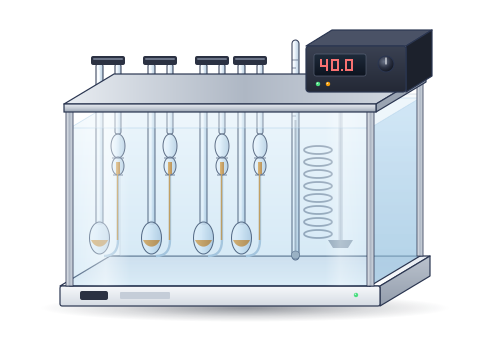
What is Viscosity bath?
Viscosity is a fuel's or oil's resistance to flow, and it changes a great deal with temperature. A small temperature error therefore gives a large viscosity error: for a typical lubricating oil near 40 °C, an error of 0.1 °C changes viscosity by roughly 0.2–0.3%, which is larger than the method's repeatability. That is why kinematic viscosity is measured in a bath held very steady, usually at 40 °C and 100 °C for lubricants and 40 °C for diesel.
The bath is a glass-walled tank filled with water (for temperatures up to about 80 °C) or a clear oil such as silicone or white oil (for higher temperatures). A stirrer and heater, with a cooling coil for temperatures near or below room temperature, keep the whole bath uniform. Several glass capillary viscometers hang vertically in holders, fully immersed, while the operator or an optical sensor times the sample meniscus passing two marks.
Kinematic viscosity is calculated as ν = C × t, where C is the calibration constant of the viscometer (mm²/s²) and t is the flow time (s). ASTM D445, ISO 3104 and IS 1448 Part 25 describe the method; ASTM D446 specifies the viscometers. Automated systems fill, time, clean and dry the viscometers themselves, but the physics is the same.
Used for
- Kinematic viscosity of lubricating oils at 40 °C and 100 °C, used for ISO VG grading and viscosity index
- Viscosity of diesel and biodiesel at 40 °C against specification limits
- Viscosity of fuel oils and marine fuels (often at 50 °C)
- Condition monitoring of in-service engine and hydraulic oils (thinning by fuel dilution, thickening by oxidation)
- Viscosity of base oils, transformer oils and other Newtonian liquids
How it works
- 01
Choose viscometer
A viscometer size is chosen so the flow time is at least 200 s (as D445 requires).
- 02
Charge
The viscometer is filled with filtered sample to the filling marks and hung vertically in the bath.
- 03
Equilibrate
The sample is left in the bath until it reaches the test temperature, typically about 30 minutes.
- 04
Time the flow
The sample is drawn above the upper timing mark and allowed to flow freely; the time to pass from the upper to the lower mark is measured.
- 05
Repeat
A second flow time is measured; the two calculated viscosities must agree within the method's determinability.
- 06
Calculate
ν = C × t for each time; the mean is reported in mm²/s.
Advantages
- High accuracy and precision when temperature and timing are well controlled
- Simple, traceable principle: time and a calibrated constant
- Several viscometers can be run at once in a single bath
- Covers a very wide viscosity range by choosing viscometer size
- Reference method for fuel and lubricant specifications
Limitations
- Only valid for Newtonian liquids; not for greases or non-Newtonian fluids
- Very sensitive to bath temperature; needs ±0.02 °C control and a calibrated thermometer
- Manual timing is operator-dependent; flow times below about 200 s need care
- Viscometers must be cleaned and dried thoroughly between samples
- Glass viscometers are fragile
2 calibration procedures
Methods that use Viscosity bath
Keep every Viscosity bath in control: usage logs, calibration and maintenance schedules, and automatic blocking of overdue instruments.