Kinematic Viscosity Bath
A clear, stirred liquid bath held to within about ±0.02 °C, in which calibrated glass capillary viscometers are timed. Flow time multiplied by the viscometer constant gives kinematic viscosity in mm²/s (cSt).
- Lubricant blending
- Petroleum refining
- Fuel terminals
- Marine fuel testing
- Fleet and machinery oil condition monitoring
- Independent testing laboratories
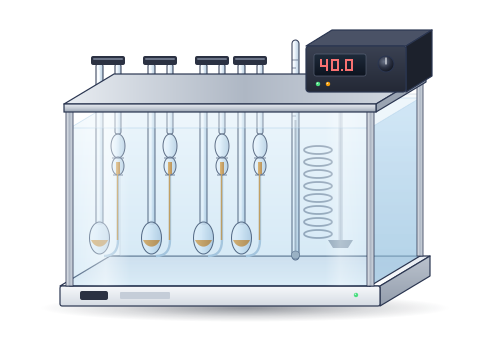
How Viscosity bath works
A fixed volume of liquid flows under gravity through a fine glass capillary. For a Newtonian liquid the time taken is proportional to its kinematic viscosity (dynamic viscosity divided by density). The viscometer constant, found by calibration with a liquid of known viscosity, converts time to viscosity.
The path of a sample
- 01
Choose viscometer
A viscometer size is chosen so the flow time is at least 200 s (as D445 requires).
- 02
Charge
The viscometer is filled with filtered sample to the filling marks and hung vertically in the bath.
- 03
Equilibrate
The sample is left in the bath until it reaches the test temperature, typically about 30 minutes.
- 04
Time the flow
The sample is drawn above the upper timing mark and allowed to flow freely; the time to pass from the upper to the lower mark is measured.
- 05
Repeat
A second flow time is measured; the two calculated viscosities must agree within the method's determinability.
- 06
Calculate
ν = C × t for each time; the mean is reported in mm²/s.
Main parts and what they do
Bath tank
Glass or glass-windowed tank deep enough that the viscometer sample sits well below the liquid surface and above the bottom.
Bath medium
Water for lower temperatures; clear silicone or white oil for higher temperatures.
Stirrer
Circulates the medium so the temperature is uniform throughout.
Heater and controller
Holds the set temperature to within about ±0.02 °C between 15 °C and 100 °C.
Cooling coil or chiller
Removes heat for tests near or below room temperature and improves control stability.
Reference thermometer
Calibrated liquid-in-glass thermometer (0.02 °C graduations) or digital contact thermometer of similar accuracy, placed near the viscometers.
Viscometer holders
Hold viscometers vertical, which is important because tilt changes the flow time.
Glass capillary viscometers
Calibrated Cannon-Fenske, Ubbelohde or reverse-flow viscometers of different sizes for different viscosity ranges.
Timer
Stopwatch or electronic timer with 0.1 s resolution, verified against a reference time signal; optical sensors on automatic units.
Lid and lighting
Insulating lid with ports and back-lighting so menisci can be seen clearly.
Terms every analyst should know
Kinematic vs dynamic viscosity
Kinematic viscosity ν (mm²/s, also called cSt) is dynamic viscosity η (mPa·s, or cP) divided by density ρ (g/cm³). So η = ν × ρ.
Viscometer constant (C)
A number specific to each viscometer, in mm²/s², found by calibration against a certified viscosity standard. It changes slightly with temperature for some viscometer types; the certificate states it.
Minimum flow time
Flow times of at least 200 s keep the kinetic energy correction negligible and reduce relative timing error.
Determinability
The allowed difference between the two viscosity values from one filling. D445 gives values by product type (for example about 0.1–0.2% for many oils).
Newtonian liquid
A liquid whose viscosity does not depend on shear rate. Most clean fuels and oils are Newtonian at test temperature; waxy or highly polymer-thickened samples may not be.
Viscosity index (VI)
A number calculated from viscosities at 40 °C and 100 °C that shows how little an oil's viscosity changes with temperature (ASTM D2270).
Keep every Viscosity bath in control: usage logs, calibration and maintenance schedules, and automatic blocking of overdue instruments.