Viscosity bath · Calibration procedure
Bath temperature verification
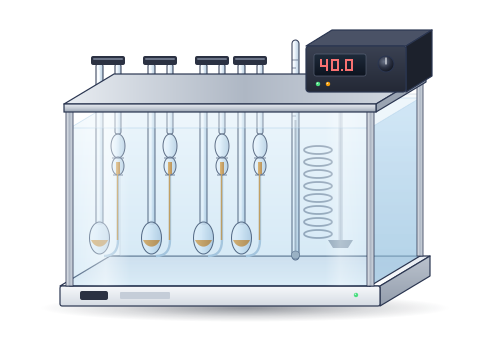
Checks the viscosity bath temperature with a calibrated reference thermometer at each test temperature, at the viscometer positions and over time.
PURPOSE
Why this is checked
Frequency
Typically a daily check at the reference thermometer before use, and a full multi-position verification every 6–12 months or per SOP.
Learn how the Viscosity bath worksYOU WILL NEED
Standards & tools
- Calibrated reference thermometer: liquid-in-glass with 0.02 °C or finer graduations or a digital contact thermometer of equivalent accuracy, traceable to national standards
- Certificate corrections for the reference thermometer at the test temperatures
BEFORE YOU START
Prerequisites
- Bath running at the set temperature for at least 1 h with lid fitted
- Bath medium at the correct level
- Reference thermometer in date
PROCEDURE
Step by step
- 1Place the reference thermometer at the first viscometer position at the depth of the viscometer bulb.
- 2Wait for a stable reading and record it, applying the certificate correction.
- 3Move to each other viscometer position and record readings.
- 4At one position, record readings every 5 minutes for 30 minutes to check stability.
- 5Repeat at each test temperature used (for example 40 °C and 100 °C).
- 6Calculate mean deviation, spread across positions and variation over time.
RECORD
Example observation table
| Position | Set (°C) | Corrected reference reading (°C) | Deviation (°C) |
|---|---|---|---|
| 1 | 40.00 | 40.012 | +0.012 |
| 2 | 40.00 | 40.005 | +0.005 |
| 3 | 40.00 | 39.996 | −0.004 |
| 4 | 40.00 | 40.009 | +0.009 |
CALCULATION
How to calculate the result
Formula
Deviation = corrected reading − set temperature; Uniformity = highest − lowest reading
Worked example
- 1Mean = (40.012 + 40.005 + 39.996 + 40.009) ÷ 4 = 40.0055 ≈ 40.006 °C.
- 2
Largest deviation = +0.012 °C, within ±0.02 °C.
- 3
Uniformity = 40.012 − 39.996 = 0.016 °C.
- 4
All positions within ±0.02 °C of 40.00 °C — pass.
ACCEPTANCE CRITERIA
Pass if
- Every position within ±0.02 °C of the test temperature (15–100 °C range, per D445); wider limits apply outside this range as stated in the method.
- No drift beyond these limits over the stability period.
IF IT FAILS
What to do
- Check stirrer, lid and medium level; adjust controller offset if the SOP allows, then repeat.
- Do not use positions that fail.
- Service the heater or controller if stability cannot be achieved.
- Assess viscosity results since the last good check.
MORE
Other Viscosity bath calibrations
In LimsPulse · Calibration Management
LimsPulse schedules this calibration, records the result against limits, and blocks the instrument everywhere if it fails or goes overdue.