Petroleum testing
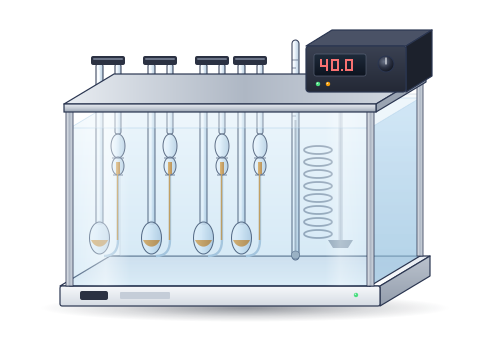
Kinematic Viscosity Bath
A clear, stirred liquid bath held to within about ±0.02 °C, in which calibrated glass capillary viscometers are timed. Flow time multiplied by the viscometer constant gives kinematic viscosity in mm²/s (cSt).
- Lubricant blending
- Petroleum refining
- Fuel terminals
- Marine fuel testing
- Fleet and machinery oil condition monitoring
- Independent testing laboratories
Follow your site SOP
This is a typical operating sequence for learning. Your instrument model and approved SOP take precedence.
STAGE 1
Before you start
- 1Check the bath temperature on the calibrated reference thermometer, not only on the controller display.
- 2Check bath medium level and clarity; top up or replace if cloudy.
- 3Select clean, dry viscometers whose constants are certified and whose range gives a flow time of at least 200 s.
- 4Filter the sample (for example through a fine sieve or sintered glass) if it may contain particles.
- A dirty or wet viscometer gives wrong flow times; any drop of solvent or water left inside changes the result.
STAGE 2
Charging
- 1Fill the viscometer as its type requires (inverted suction for Cannon-Fenske routine, filling tube for Ubbelohde), avoiding bubbles.
- 2Hang it vertically in the holder so the sample is fully immersed.
- 3Allow the sample to reach bath temperature, typically about 30 minutes (longer for viscous samples).
- Do not use mouth suction; use a rubber bulb or vacuum line to draw sample.
STAGE 3
Timing
- 1Draw the sample above the upper timing mark and let it flow freely.
- 2Start the timer as the meniscus passes the upper mark and stop it as it passes the lower mark.
- 3Repeat to get a second flow time from the same filling (or charge a second viscometer as the method requires).
- 4Calculate ν = C × t for each time and check the two agree within the determinability; if not, clean and repeat.
- Keep the timer's start and stop on the same edge of the meniscus each time.
STAGE 4
Cleaning
- 1Drain the viscometer and rinse several times with a suitable solvent (for example petroleum spirit or heptane), then a volatile solvent such as acetone.
- 2Dry with a gentle stream of filtered dry air or by vacuum.
- 3Periodically clean with a non-chromic acid cleaner to remove deposits.
- 4Record results with the viscometer serial number, constant and bath temperature.
- Avoid chromic acid cleaning mixtures; they are highly toxic and carcinogenic. Use the alternatives your SOP allows.
In LimsPulse · Calibration Management
Keep every Viscosity bath in control: usage logs, calibration and maintenance schedules, and automatic blocking of overdue instruments.