Ion Chromatograph (IC)
Separates charged species (anions, cations, small organic acids and amines) on an ion-exchange column and usually detects them by conductivity. Used in pharma QC for counter-ions, inorganic impurities and ions in water.
- Pharmaceutical
- Power and water utilities
- Environmental
- Food & beverage
- Semiconductor
- Chemicals
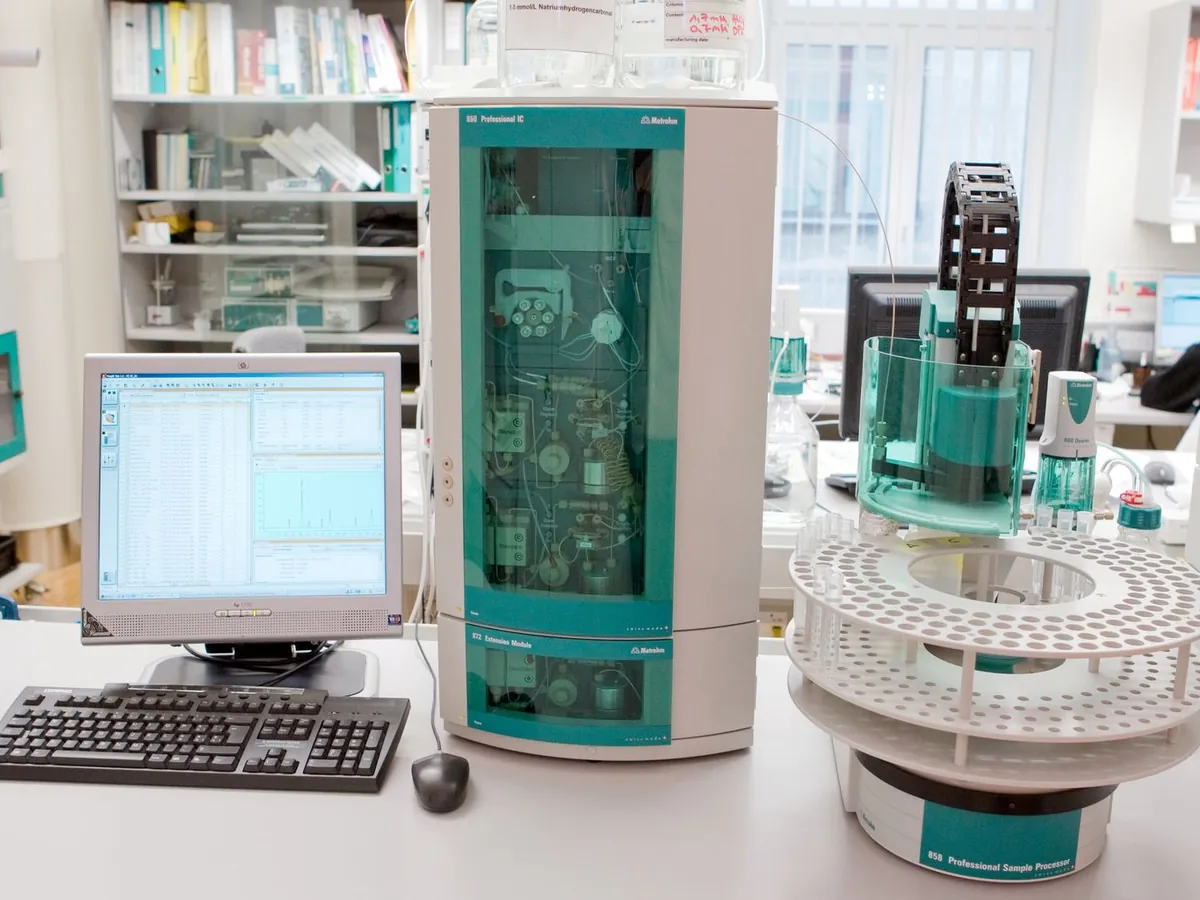
What is IC?
An ion chromatograph is a liquid chromatograph designed for ions. The column is packed with an ion-exchange resin that carries fixed charged groups. Anions in the sample are attracted to an anion-exchange column; cations to a cation-exchange column. An eluent containing competing ions (for example hydroxide or carbonate for anions, methanesulfonic acid for cations) pushes the sample ions along, and each ion leaves the column at a different time depending on how strongly it is held.
Most inorganic ions do not absorb UV light, so IC normally uses a conductivity detector. To see small sample peaks against a highly conductive eluent, a suppressor is placed before the detector. It converts the eluent into weakly conducting water or carbonic acid and converts sample ions into a more conductive form, which greatly improves sensitivity.
In a pharmaceutical lab IC is used to assay counter-ions in drug salts (chloride, sulfate, mesylate, sodium, potassium), to measure inorganic impurities and ions in raw materials and water, and, with pulsed amperometric detection, to analyse sugars and some aminoglycoside antibiotics.
Used for
- Counter-ion assay of API salts (e.g. chloride, bromide, sulfate, mesylate, maleate, sodium)
- Anions and cations in purified water and process water
- Inorganic impurities (e.g. sulfate, phosphate, nitrate) in raw materials
- Organic acids and amines in formulations and excipients
- Sugars and aminoglycosides by pulsed amperometric detection (PAD)
- Ions in cleaning validation and buffer verification
How it works
- 01
Eluent
Prepared from reagents (e.g. carbonate / bicarbonate) or generated electrolytically from water (e.g. potassium hydroxide).
- 02
Pump
A metal-free (PEEK) pump delivers a steady flow, typically about 0.25–1.5 mL/min depending on column diameter.
- 03
Injection
A loop injects a fixed volume of the filtered, diluted sample.
- 04
Guard and analytical column
Ions separate on the ion-exchange resin according to charge and affinity.
- 05
Suppressor
Exchanges eluent counter-ions for H⁺ (anions) or OH⁻ (cations), lowering background conductivity.
- 06
Conductivity detector
Measures the conductivity of each eluting ion band in a temperature-controlled cell.
Advantages
- Measures many ions in one run, at low mg/L or µg/L levels
- No need for a chromophore
- Eluent generators give highly reproducible gradients from water alone
- Small sample volumes and simple sample preparation (dilute and filter)
Limitations
- Columns and suppressors are specialised and expensive
- High-salt or high-organic samples may overload or damage the column
- Carbonate from air interferes with hydroxide eluents
- Contamination from glassware, filters and water easily shows up at low levels
2 calibration procedures
Keep every IC in control: usage logs, calibration and maintenance schedules, and automatic blocking of overdue instruments.