IC · Calibration procedure
Conductivity detector linearity
Checks that the suppressed conductivity response rises in proportion to ion concentration, using a series of chloride (or mixed-anion) standards.
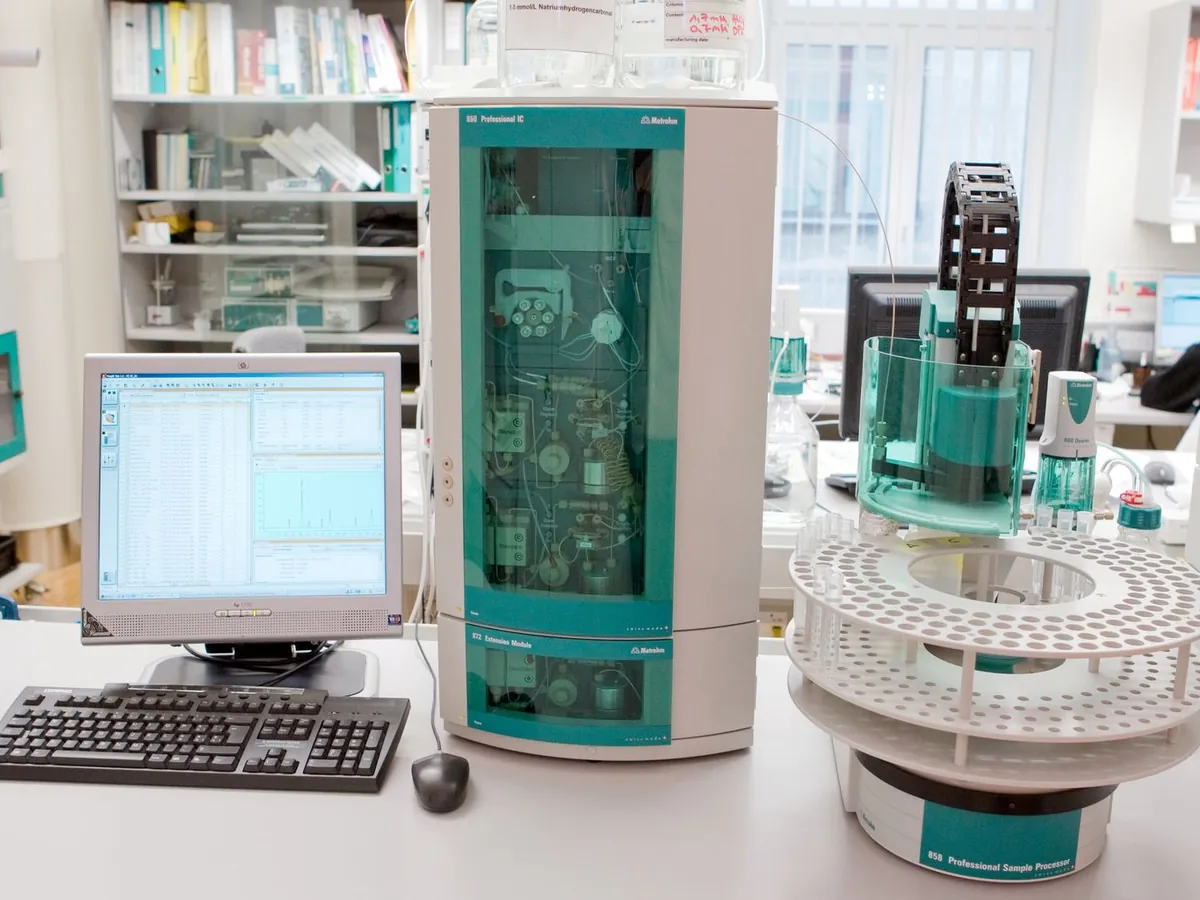
PURPOSE
Why this is checked
IC results are calculated from a calibration curve. If the detector and suppressor response is not linear over the working range, results at low or high concentrations will be biased.
Frequency
Typically every 6 months, and after major repair or relocation, as defined in your calibration SOP.
Learn how the IC worksYOU WILL NEED
Standards & tools
- Certified chloride stock standard (e.g. 1000 mg/L, traceable)
- Deionised water (18.2 MΩ·cm) for dilutions
- Optionally, a potassium chloride conductivity standard (0.001 mol/L KCl is about 147 µS/cm at 25 °C) to check the cell reading
BEFORE YOU START
Prerequisites
- Equilibrate the system with the routine anion column, eluent and suppressor until background conductivity is stable
- Inject a water blank and confirm there is no significant chloride peak
PROCEDURE
Step by step
- 1Prepare at least five standards across the working range, e.g. 0.5, 1, 2, 5 and 10 mg/L chloride.
- 2Inject each standard (in duplicate if your SOP requires) from lowest to highest.
- 3Record the chloride peak area at each level.
- 4Plot peak area against concentration and calculate the slope, intercept and correlation coefficient (r).
RECORD
Example observation table
| Chloride (mg/L) | Peak area (µS·min) |
|---|---|
| 0.5 | 0.061 |
| 1.0 | 0.124 |
| 2.0 | 0.246 |
| 5.0 | 0.618 |
| 10.0 | 1.229 |
CALCULATION
How to calculate the result
Least-squares line: Area = slope × Concentration + intercept; r = Σ(x − x̄)(y − ȳ) ÷ √[Σ(x − x̄)² × Σ(y − ȳ)²]
- Slope = 0.1229 µS·min per mg/L; intercept = 0.0007 µS·min
- r = 0.99999 (r² = 0.99999)
- Result meets r ≥ 0.999
ACCEPTANCE CRITERIA
Pass if
- Correlation coefficient r typically not less than 0.999 over the range; intercept small relative to the lowest standard, as per your SOP.
IF IT FAILS
What to do
- Check the suppressor (exhausted or damaged suppressors cause non-linear response) and background conductivity.
- Check standard preparation and water quality.
- Check cell temperature control; service the detector if needed.
- Repeat after correction; label out of calibration until it passes.
MORE
Other IC calibrations
In LimsPulse · Calibration Management
LimsPulse schedules this calibration, records the result against limits, and blocks the instrument everywhere if it fails or goes overdue.