Chromatography
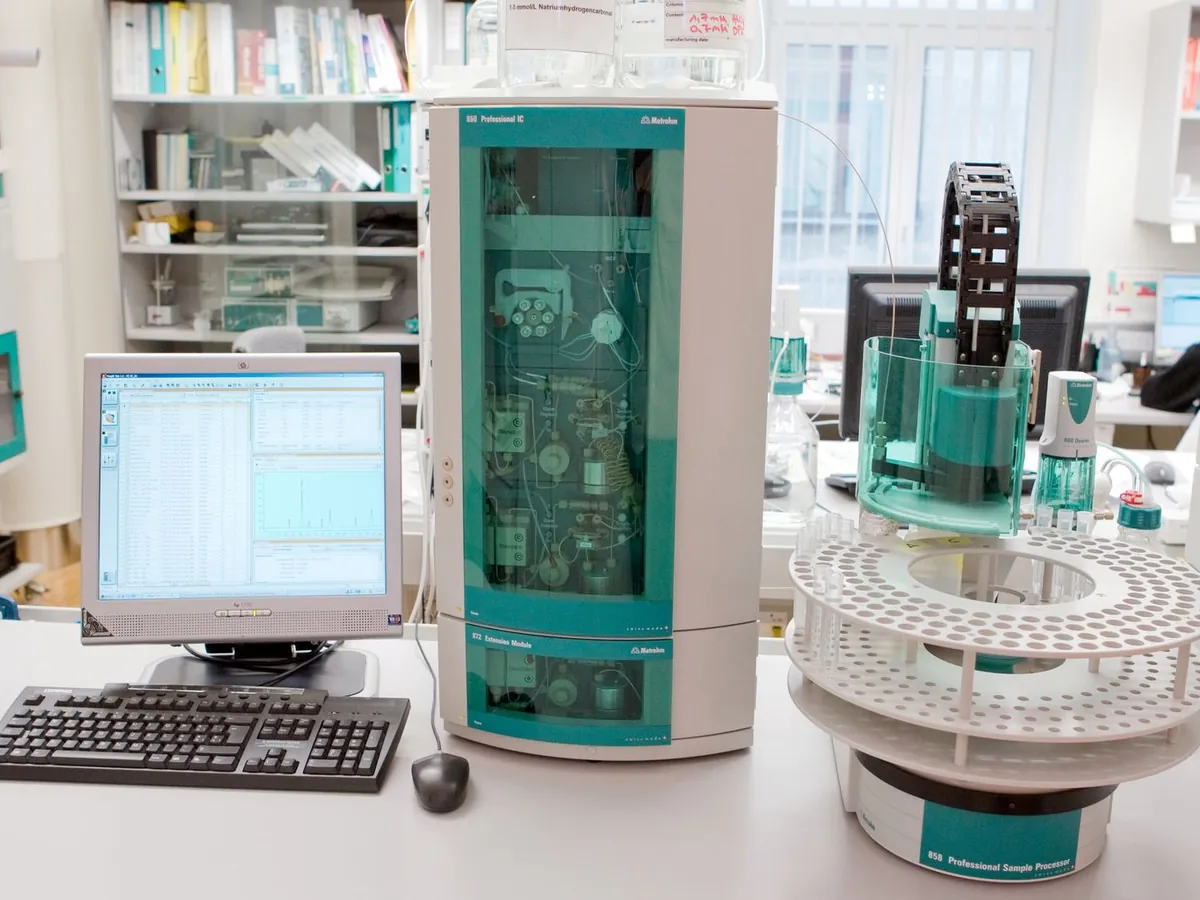
Ion Chromatograph (IC)
Separates charged species (anions, cations, small organic acids and amines) on an ion-exchange column and usually detects them by conductivity. Used in pharma QC for counter-ions, inorganic impurities and ions in water.
- Pharmaceutical
- Power and water utilities
- Environmental
- Food & beverage
- Semiconductor
- Chemicals
Follow your site SOP
This is a typical operating sequence for learning. Your instrument model and approved SOP take precedence.
STAGE 1
Before you start
- 1Use fresh ultrapure water (typically 18.2 MΩ·cm) for eluent and dilutions.
- 2Prepare eluent as per the method, or check the eluent generator cartridge life.
- 3Rinse sample vials and volumetric ware with ultrapure water; avoid glassware that can leach ions where the method says so.
- 4Check that the right columns (anion or cation) and suppressor are installed.
- Never run the suppressor without flow, and never run it dry; it is easily damaged.
STAGE 2
Start-up
- 1Start the pump at the method flow and switch on the suppressor and eluent generator.
- 2Wait for background conductivity and baseline to stabilise (often 30–60 minutes).
- 3Inject a water blank to confirm a clean baseline.
- High background conductivity means an exhausted suppressor, contaminated eluent or a leak; investigate before running samples.
STAGE 3
Running samples
- 1Dilute samples so the main ion is within the calibration range and does not overload the column.
- 2Filter samples through a 0.2 or 0.45 µm IC-certified filter.
- 3Run blank, calibration standards, check standards and samples as per the sequence.
- 4Check resolution between critical pairs (e.g. chloride and a nearby ion) and standard %RSD.
- Samples with high organic solvent content can damage some columns and suppressors; check compatibility.
STAGE 4
Shutdown
- 1Keep the system flowing at low rate if it will be used soon, or shut down as per the manufacturer's guide.
- 2Store columns in eluent or the supplier's storage solution with the ends capped.
- 3Complete the instrument and column logs.
In LimsPulse · Calibration Management
Keep every IC in control: usage logs, calibration and maintenance schedules, and automatic blocking of overdue instruments.