IC · Calibration procedure
Pump flow rate accuracy
Checks that the IC pump delivers the set flow, by weighing water collected over a timed interval.
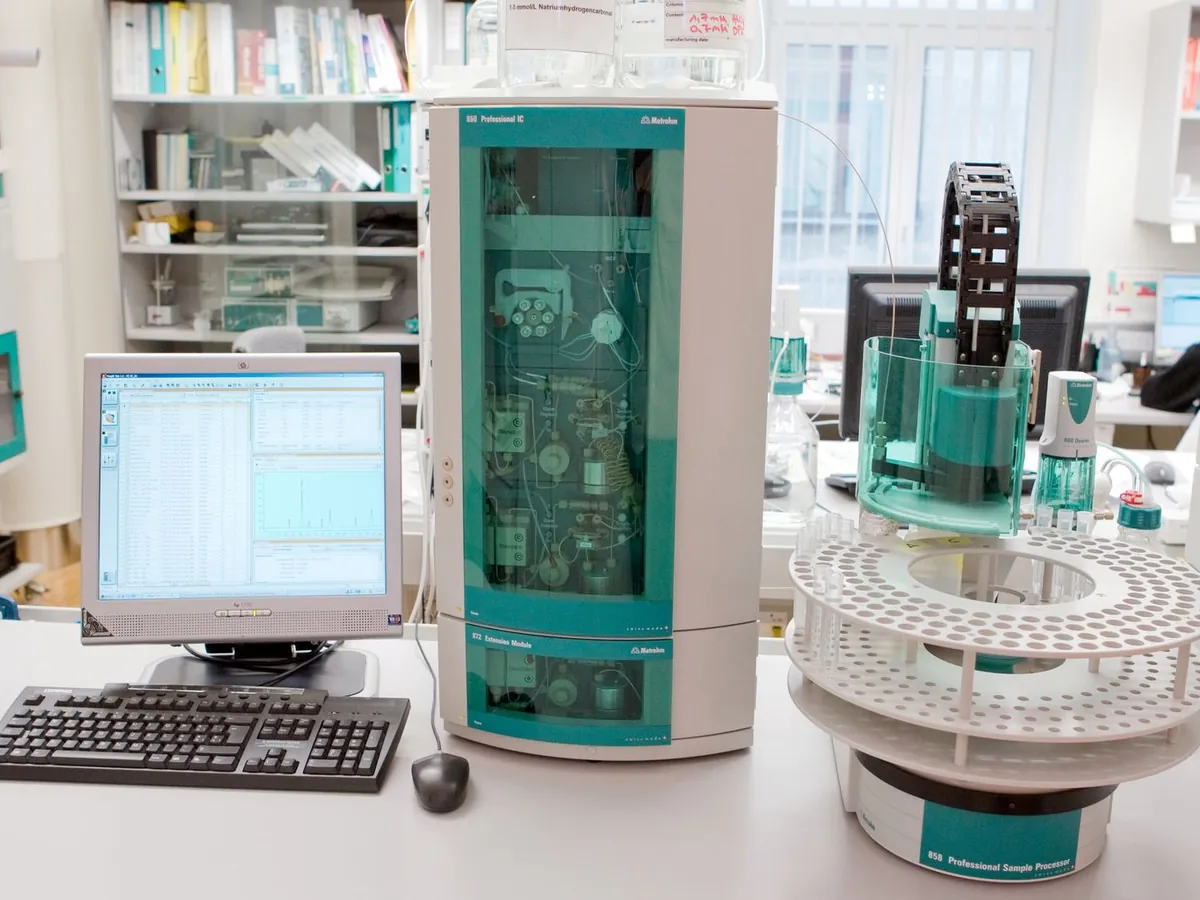
PURPOSE
Why this is checked
Ion chromatography identifies ions by retention time and quantifies them by peak area. Both depend on a stable, accurate flow from the metal-free pump.
Frequency
Typically every 6 months, and after major repair or relocation, as defined in your calibration SOP.
Learn how the IC worksYOU WILL NEED
Standards & tools
- Calibrated analytical balance
- Calibrated stopwatch
- Calibrated thermometer
- Deionised water (18.2 MΩ·cm)
- Tared, capped plastic collection vial
BEFORE YOU START
Prerequisites
- Bypass the column and suppressor with a restriction tubing (or as the manufacturer specifies), or keep them in line if the procedure says so
- Switch off the eluent generator and suppressor if bypassed
- Purge the pump and check for leaks
PROCEDURE
Step by step
- 1Pump deionised water at 0.5 mL/min and let the flow stabilise.
- 2Collect the outlet into a tared vial for exactly 10.00 minutes and weigh it.
- 3Convert mass to volume using the density of water at the measured temperature.
- 4Repeat at 1.0 mL/min and 1.5 mL/min, or at the flows your methods use.
RECORD
Example observation table
| Set flow (mL/min) | Time (min) | Mass (g) | Volume (mL) | Actual flow (mL/min) | % error |
|---|---|---|---|---|---|
| 0.5 | 10.00 | 4.968 | 4.983 | 0.4983 | −0.34 |
| 1.0 | 10.00 | 9.991 | 10.021 | 1.0021 | +0.21 |
| 1.5 | 5.00 | 7.511 | 7.534 | 1.5067 | +0.45 |
CALCULATION
How to calculate the result
Volume = Mass ÷ Density; Actual flow = Volume ÷ Time; % error = (Actual − Set) ÷ Set × 100
- Set 1.0 mL/min; 9.991 g collected in 10.00 min at 25 °C (density 0.9970 g/mL)
- Volume = 9.991 ÷ 0.9970 = 10.021 mL
- Actual flow = 10.021 ÷ 10.00 = 1.0021 mL/min
- % error = (1.0021 − 1.0) ÷ 1.0 × 100 = +0.21%
ACCEPTANCE CRITERIA
Pass if
- Actual flow typically within ±2.0% of the set value at each flow, or as per the manufacturer's specification and your SOP.
IF IT FAILS
What to do
- Label the instrument 'Out of calibration'.
- Check for leaks and salt deposits, worn seals and check valves; arrange service.
- Assess the impact on results since the last passing calibration and repeat after repair.
MORE
Other IC calibrations
In LimsPulse · Calibration Management
LimsPulse schedules this calibration, records the result against limits, and blocks the instrument everywhere if it fails or goes overdue.