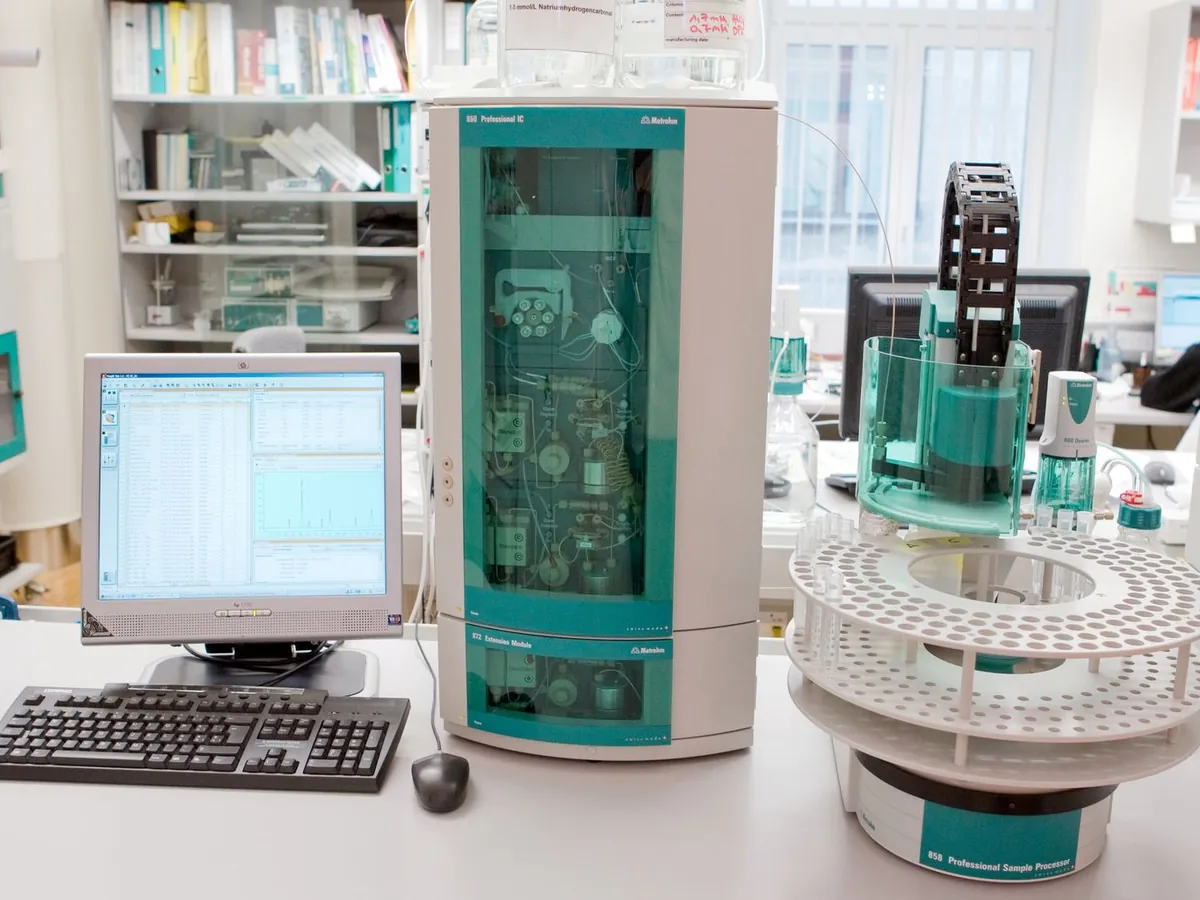
Ion Chromatograph (IC)
Separates charged species (anions, cations, small organic acids and amines) on an ion-exchange column and usually detects them by conductivity. Used in pharma QC for counter-ions, inorganic impurities and ions in water.
- Pharmaceutical
- Power and water utilities
- Environmental
- Food & beverage
- Semiconductor
- Chemicals
How IC works
Separation is by ion exchange: sample ions compete with eluent ions for the fixed charged sites on the resin. Ions with higher charge or greater affinity are held longer. After separation, a suppressor lowers the background conductivity of the eluent and raises the conductivity of the analyte ions, so the conductivity detector sees clear peaks.
The path of a sample
- 01
Eluent
Prepared from reagents (e.g. carbonate / bicarbonate) or generated electrolytically from water (e.g. potassium hydroxide).
- 02
Pump
A metal-free (PEEK) pump delivers a steady flow, typically about 0.25–1.5 mL/min depending on column diameter.
- 03
Injection
A loop injects a fixed volume of the filtered, diluted sample.
- 04
Guard and analytical column
Ions separate on the ion-exchange resin according to charge and affinity.
- 05
Suppressor
Exchanges eluent counter-ions for H⁺ (anions) or OH⁻ (cations), lowering background conductivity.
- 06
Conductivity detector
Measures the conductivity of each eluting ion band in a temperature-controlled cell.
Main parts and what they do
Eluent reservoir or eluent generator
Supplies the competing-ion eluent; a generator makes it electrolytically from deionised water.
Metal-free pump
PEEK flow path avoids metal-ion contamination and corrosion from eluents.
Injection valve and loop / autosampler
Introduces a fixed sample volume (often 10–100 µL).
Guard column
Protects the analytical column from particles and strongly retained matrix.
Analytical ion-exchange column
Separates anions or cations; chosen for capacity and selectivity.
Suppressor
Reduces background conductivity and enhances analyte response (electrolytic, chemical or membrane type).
Conductivity detector (with cell thermostat)
Measures conductivity; temperature control is essential because conductivity changes about 2% per °C.
Data system
Controls the instrument, records chromatograms, integrates and calculates results with an audit trail.
Terms every analyst should know
Ion exchange
Reversible swapping of ions between a solution and fixed charged groups on a resin. Anion exchangers carry positive groups; cation exchangers carry negative groups.
Selectivity
Multiply charged ions (sulfate, phosphate) are generally held more strongly than singly charged ions (chloride, nitrate).
Suppression
Chemical or electrolytic removal of eluent conductivity before the detector. It is what makes low-level conductivity detection possible.
Background conductivity
The conductivity of the eluent after the suppressor. A low, stable value (often below about 1–2 µS/cm for hydroxide eluents) indicates a healthy system.
Eluent generation
Producing KOH or MSA electrolytically from pure water, giving accurate concentrations and gradients without manual eluent preparation.
Carbonate dip
A negative or positive peak caused by dissolved CO₂, which can interfere with early anions when hydroxide eluent is used.
Keep every IC in control: usage logs, calibration and maintenance schedules, and automatic blocking of overdue instruments.