Inductively Coupled Plasma Optical Emission Spectrometer (ICP-OES)
Excites atoms in an argon plasma at about 6000–10,000 K and measures the light each element emits. Measures many elements at once from trace to percent levels.
- Pharmaceutical
- Environmental
- Food & beverage
- Petrochemical
- Mining & metallurgy
- Chemicals
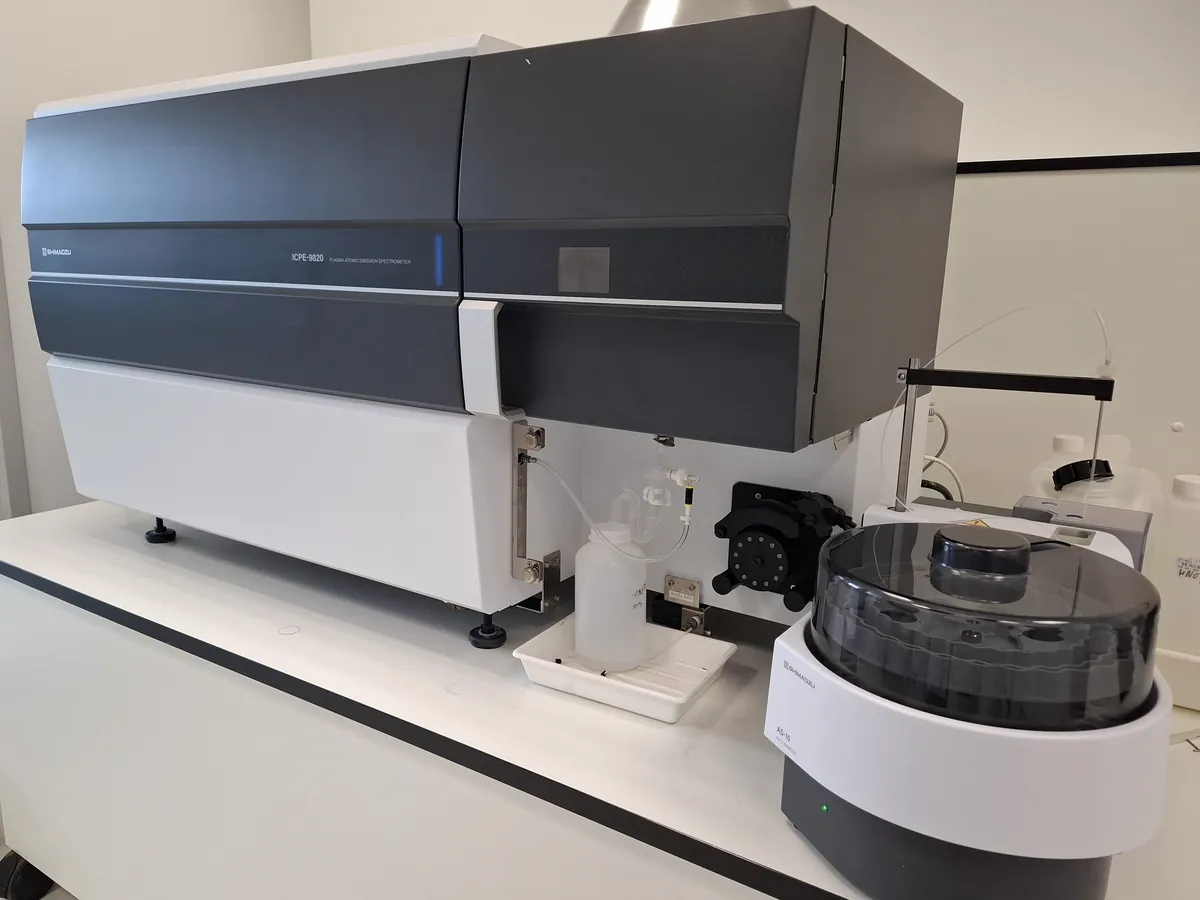
What is ICP-OES?
ICP-OES sprays the sample solution into an argon plasma, a very hot ionised gas sustained by a radio-frequency coil. The heat breaks the sample into atoms and ions and lifts their electrons to higher energy levels. When the electrons fall back, they give out light at wavelengths that are characteristic of each element.
A spectrometer separates this light, and a detector measures the intensity at the chosen lines of many elements at the same time. Intensity is proportional to concentration, so results are calculated from calibration standards. Typical detection limits are in the low µg/L range for many elements.
In pharma QC, ICP-OES is used for elemental impurities (ICH Q3D / USP <232>, <233>) where its sensitivity is adequate, for catalyst residues, for assay of mineral salts and for multi-element testing of excipients. It tolerates higher dissolved solids than ICP-MS.
Used for
- Elemental impurities in APIs, excipients and drug products where limits allow
- Residual catalysts (Pd, Pt, Ni, Ru, Rh) in APIs
- Assay of metals in mineral supplements and electrolytes
- Multi-element screening of raw materials
- Metals in cleaning validation samples
How it works
- 01
Sample introduction
A peristaltic pump feeds the solution to a nebuliser, which forms an aerosol; the spray chamber removes large droplets.
- 02
Plasma
Fine droplets enter the argon plasma, where they are dried, vaporised, atomised, ionised and excited.
- 03
Emission
Excited atoms and ions emit light at characteristic wavelengths as they relax.
- 04
Viewing
The light is collected radially (side-on) or axially (end-on); axial viewing gives better detection limits.
- 05
Spectrometer
An echelle grating and prism disperse the light onto a solid-state (CCD/CID) detector.
- 06
Data system
Integrates line intensities, subtracts background and calculates concentrations from the calibration.
Advantages
- Measures many elements in one run
- Wide linear range (often four to six orders of magnitude)
- Few chemical interferences thanks to the very hot plasma
- Tolerates higher total dissolved solids than ICP-MS
- Fast throughput with an autosampler
Limitations
- Less sensitive than ICP-MS; may not reach low limits for Cd, Pb, As, Hg in high-dose products
- Spectral interferences from line overlaps need careful line selection
- High argon consumption and running cost
- Samples must usually be digested to a clear acid solution
2 calibration procedures
Keep every ICP-OES in control: usage logs, calibration and maintenance schedules, and automatic blocking of overdue instruments.