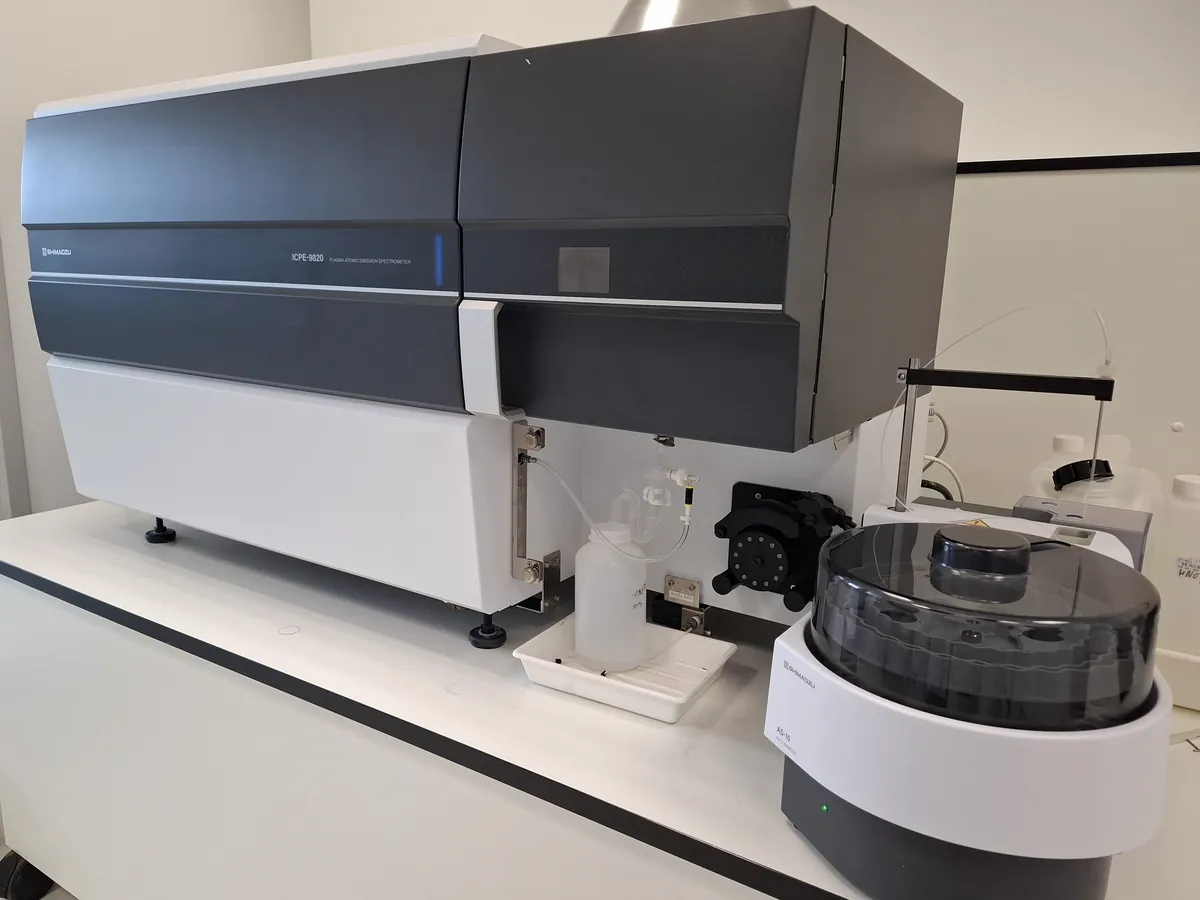
Inductively Coupled Plasma Optical Emission Spectrometer (ICP-OES)
Excites atoms in an argon plasma at about 6000–10,000 K and measures the light each element emits. Measures many elements at once from trace to percent levels.
- Pharmaceutical
- Environmental
- Food & beverage
- Petrochemical
- Mining & metallurgy
- Chemicals
Test your ICP-OES knowledge
Multiple-choice questions
Pick an answer to see whether you are right and why.
Q1. What does ICP-OES measure?
basicQ2. Which gas is normally used to form the plasma in ICP-OES?
basicQ3. Compared with radial viewing, axial viewing of the plasma generally gives:
basicQ4. An element gives a high result at one wavelength but a normal result at a second line. The most likely cause is:
intermediateQ5. Why is yttrium often added to all solutions in ICP-OES?
intermediateQ6. The detection limit is usually calculated as:
intermediateQ7. Blank SD is 6.0 cps and the slope is 12.0 cps per µg/L. What is the detection limit?
advanced
Viva questions
Think of your answer first, then open it to compare.
1. What is a plasma and how is it sustained in ICP?
A plasma is a hot, electrically conductive gas of ions and electrons. In ICP, argon flowing through a quartz torch is seeded with electrons from a spark; a radio-frequency current in the copper load coil creates an oscillating magnetic field that accelerates the electrons, which collide with argon and keep it ionised at several thousand kelvin.
2. Why is wavelength calibration important in ICP-OES?
Emission lines are very narrow. If the wavelength scale drifts, the software measures beside the peak, so intensity drops and background points may fall on the line, giving low or wrong results.
3. When would you choose ICP-MS instead of ICP-OES for elemental impurities?
When the required limits (J values) are below what ICP-OES can reliably quantify, for example Class 1 elements in high-dose oral products or in parenteral and inhalation products with low PDEs. ICP-OES is preferred for higher concentrations and matrices with more dissolved solids.
Keep every ICP-OES in control: usage logs, calibration and maintenance schedules, and automatic blocking of overdue instruments.