Flame Photometer
Measures sodium, potassium and a few other alkali and alkaline earth metals by spraying a solution into a flame and measuring the light the excited atoms emit at their characteristic wavelengths.
- Environmental and water testing
- Agriculture and soil testing
- Fertiliser manufacture
- Food and beverage
- Cement and glass (alkali content)
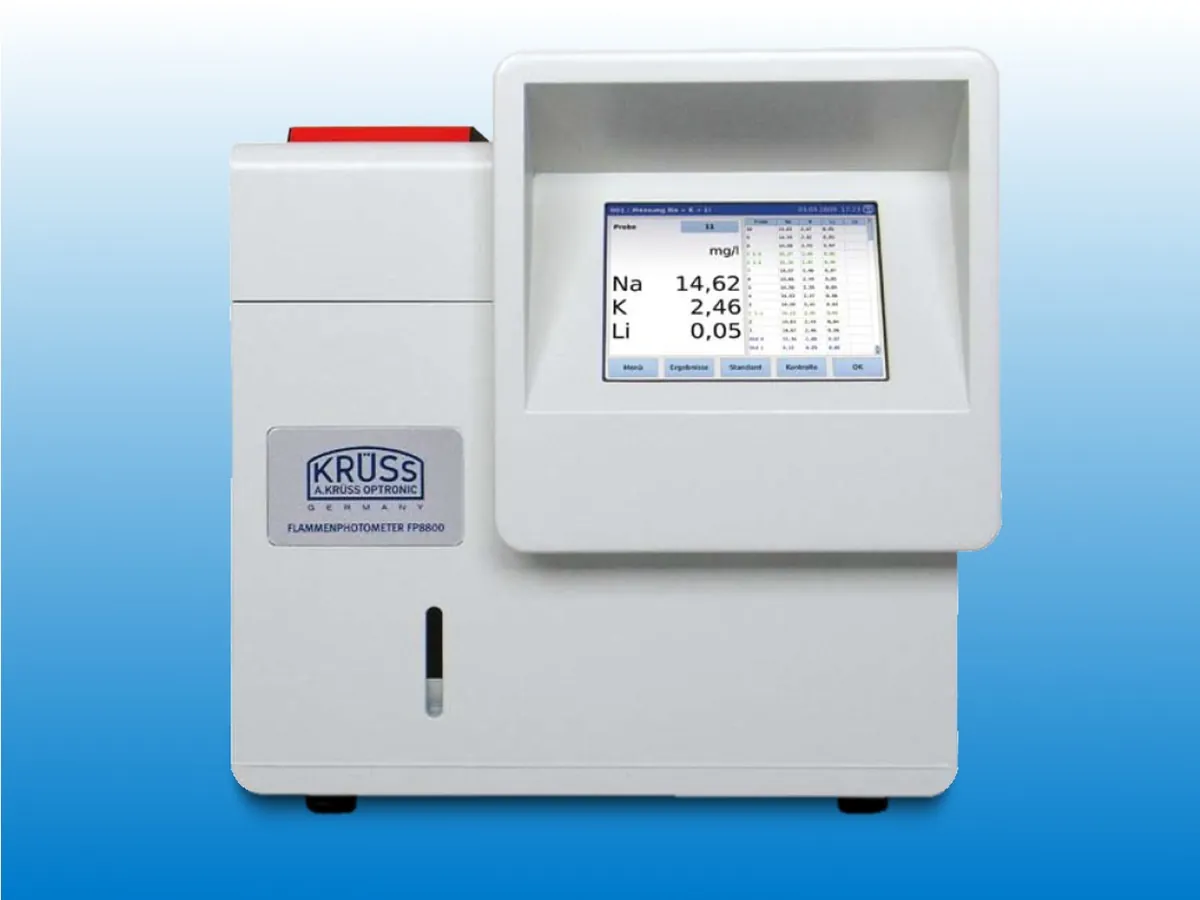
What is Flame photometer?
A flame photometer is a simple atomic emission instrument. A liquid sample is drawn up by a nebuliser and sprayed as a fine mist into a low-temperature flame, usually of LPG or propane with air. In the flame the metal atoms are excited and give off light of a typical colour: yellow for sodium, violet-red for potassium, red for lithium and orange-red for calcium.
An optical filter picks out the line of interest and a photodetector measures its intensity. Because emission is proportional to concentration over a limited range, the reading is compared with a calibration curve prepared from standard solutions.
Flame photometers are cheap, fast and easy to run. They remain common in water, soil and fertiliser laboratories for sodium and potassium, and are used to calculate sodium adsorption ratio (SAR) for irrigation water.
Used for
- Sodium and potassium in drinking water, groundwater and wastewater
- Exchangeable and available potassium in soil extracts
- Sodium adsorption ratio (SAR) for irrigation water quality
- Potassium in fertilisers and plant tissue digests
- Lithium and calcium in some industrial and clinical applications
How it works
- 01
Aspiration
The sample is drawn up the capillary into the nebuliser by the air stream.
- 02
Nebulisation
The liquid breaks into a fine aerosol; large drops drain away in the mixing chamber.
- 03
Atomisation and excitation
In the flame the solvent evaporates, salts dissociate into atoms and some atoms are excited.
- 04
Emission and filtering
Excited atoms emit light; an interference filter passes only the line of interest (for example 589 nm for Na, 766 nm for K).
- 05
Detection
A photodiode or photocell converts the light to a signal shown as a reading relative to the calibration.
Advantages
- Low purchase and running cost compared with AAS or ICP-OES
- Fast: a reading takes a few seconds
- Simple to operate; suitable for teaching and routine labs
- Good sensitivity for sodium and potassium, which emit strongly at low flame temperatures
Limitations
- Limited to a few easily excited elements (mainly Na, K, Li, Ca, Ba)
- Calibration is linear only over a narrow range; samples often need dilution
- Ionisation and mutual interferences (for example Na on K) affect accuracy at high concentrations
- Flame stability depends on gas pressure, so readings drift and must be checked often
- Viscosity and dissolved solids change the nebulisation rate and the signal
1 calibration procedure
Methods that use Flame photometer
Keep every Flame photometer in control: usage logs, calibration and maintenance schedules, and automatic blocking of overdue instruments.