Flame Photometer
Measures sodium, potassium and a few other alkali and alkaline earth metals by spraying a solution into a flame and measuring the light the excited atoms emit at their characteristic wavelengths.
- Environmental and water testing
- Agriculture and soil testing
- Fertiliser manufacture
- Food and beverage
- Cement and glass (alkali content)
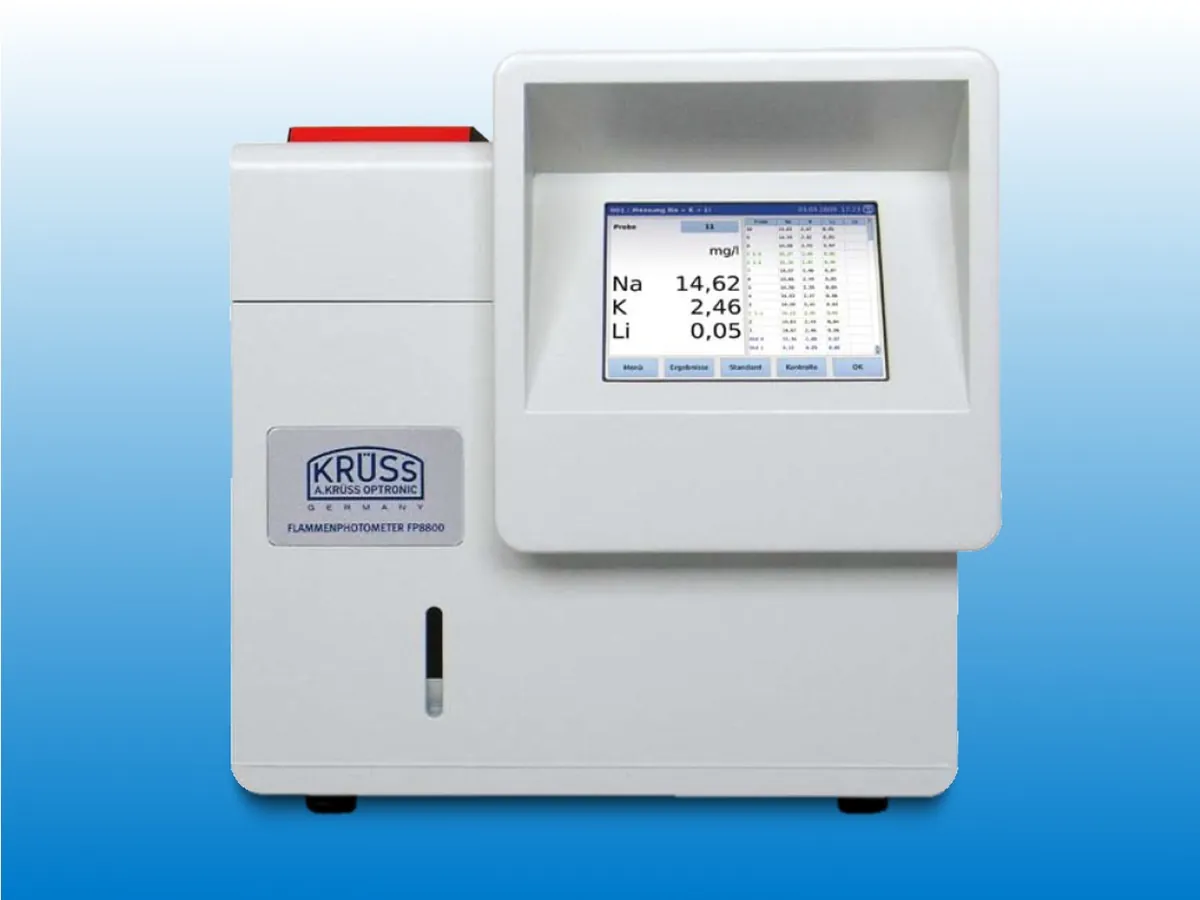
How Flame photometer works
The sample is nebulised into a flame where the solvent evaporates, salts break into atoms, and some atoms are thermally excited. When excited electrons fall back to the ground state they emit light at fixed wavelengths. The intensity of that light, isolated by a filter, is proportional to the concentration of the element over the working range.
The path of a sample
- 01
Aspiration
The sample is drawn up the capillary into the nebuliser by the air stream.
- 02
Nebulisation
The liquid breaks into a fine aerosol; large drops drain away in the mixing chamber.
- 03
Atomisation and excitation
In the flame the solvent evaporates, salts dissociate into atoms and some atoms are excited.
- 04
Emission and filtering
Excited atoms emit light; an interference filter passes only the line of interest (for example 589 nm for Na, 766 nm for K).
- 05
Detection
A photodiode or photocell converts the light to a signal shown as a reading relative to the calibration.
Main parts and what they do
Nebuliser and capillary
Draws up the sample and sprays it as a fine aerosol.
Mixing (spray) chamber
Mixes aerosol with fuel and air and drains away large droplets.
Burner
Produces a stable, low-temperature flame.
Fuel and air regulators
Keep gas and air pressures constant so the flame is steady.
Optical filters
Interference filters that isolate the Na, K, Li or Ca emission lines.
Photodetector and amplifier
Converts light intensity to an electrical signal and display reading.
Compressor
Supplies clean, oil-free air to the nebuliser.
Drain trap
Removes waste liquid from the spray chamber while keeping a gas seal.
Terms every analyst should know
Characteristic emission lines
Sodium emits mainly at 589 nm, potassium at about 766–769 nm, lithium at 671 nm and calcium (as CaOH bands) around 622 nm.
Low-temperature flame
An air–LPG or air–propane flame (about 1900 °C) excites alkali metals well but few other elements, which keeps the spectrum simple.
Ionisation interference
In the flame some alkali atoms lose an electron and stop emitting at the atomic line. Adding an excess of another easily ionised element (an ionisation buffer, such as caesium or lithium) evens out this effect.
Matrix effects
Differences in viscosity, acid content or dissolved salts between samples and standards change aspiration rate. Standards should be matrix-matched where possible.
Calibration range
Emission becomes non-linear at higher concentrations because of self-absorption. Typical working ranges are about 0–10 mg/L or 0–100 mg/L depending on the instrument and setting.
Keep every Flame photometer in control: usage logs, calibration and maintenance schedules, and automatic blocking of overdue instruments.