Calibration with sodium and potassium standards
Builds and checks the response of the flame photometer with a series of sodium and potassium standards, confirming linearity and accuracy.
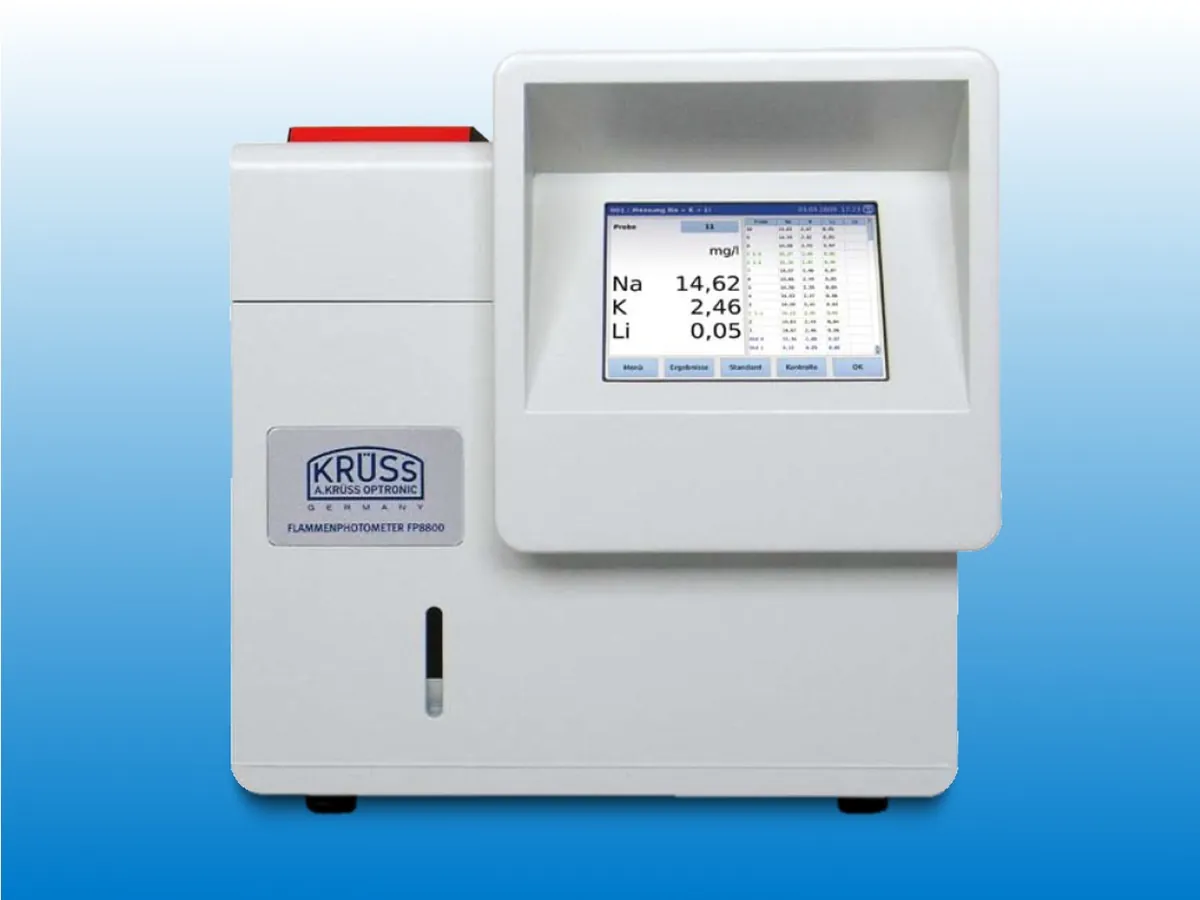
Why this is checked
The flame photometer does not measure concentration directly; it compares emission with standards. Calibration confirms that the response is linear over the working range, that the zero is stable and that an independent check standard reads correctly.
A working calibration is set at each use; the formal linearity and accuracy check is typically monthly or quarterly, as defined in your SOP.
Learn how the Flame photometer worksStandards & tools
- Sodium stock solution 1000 mg/L Na (from dried NaCl or a certified standard)
- Potassium stock solution 1000 mg/L K (from dried KCl or a certified standard)
- Working standards: 0, 2, 4, 6, 8 and 10 mg/L of each element, prepared in purified water with Class A glassware
- Independent check standard (different lot or supplier), for example 5 mg/L
Prerequisites
- Flame lit and burner warmed up with purified water aspirating for 10–15 minutes
- Nebuliser clean and aspiration steady
- Standards prepared fresh or within their assigned expiry
Step by step
- 1Select the sodium filter. Aspirate the blank and set zero.
- 2Aspirate the 10 mg/L standard and set the reading to 100.
- 3Re-check zero and the top standard until both are stable.
- 4Aspirate each working standard from low to high and record the readings.
- 5Aspirate the independent check standard and record the reading.
- 6Repeat steps 1–5 with the potassium filter and potassium standards.
- 7Fit a straight line (reading vs concentration), calculate the correlation coefficient and the check standard recovery.
Example observation table
| Standard (mg/L) | Na reading | K reading |
|---|---|---|
| 0 | 0.0 | 0.0 |
| 2 | 19.6 | 20.4 |
| 4 | 40.3 | 39.6 |
| 6 | 60.1 | 60.5 |
| 8 | 79.4 | 80.2 |
| 10 | 100.0 | 100.0 |
| Check standard 5 mg/L | 50.4 | 50.6 |
How to calculate the result
- 1
Sodium: least-squares fit gives slope = 9.989, intercept = −0.043, r = 0.99996
- 2Na check standard: (50.4 − (−0.043)) ÷ 9.989 = 5.05 mg/L; recovery = 5.05 ÷ 5 × 100 = 101.0%
- 3
Potassium: slope = 10.004, intercept = 0.095, r = 0.99996
- 4K check standard: (50.6 − 0.095) ÷ 10.004 = 5.05 mg/L; recovery = 101.0%
Pass if
- Correlation coefficient typically not less than 0.995 (or as defined in your SOP)
- Independent check standard recovered within about ±5–10% of nominal, as defined in your SOP
- Blank returns to zero within about ±1 reading unit after the top standard
What to do
- Do not analyse samples until the calibration passes.
- Clean the nebuliser and burner, check gas and air pressures, and allow longer warm-up.
- Prepare fresh standards and repeat.
- If linearity still fails, narrow the working range and dilute samples, or call service.
LimsPulse schedules this calibration, records the result against limits, and blocks the instrument everywhere if it fails or goes overdue.