Differential Scanning Calorimeter (DSC)
Measures the heat flowing into or out of a small sample compared with an empty reference pan while both are heated or cooled. It shows melting, crystallisation, glass transitions and polymorphic changes.
- Pharmaceutical
- Polymers and plastics
- Food
- Materials research
- Chemicals
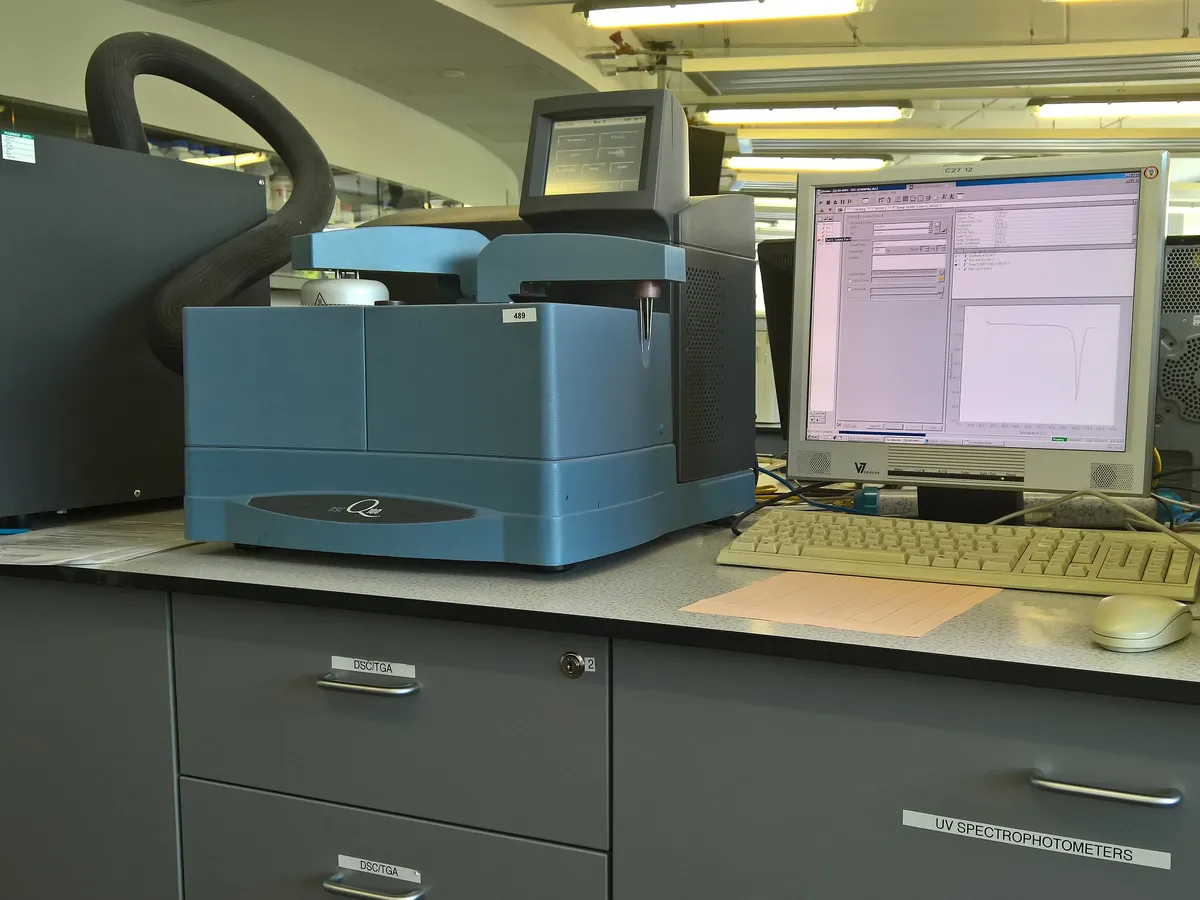
What is DSC?
In a DSC, a few milligrams of sample are sealed in a small metal pan and placed in a furnace next to an empty reference pan. Both pans are heated at the same programmed rate. When the sample melts, crystallises or changes form, it absorbs or releases heat, and the instrument records the difference in heat flow between the two pans.
The result is a thermogram: heat flow plotted against temperature. Melting appears as an endothermic peak, crystallisation as an exothermic peak, and a glass transition as a step in the baseline. The peak onset gives the transition temperature and the peak area gives the enthalpy (in J/g).
In pharmaceutical work DSC is used to characterise APIs and excipients, detect polymorphs and solvates, study drug–excipient compatibility, measure purity by the van 't Hoff method and support stability studies.
Used for
- Melting point and enthalpy of fusion of APIs
- Polymorph and solvate screening
- Glass transition of amorphous materials and polymers
- Drug–excipient compatibility studies
- Purity estimation of highly pure crystalline substances
- Characterisation of lipids and solid dispersions
How it works
- 01
Weigh & seal
Weigh 2–5 mg of sample into a pan and crimp the lid.
- 02
Load
Place the sample pan and an empty reference pan on the sensor.
- 03
Purge
Flow dry nitrogen through the cell at a steady rate.
- 04
Heat
Heat at a programmed rate, commonly 10 °C/min.
- 05
Record
The instrument records heat flow against temperature.
- 06
Evaluate
Determine onset, peak temperature and peak area (enthalpy).
Advantages
- Needs only 1–10 mg of sample
- Measures both temperature and energy of transitions
- Detects transitions that cannot be seen by eye, such as glass transitions
- Fast and highly sensitive
Limitations
- Results depend on heating rate, pan type, sample mass and purge gas
- Overlapping events (for example melting with decomposition) are hard to interpret alone
- Needs regular calibration and careful baseline handling
- Does not identify what a transition is; other techniques (TGA, XRPD, microscopy) are often needed
1 calibration procedure
Keep every DSC in control: usage logs, calibration and maintenance schedules, and automatic blocking of overdue instruments.