Differential Scanning Calorimeter (DSC)
Measures the heat flowing into or out of a small sample compared with an empty reference pan while both are heated or cooled. It shows melting, crystallisation, glass transitions and polymorphic changes.
- Pharmaceutical
- Polymers and plastics
- Food
- Materials research
- Chemicals
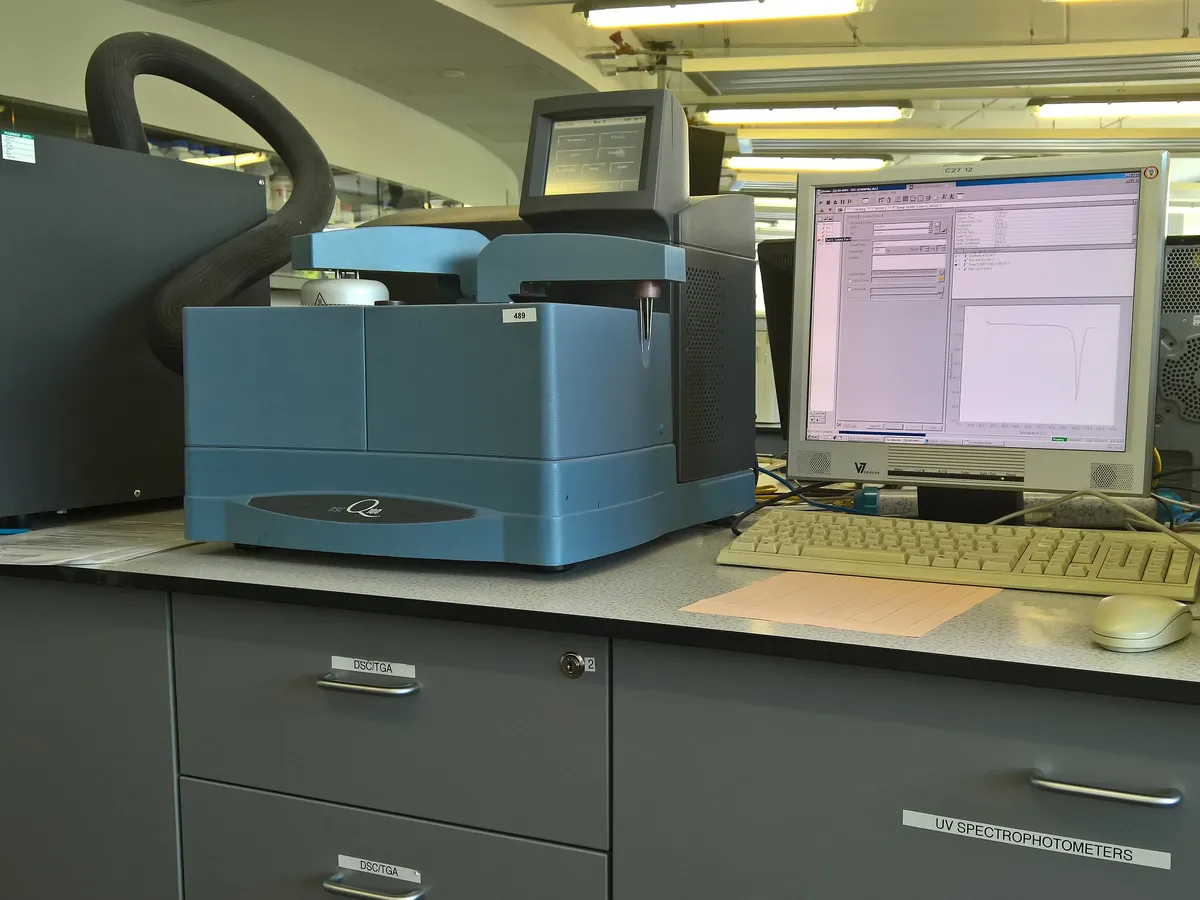
How DSC works
In heat-flux DSC the sample and reference pans sit on a sensor in the same furnace. The temperature difference between them is measured and converted to a heat-flow difference using a calibration. When the sample undergoes an endothermic event such as melting, it lags behind the reference and the signal shows a peak. The area of the peak is proportional to the enthalpy of the event.
The path of a sample
- 01
Weigh & seal
Weigh 2–5 mg of sample into a pan and crimp the lid.
- 02
Load
Place the sample pan and an empty reference pan on the sensor.
- 03
Purge
Flow dry nitrogen through the cell at a steady rate.
- 04
Heat
Heat at a programmed rate, commonly 10 °C/min.
- 05
Record
The instrument records heat flow against temperature.
- 06
Evaluate
Determine onset, peak temperature and peak area (enthalpy).
Main parts and what they do
Furnace / cell
Small, low-mass furnace that heats and cools the sample and reference uniformly.
Heat-flux sensor
Thermocouple or thermopile sensor under each pan that measures the temperature difference.
Sample and reference pans
Aluminium pans for most work (up to about 600 °C); hermetic, vented or high-pressure pans for special cases.
Crimper press
Seals the lid onto the pan.
Purge gas system
Delivers dry nitrogen (typically 20–50 mL/min) to keep the cell inert and dry.
Cooling accessory
Intracooler or liquid nitrogen system for sub-ambient work and fast cooling.
Autosampler (optional)
Loads pans automatically for unattended runs.
Software
Controls the temperature programme, records data and evaluates onset, peak and enthalpy with an audit trail.
Terms every analyst should know
Endotherm and exotherm
Endothermic events (melting, evaporation) absorb heat; exothermic events (crystallisation, decomposition) release it.
Onset temperature
The intersection of the baseline with the tangent to the leading edge of the peak. For pure substances it is the reported melting temperature.
Enthalpy of fusion (ΔH)
Heat absorbed per gram during melting, calculated from the peak area. Indium's is about 28.45 J/g.
Glass transition (Tg)
A step change in heat capacity when an amorphous solid becomes rubbery. It shows as a baseline shift, not a peak.
Polymorphism
Different crystal forms of the same compound can have different melting points and enthalpies, which DSC can reveal.
Heating rate effect
Faster heating gives larger signals but poorer resolution and shifts peaks to higher temperatures.
Keep every DSC in control: usage logs, calibration and maintenance schedules, and automatic blocking of overdue instruments.