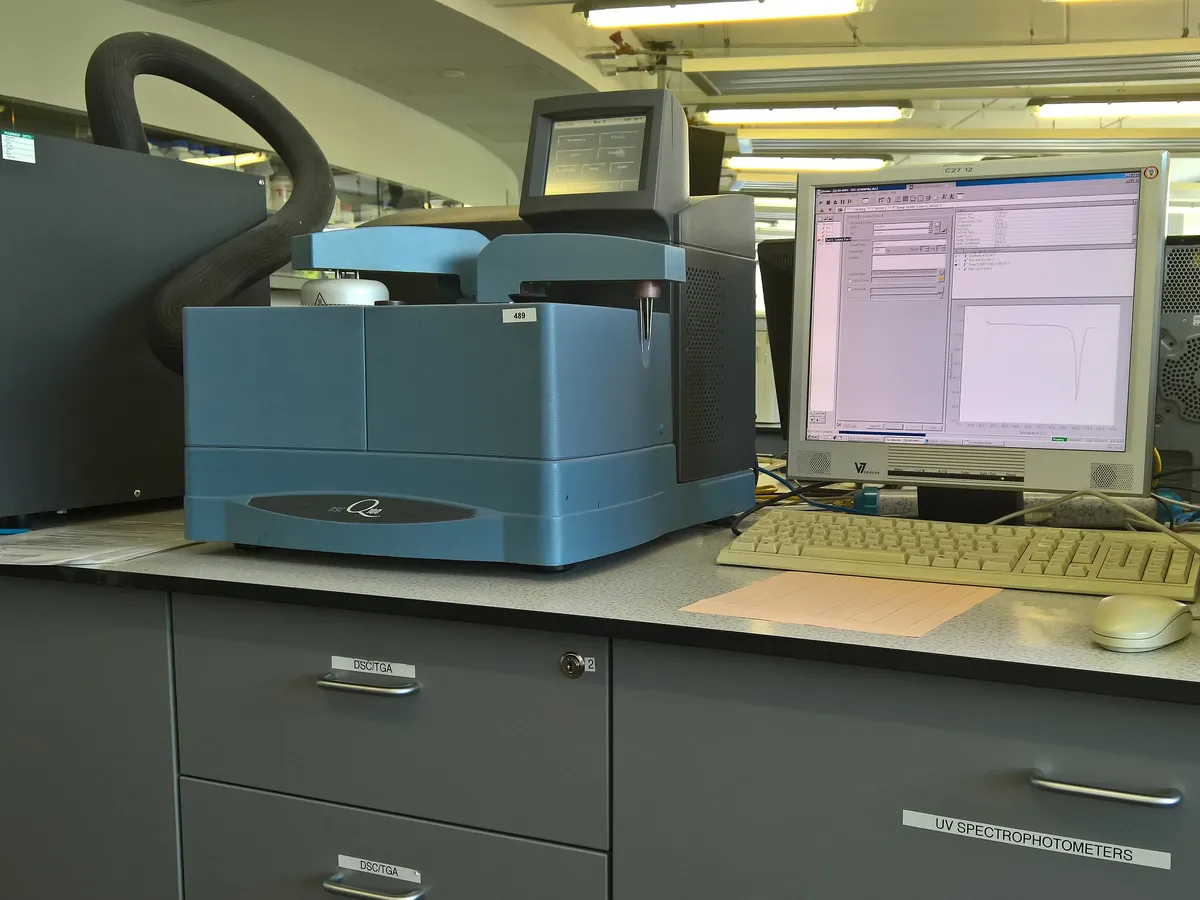
Differential Scanning Calorimeter (DSC)
Measures the heat flowing into or out of a small sample compared with an empty reference pan while both are heated or cooled. It shows melting, crystallisation, glass transitions and polymorphic changes.
- Pharmaceutical
- Polymers and plastics
- Food
- Materials research
- Chemicals
Test your DSC knowledge
Multiple-choice questions
Pick an answer to see whether you are right and why.
Q1. What does a DSC measure?
basicQ2. Which standard is most commonly used to calibrate DSC temperature and enthalpy?
basicQ3. On a DSC thermogram, how does a glass transition appear?
intermediateQ4. Which value from a DSC melting peak is normally reported as the melting temperature of a pure substance?
intermediateQ5. Indium gives a measured enthalpy of 28.21 J/g against a certified 28.45 J/g. What is the % error?
intermediateQ6. A DSC shows an endotherm at 110 °C that TGA shows is accompanied by a 5% mass loss. What is the most likely event?
advancedQ7. What happens to a DSC melting peak when the heating rate is increased?
advanced
Viva questions
Think of your answer first, then open it to compare.
1. What is the difference between an endothermic and an exothermic event? Give examples.
Endothermic events absorb heat, such as melting and evaporation. Exothermic events release heat, such as crystallisation and many decompositions.
2. How is DSC used to study polymorphism?
Different polymorphs usually melt at different temperatures and with different enthalpies. DSC can show separate melting peaks, transitions between forms, or recrystallisation, which are then confirmed by XRPD.
3. Why should the indium calibration use the same heating rate, pan type and purge gas as routine methods?
Thermal lag and heat transfer depend on these conditions. Calibrating under the same conditions makes sure the correction applied is valid for the routine measurements.
Keep every DSC in control: usage logs, calibration and maintenance schedules, and automatic blocking of overdue instruments.