Atmospheric Distillation Apparatus
Distils 100 mL of a fuel from a flask at a controlled rate and records the vapour temperature as each volume is collected. The resulting curve (IBP, T10, T50, T90, FBP) describes how the fuel evaporates.
- Petroleum refining
- Fuel terminals and retail quality control
- Aviation fuel quality
- Solvent manufacture
- Independent testing laboratories
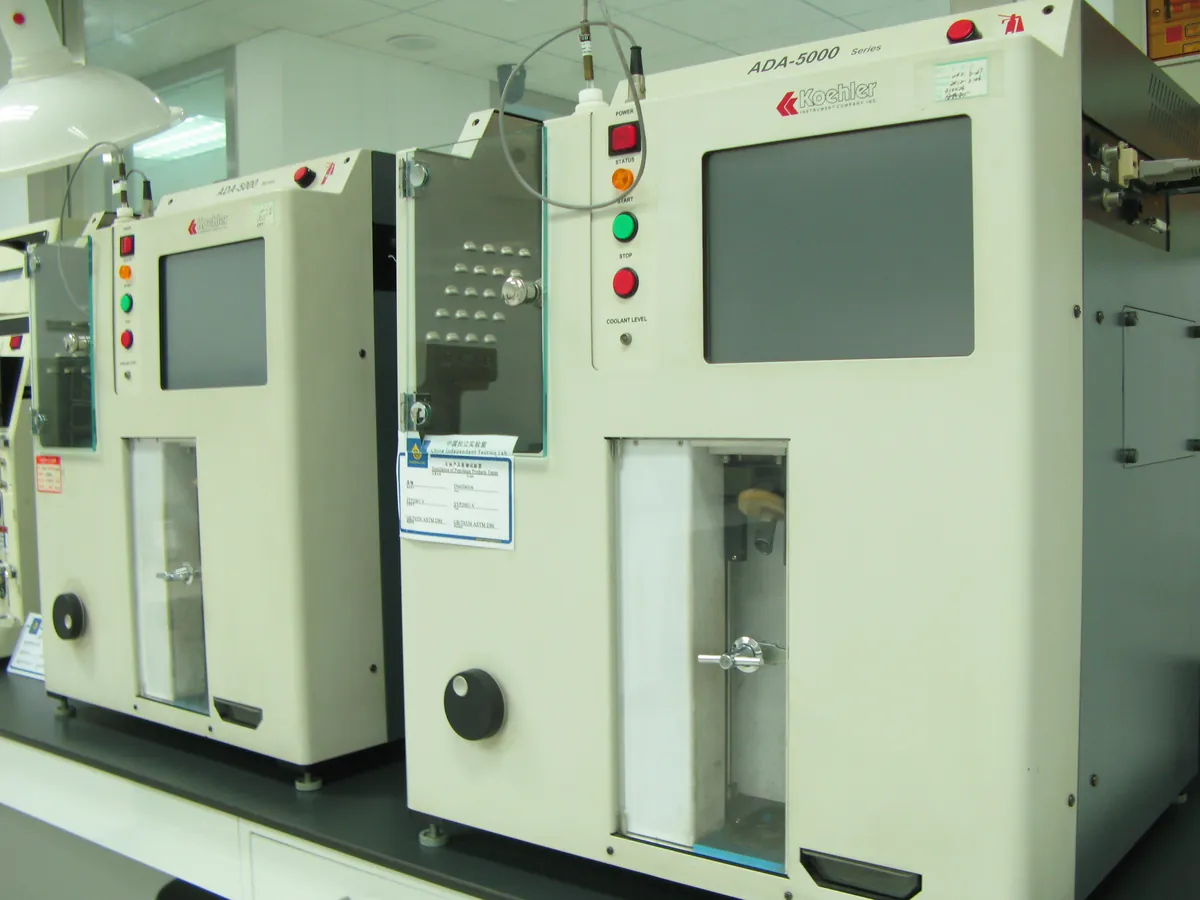
What is Distillation unit?
Fuels are mixtures of hundreds of hydrocarbons with different boiling points, so they boil over a range of temperatures rather than at one point. The atmospheric distillation test (ASTM D86, ISO 3405, IS 1448 Part 18) measures this boiling range. A 100 mL sample is heated in a flask, the vapour is condensed in a cooled tube and collected in a graduated cylinder, and the vapour temperature is recorded at each recovered volume.
The key points are the initial boiling point (IBP, first drop from the condenser), the temperatures at which 10%, 50% and 90% have been recovered (T10, T50, T90), and the final boiling point (FBP, the highest temperature). The volumes of residue left in the flask and of loss (vapour that escapes) are also reported. Specifications for petrol, jet fuel, kerosene and diesel set limits on these values because they control cold starting, vapour lock, warm-up, deposits and smoke.
Manual units use a gas or electric heater and a mercury-in-glass or electronic thermometer, with the operator reading volumes by eye. Automatic analysers track the receiver level with an optical follower, control the heating to keep the distillation rate in range, apply barometric corrections and print the full curve. Because a flammable liquid is boiled near a heater, automatic units include fire detection and extinguishing systems.
Used for
- Distillation curve of petrol (gasoline): T10, T50, T90, FBP and E70/E100 evaporated values
- Distillation of diesel and heating oils: T90 or T95 and recovery at 350 °C / 360 °C
- Boiling range of kerosene, jet fuel (Jet A-1) and aviation gasoline
- Boiling range of naphthas, solvents and petroleum spirits
- Detecting contamination or blending errors between fuel grades
- Input data for calculated cetane index and for refinery process control
How it works
- 01
Charge
100 mL of sample, measured in the receiving cylinder at the specified temperature, is poured into a 125 mL distillation flask.
- 02
Assemble
The temperature sensor is fitted centrally so the top of its bulb is level with the lower edge of the side-arm; the flask is connected to the condenser.
- 03
Heat to IBP
Heat is applied so the first drop falls from the condenser within the time set for the sample group (typically 5–15 minutes). This temperature is the IBP.
- 04
Steady distillation
Heat is adjusted to keep a uniform rate of about 4–5 mL per minute; temperatures are recorded at set volumes (5, 10, 20 … 90, 95 mL).
- 05
End point
When about 5 mL remain in the flask, heat is adjusted so the end point is reached within a set time; the maximum temperature is the FBP.
- 06
Residue and loss
After cooling, the residue in the flask is measured. Loss = 100 − (recovery + residue).
Advantages
- Simple, well-established test with decades of specification data behind it
- Gives a whole curve, not just one number, from a single 100 mL sample
- Automatic analysers control rate and record data, reducing operator effect
- Covers light naphthas to middle distillates in one apparatus with different group conditions
Limitations
- Empirical: the curve is a batch distillation with little fractionation, not true boiling points
- Not suitable for heavy products that crack (decompose) above about 400 °C
- Needs careful sample handling for volatile products (cooling, sealed containers) to avoid losing light ends
- Results must be corrected for barometric pressure and the thermometer lag differences between manual and automatic units
- Takes about 30–45 minutes per sample, plus cooling time
1 calibration procedure
Methods that use Distillation unit
Keep every Distillation unit in control: usage logs, calibration and maintenance schedules, and automatic blocking of overdue instruments.