Distillation Characteristics at Atmospheric Pressure
100 mL of fuel is distilled from a 125 mL flask at a controlled rate. Vapour temperature is recorded against volume recovered to give IBP, T10, T50, T90 and FBP; recovery, residue and loss are measured and the temperatures corrected to 101.3 kPa.
- Petroleum, oil & gas
- Atmospheric distillation
- Distillation unit
Reference: Typical method based on ASTM D86, ISO 3405 and IS 1448 Part 18. Group conditions, timings and corrections follow the current edition.
Why this method works
A fuel is a mixture, so it boils over a range. In a simple batch distillation, the lightest components distil first and the temperature rises as heavier components follow. The vapour temperature at the flask side-arm at each recovered volume describes the volatility of the fuel. Front-end values (IBP, T10) relate to cold starting and vapour lock, mid-range values (T50) to warm-up and driveability, and back-end values (T90, FBP) to deposits, smoke and complete combustion.
Instruments used
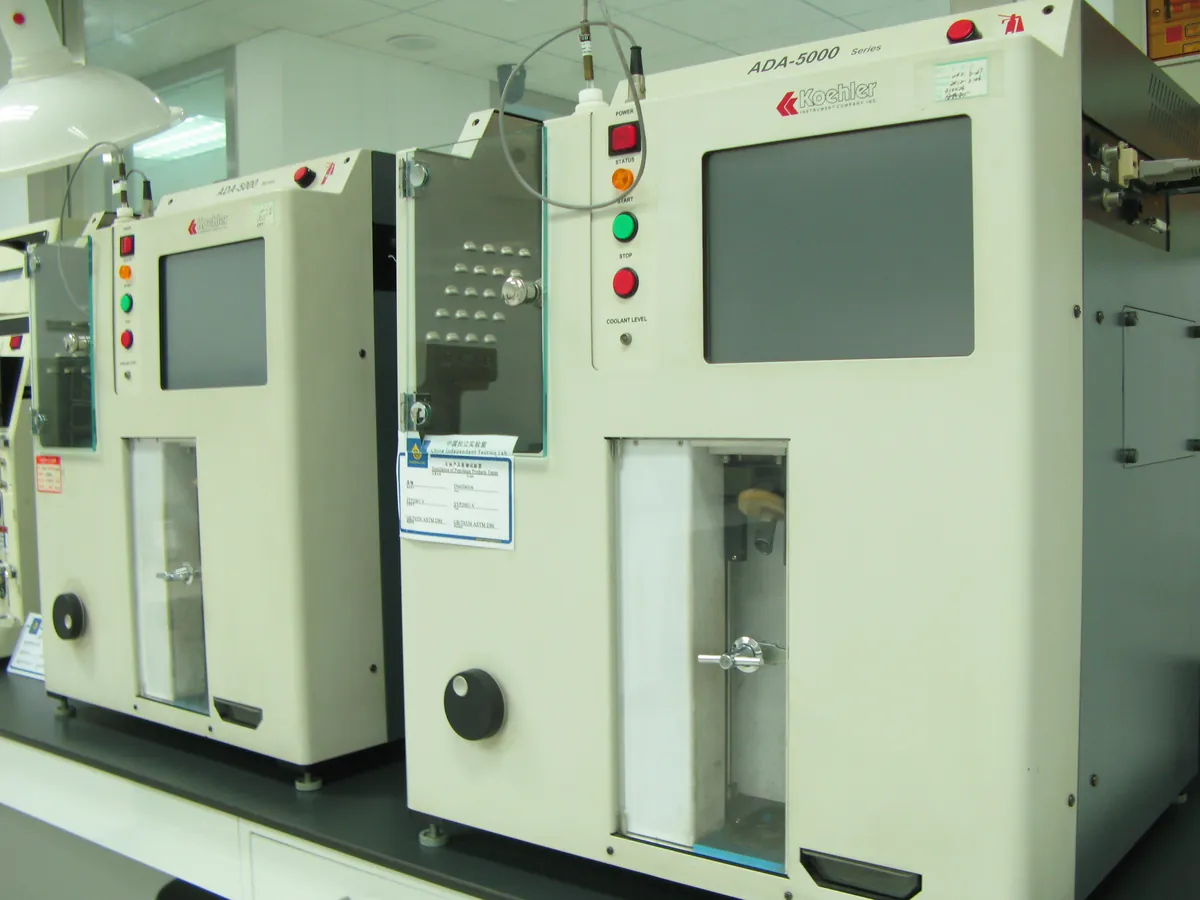
Reagents & standards
| Reagent | Grade / specification |
|---|---|
| Boiling chips | Clean, dry, for samples that may bump |
| Cleaning solvent | Suitable hydrocarbon solvent and acetone for cleaning and drying flasks |
| Check sample | Pure compound (for example toluene) or certified fuel for periodic checks |
Preparing the sample
- 01
Assign group
Decide the D86 group (1–4) from sample type and volatility.
- 02
Condition
Cool volatile samples (petrol) to the group temperature; keep diesel at room temperature.
- 03
Measure 100 mL
Measure in the receiving cylinder at the specified temperature.
- 04
Charge flask
Transfer to the flask; fit sensor and connect condenser.
- 05
Distil
Heat to IBP within the set time, then hold 4–5 mL/min.
Procedure
- 1Assign the sample group: petrol is usually Group 1 or 2 (depending on vapour pressure), kerosene and jet fuel Group 3 or 4 by IBP, diesel Group 4.
- 2For volatile samples, cool the sample bottle, flask and cylinder to the group temperature before opening and measuring.
- 3Set condenser and receiver temperatures for the group and choose the correct flask support board.
- 4Measure 100 mL in the receiving cylinder and pour it into the flask, letting the cylinder drain.
- 5Fit the temperature sensor centrally, top of the bulb level with the lower edge of the side-arm, and connect to the condenser.
- 6Heat so that the first drop falls in the time allowed for the group; record IBP.
- 7Keep a uniform distillation rate of 4–5 mL/min; record temperatures at 5, 10, 20 … 90 and 95 mL as needed.
- 8When about 5 mL remain, make a final heat adjustment so the end point is reached within the allowed time; record FBP.
- 9Allow the receiver to drain; record total recovery. Cool the flask and measure the residue in a small graduated cylinder.
Standard preparation
- 1Run a check sample (for example toluene) at the SOP frequency and confirm its result is within the tolerance in the current method.
Notes for analysts
- Whether temperatures are corrected for barometric pressure depends on the specification and the agreement between parties; D86 allows reporting with or without correction, but the report must say which.
- Per cent evaporated = per cent recovered + loss. Many petrol specifications use evaporated values, which need a loss correction to 101.3 kPa as described in the current D86.
- If the sample decomposes (white fumes, falling temperature), stop the test and report the decomposition point.
- Fire safety: the apparatus boils flammable fuel next to a heater. Never leave it unattended; keep the fire suppression armed and an extinguisher at hand.
Method parameters (typical)
| Sample volume | 100 mL in a 125 mL flask |
|---|---|
| Time to IBP | Typically 5–15 min from start of heating (group dependent) |
| Distillation rate | Uniform 4–5 mL/min from 5% recovered to 5 mL residue |
| End-point time | From 5 mL residue to end point within the time set by the method (typically ≤ 5 min) |
| Condenser temperature | About 0–1 °C for volatile groups; warmer range allowed for Group 4 (as specified) |
| Temperature sensor | ASTM-specified thermometer or electronic sensor with lag correction |
| Barometric pressure | Recorded at time of test, in kPa |
System suitability & sequence
| Parameter | Limit |
|---|---|
| Check sample | Within method tolerance |
| Timing and rate | IBP time, rate and end-point time within the group limits; otherwise repeat |
| Loss | Within the limit for the group (unusually high loss means a leak or poor cooling) |
Typical sequence
- 1Check sample
- 2Samples in order of group
- 3Check sample at the end of a long run
Calculation with a worked example
Where
- R
- Maximum volume recovered in the receiver (mL, = % of 100 mL)
- Rs
- Residue volume measured after cooling (mL)
- L
- Loss (mL, = %)
- tc
- Observed temperature reading (°C)
- Pk
- Barometric pressure at time of test (kPa)
- Cc
- Correction to add to tc (°C)
Given
- Sample
- Diesel, Group 4
- Observed IBP / T10 / T50 / T90 / FBP
- 172.0 / 208.5 / 268.0 / 335.5 / 358.0 °C
- Recovery R
- 97.5 mL
- Residue Rs
- 1.3 mL
- Barometric pressure Pk
- 99.0 kPa
Working
- 1
Total recovery = 97.5 + 1.3 = 98.8%
- 2
Loss = 100 − 98.8 = 1.2%
- 3
101.3 − 99.0 = 2.3 kPa
- 4
IBP: Cc = 0.0009 × 2.3 × (273 + 172.0) = 0.92 → 172.9 °C
- 5
T10: Cc = 0.0009 × 2.3 × 481.5 = 1.00 → 209.5 °C
- 6
T50: Cc = 0.0009 × 2.3 × 541.0 = 1.12 → 269.1 °C
- 7
T90: Cc = 0.0009 × 2.3 × 608.5 = 1.26 → 336.8 °C
- 8
FBP: Cc = 0.0009 × 2.3 × 631.0 = 1.31 → 359.3 °C
Corrected: IBP 172.9 °C, T10 209.5 °C, T50 269.1 °C, T90 336.8 °C, FBP 359.3 °C; recovery 97.5%, residue 1.3%, loss 1.2%
What result passes
- Compare with the product specification. For example, ASTM D975 No. 2-D diesel sets T90 between 282 °C and 338 °C, so the T90 above (336.8 °C) passes but is close to the limit; EN 590 and IS 1460 instead set recovery limits at 250, 350 and 360 °C — check the current edition.
- Petrol specifications typically limit T10, T50, T90, FBP and residue, or the per cent evaporated at 70, 100 and 150 °C.
Validation parameters (ICH Q2(R2))
| Parameter | Typical requirement |
|---|---|
| Trueness | Check sample or certified fuel within tolerance |
| Precision | Repeatability and reproducibility from the current D86 tables, which depend on the group and on the slope of the curve |
| Comparability | Automatic analyser shown to agree with the manual method (lag correction) |
Run this method in LimsPulse: specifications and STPs under version control, results calculated and checked against limits, and a signed Certificate of Analysis.