Yeast and Mould Count in Food (Spread Plate)
Counts viable yeasts and moulds in a food by spreading 0.1 mL of decimal dilutions on Dichloran Rose Bengal Chloramphenicol (DRBC) agar or Dichloran 18% Glycerol (DG18) agar, incubating at 25 °C for 5 days and counting colonies. The result shows spoilage risk and the hygiene of handling and storage.
- Food & beverage
- Spread plate on DRBC agar (aw > 0.95) or DG18 agar (aw ≤ 0.95), 25 °C
- LAF
- Autoclave
- Incubator
- Colony counter
- Analytical balance
- Water bath
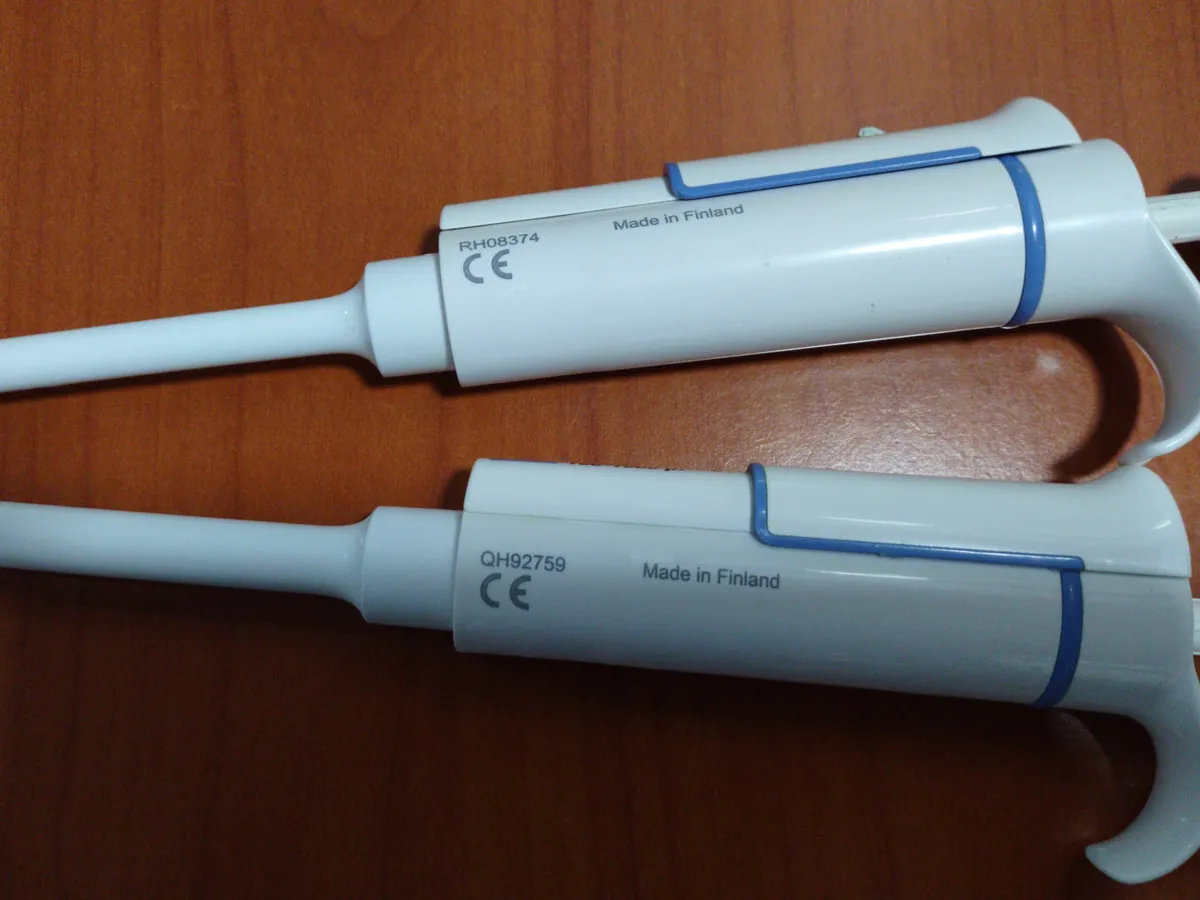
- Micropipette
Reference: Typical method based on ISO 21527-1 (products with water activity > 0.95) and ISO 21527-2 (water activity ≤ 0.95), with ISO 7218 and ISO 6887. Always follow the current editions and your validated SOP.
Why this method works
Chloramphenicol in the media suppresses bacteria. Dichloran and rose bengal restrict the spread of fast-growing moulds so that separate colonies can be counted. For dry foods (water activity ≤ 0.95), DG18 contains glycerol to lower water activity, which supports xerophilic moulds and avoids osmotic shock. Surface (spread) plating gives moulds air for growth and spore formation and avoids heat damage from molten agar. Each yeast cell or mould propagule (spore or hyphal fragment) that grows forms one colony, counted as a cfu.
Instruments used
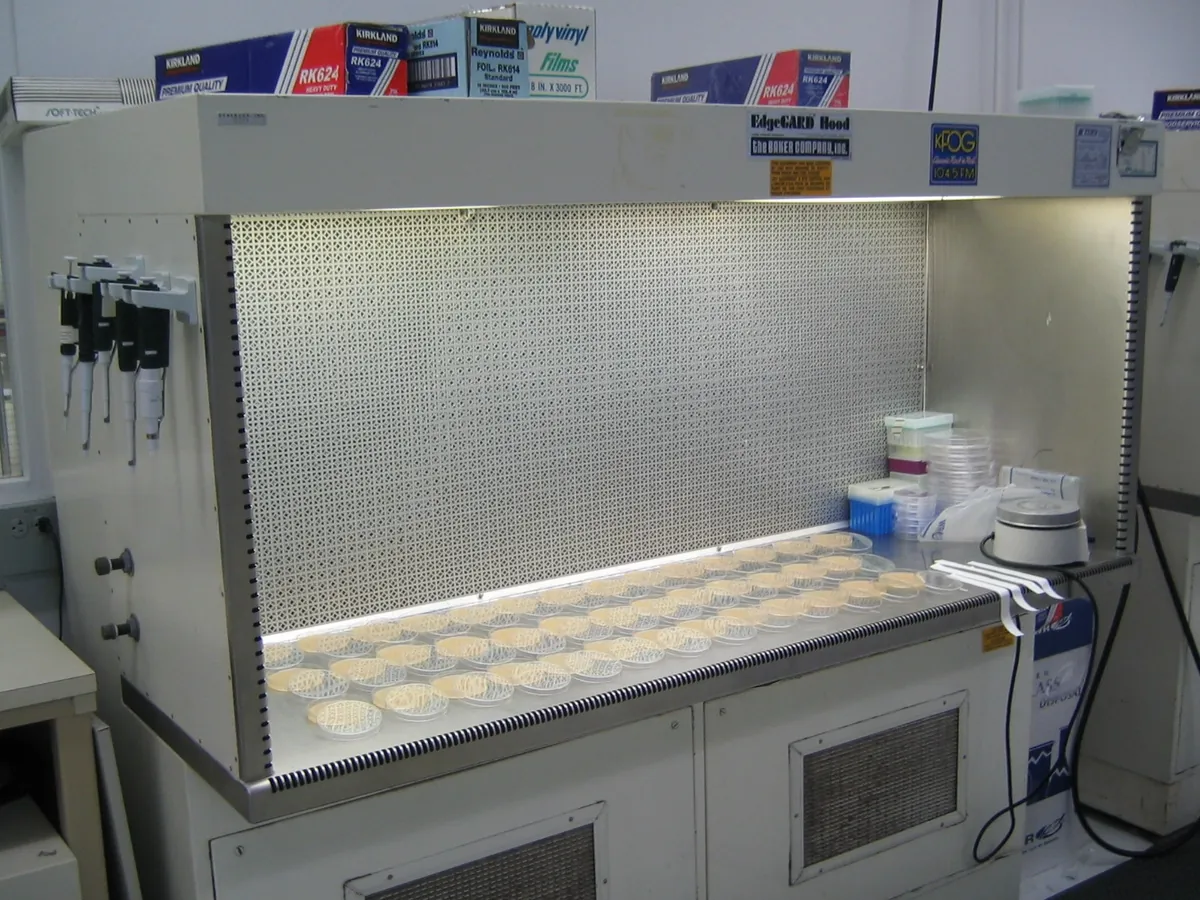
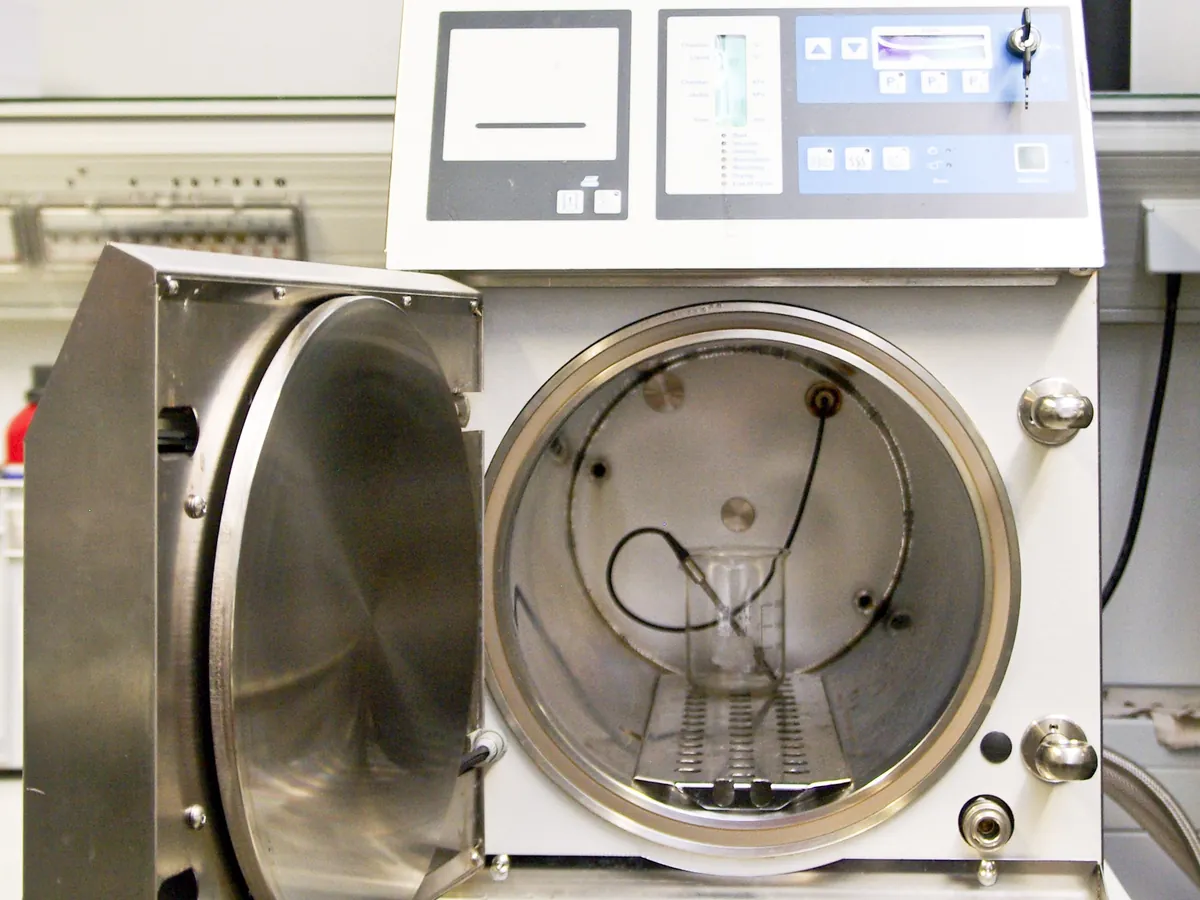


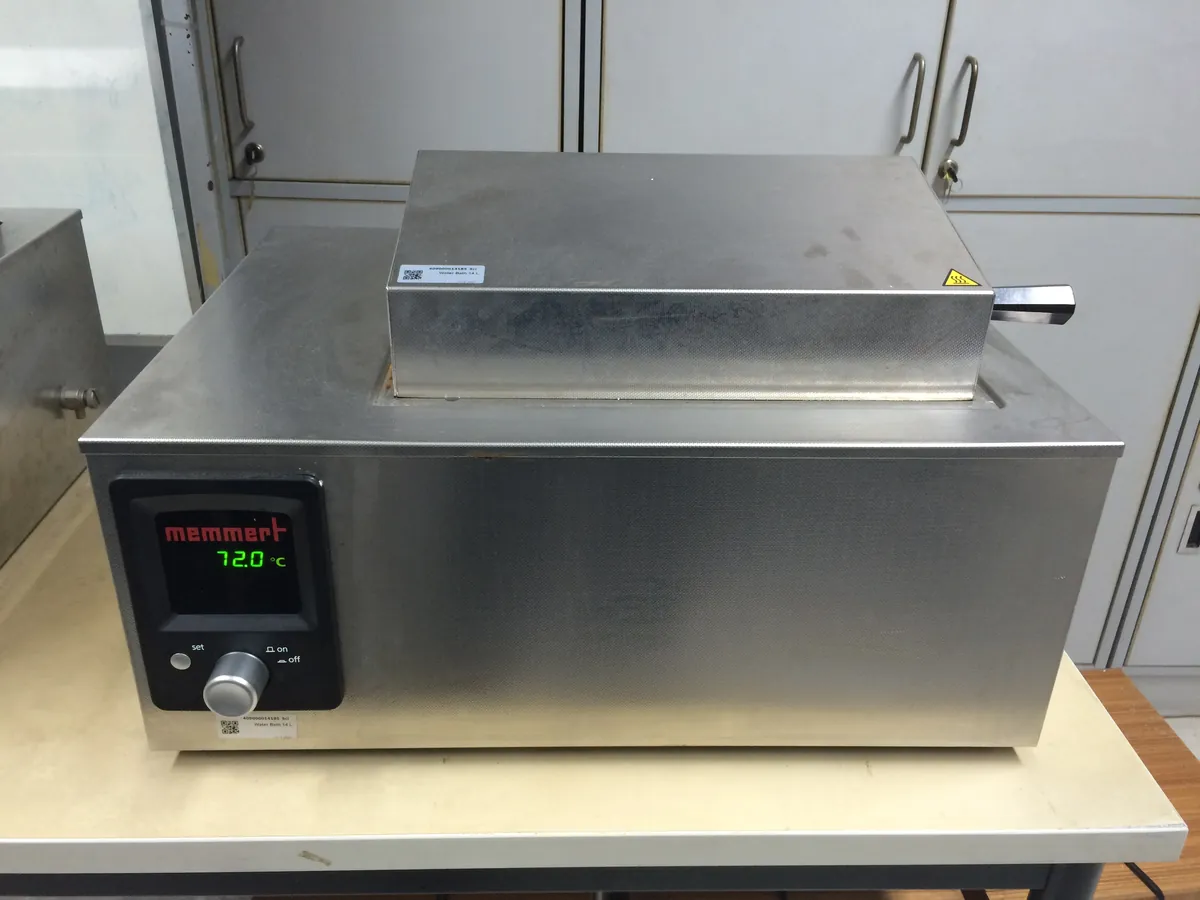
Reagents & standards
| Reagent | Grade / specification |
|---|---|
| DRBC agar | Dichloran Rose Bengal Chloramphenicol agar for foods with aw > 0.95; protect poured plates from light (rose bengal forms inhibitory products in light) |
| DG18 agar | Dichloran 18% Glycerol agar with chloramphenicol, for foods with aw ≤ 0.95 |
| Diluent | Peptone water or buffered peptone water as per ISO 6887; a wetting agent may be added for powders or mouldy foods if the SOP allows |
| Sterile spreaders | Glass or disposable L-shaped spreaders |
| Control strains for media performance | Yeast and mould reference strains and a bacterial strain for selectivity, as listed in ISO 11133 |
Preparing the sample
- 01
Choose medium
Use DRBC for moist foods (aw > 0.95) and DG18 for dry foods (aw ≤ 0.95).
- 02
Pre-dry plates
Use plates with dry surfaces so the 0.1 mL inoculum absorbs quickly.
- 03
Initial suspension
Homogenise 10 g in 90 mL diluent (10^-1); make further dilutions.
- 04
Spread
Spread 0.1 mL of each dilution over the agar surface, in duplicate.
- 05
Incubate upright
Incubate at 25 °C for 5 days, plates upright and undisturbed.
- 06
Count
Count yeast and mould colonies and calculate cfu/g.
Procedure
- 1Pour DRBC or DG18 plates (about 15 mL) in advance and dry the surface so no visible moisture remains. Store DRBC plates in the dark.
- 2Prepare the 10^-1 initial suspension and further decimal dilutions as per ISO 6887, working in a laminar air flow cabinet. Mix each dilution well just before plating, as mould spores settle quickly.
- 3Pipette 0.1 mL of each chosen dilution onto the centre of two plates and spread it evenly over the whole surface with a sterile spreader until absorbed.
- 4Incubate the plates upright (not inverted) at 25 ± 1 °C for 5 days. Do not stack or move plates often, because disturbance spreads mould spores and creates satellite colonies.
- 5Examine plates after 2 days and record counts of any fast-spreading moulds in case later counting becomes impossible; make the final count after 5 days.
- 6Count plates with not more than 150 colonies. Yeast and mould colonies may be counted separately if required; moulds are usually fuzzy or filamentous, yeasts smooth and moist.
- 7Handle mould plates with care and keep lids closed during counting to avoid releasing spores into the laboratory.
Standard preparation
- 1Media performance: test each batch of DRBC or DG18 with yeast, mould and bacterial reference strains as described in ISO 11133.
- 2Medium sterility: incubate an uninoculated plate from each batch with the run.
- 3Spreading technique: analysts demonstrate even spreading and recovery on control cultures as part of training and competence records.
Notes for analysts
- The catalogue lists this method as a spread plate. Some laboratories use pour plates for yeasts and moulds; ISO 21527 specifies surface spreading.
- Mould counts depend strongly on how much the sample was homogenised, because breaking hyphae creates more propagules; keep homogenisation time consistent.
- Heat-resistant moulds and preservative-resistant yeasts need special methods that are outside this routine count.
- The worked example values are illustrative.
Method parameters (typical)
| Test portion and initial dilution | 10 g in 90 mL diluent (1:10) |
|---|---|
| Medium, aw > 0.95 | DRBC agar (ISO 21527-1) |
| Medium, aw ≤ 0.95 | DG18 agar (ISO 21527-2) |
| Inoculum | 0.1 mL per plate, spread on the surface |
| Incubation | 25 ± 1 °C, 5 days, aerobic, plates upright |
| Countable range | Not more than 150 colonies per plate |
| Lowest reportable count | Less than 100 cfu/g when no colonies grow on 0.1 mL of 10^-1 |
| Reporting | cfu/g or cfu/mL, two significant figures; yeasts and moulds together or separately |
System suitability & sequence
| Parameter | Limit |
|---|---|
| Medium sterility control | No growth on uninoculated plate |
| Diluent sterility control | No growth from 0.1 mL diluent spread on the medium |
| Selectivity | Bacterial control strain inhibited during media performance testing |
| Environment | LAF settle plate within limits; mould contamination of the lab is a known risk |
Typical sequence
- 1Medium sterility control
- 2Diluent sterility control
- 3Sample 10^-1, duplicate plates
- 4Sample 10^-2, duplicate plates
- 5Further dilutions for heavily contaminated foods
- 6LAF settle plate during plating
Calculation with a worked example
Where
- N
- Yeast and mould count, cfu per g or mL
- ΣC
- Sum of colonies on the retained plates
- V
- Volume spread per plate, mL (0.1 mL)
- n
- Number of plates retained at that dilution
- d
- Dilution of the retained plates (e.g. 10^-1); dilution factor = 1 ÷ d
Given
- Food
- Fruit yoghurt (aw > 0.95, DRBC agar)
- Volume spread
- 0.1 mL per plate
- 10^-1 plates
- 34 and 28 colonies
- 10^-2 plates
- No colonies
Working
- 1Only the 10^-1 plates have colonies, so a single-dilution calculation applies.
- 2
ΣC = 34 + 28 = 62 colonies; n = 2; V = 0.1 mL; d = 0.1
- 3N = 62 ÷ (0.1 × 2 × 0.1) = 62 ÷ 0.02 = 3,100 cfu/g
- 4Check with the calculator form: mean = 31 colonies; 31 ÷ 0.1 mL × 10 = 3,100 cfu/g
Yeast and mould count = 3.1 × 10^3 cfu/g.
Try it with your numbersWhat result passes
- Compare with the product specification or applicable standard (for example FSSAI microbiological standards for the product category). Limits are product-specific.
- If no colonies grow on the 10^-1 plates (0.1 mL spread), report less than 100 cfu/g.
- When two successive dilutions both give countable plates, use the weighted mean formula N = ΣC ÷ (V × (n1 + 0.1 n2) × d) with V = 0.1 mL.
- Rising yeast and mould counts in a product over shelf-life studies point to spoilage risk, packaging or storage problems.
Validation parameters (ICH Q2(R2))
| Parameter | Typical requirement |
|---|---|
| Method status | ISO 21527-1 and ISO 21527-2 are reference methods; verify in-house |
| Medium choice | Confirm the water activity of the product to choose DRBC or DG18 |
| Precision | Expect wider variation than bacterial counts, because mould colonies may arise from single spores or from clumps of hyphae |
| Proficiency testing | Regular participation for yeast and mould enumeration |
Run this method in LimsPulse: specifications and STPs under version control, results calculated and checked against limits, and a signed Certificate of Analysis.