Viscometer / rheometer
Measures how thick a liquid is, that is its resistance to flow (viscosity). Used for syrups, suspensions, gels, creams and polymer solutions.
- Pharmaceutical
- Cosmetics
- Food & beverage
- Paints & coatings
- Polymers
- Petrochemicals
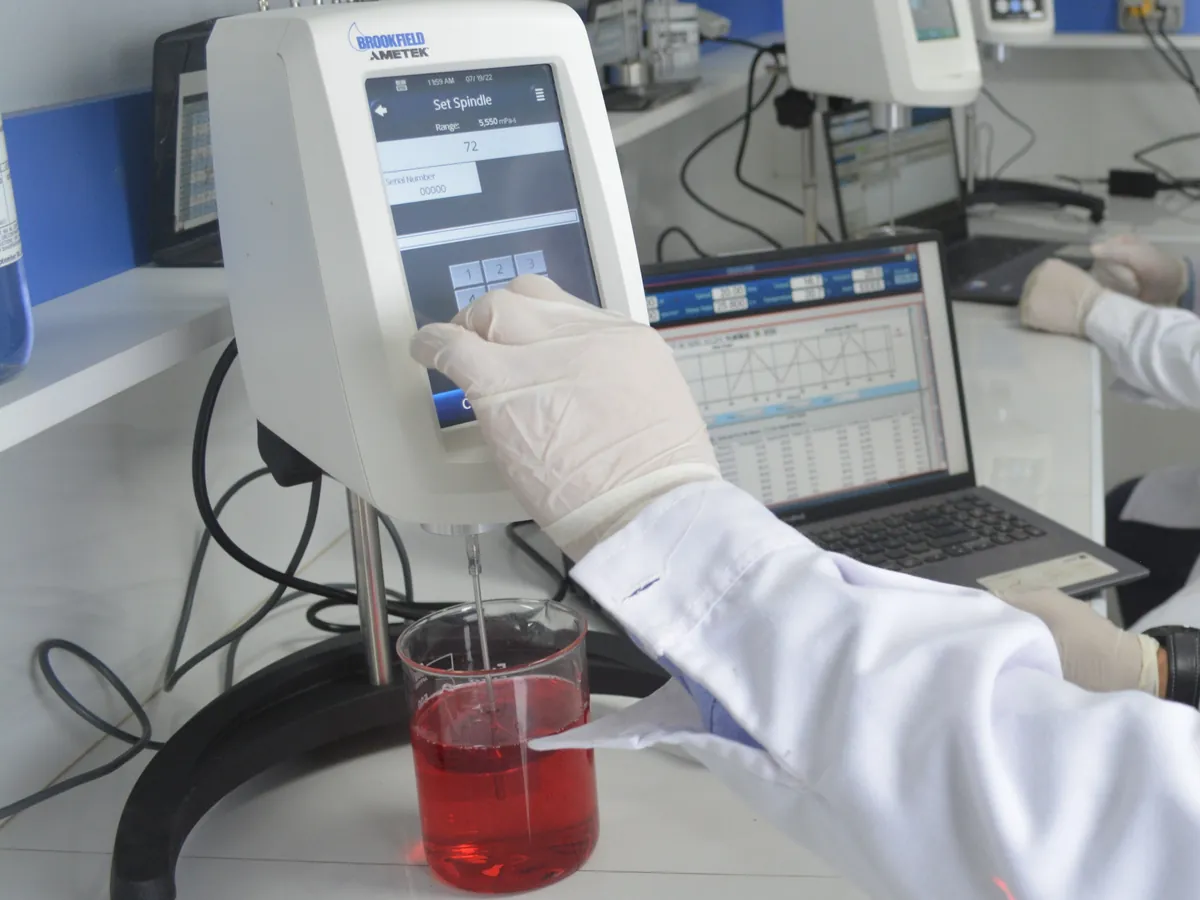
What is Viscometer?
Viscosity describes how easily a liquid flows. Water flows easily and has a low viscosity (about 1 mPa·s at 20 °C); honey flows slowly and has a high viscosity. In pharma, viscosity affects how a syrup pours, how well a suspension stays mixed, how a cream spreads and how a gel stays in place.
There are two main instrument types. Capillary (glass) viscometers time how long a fixed volume of liquid takes to flow through a narrow tube; they suit thin, Newtonian liquids. Rotational viscometers turn a spindle in the sample and measure the torque needed; they suit thicker and non-Newtonian products such as suspensions, gels and creams. A rheometer is an advanced rotational instrument that can also measure yield stress, viscoelasticity and flow curves.
The QC lab most often uses a rotational viscometer with a set of spindles and speeds. Because viscosity changes strongly with temperature, the sample is held in a water bath or temperature-controlled jacket during measurement.
Used for
- Viscosity of oral syrups, suspensions and emulsions
- Consistency of creams, ointments and gels
- Viscosity grade of excipients such as HPMC, carbomer and povidone
- Intrinsic or kinematic viscosity of polymer solutions with capillary viscometers
- In-process control of coating suspensions and binder solutions
- Stability testing to detect thickening or thinning over time
How it works
- 01
Condition the sample
The sample is brought to the stated temperature, usually 20 °C or 25 °C, in a water bath or jacket.
- 02
Select spindle and speed
A spindle and speed are chosen so the torque reading falls in the accurate part of the range.
- 03
Rotate
The motor turns the spindle at the set speed in the sample.
- 04
Measure torque
The liquid's resistance deflects a calibrated spring or loads a torque sensor; the percentage of full-scale torque is measured.
- 05
Calculate viscosity
The instrument converts % torque into viscosity using the spindle and speed factor (viscosity = % torque × full-scale range ÷ 100).
- 06
Record
The viscosity, % torque, spindle, speed, temperature and time are recorded.
Advantages
- Rotational instruments cover a very wide range with different spindles and speeds
- Can measure non-Newtonian samples by testing at several speeds
- Quick and simple for routine QC
- Capillary viscometers are cheap and very precise for Newtonian liquids
- Rheometers give full flow and viscoelastic profiles for development work
Limitations
- Strongly temperature dependent; poor temperature control gives large errors
- Results for non-Newtonian samples depend on spindle, speed and time, so conditions must be fixed exactly
- Readings at very low torque are not accurate
- Air bubbles, settling and sample history (shaking, shearing) affect the result
- Capillary viscometers are unsuitable for thick or non-Newtonian samples
2 calibration procedures
Methods that use Viscometer
Keep every Viscometer in control: usage logs, calibration and maintenance schedules, and automatic blocking of overdue instruments.