Viscometer / rheometer
Measures how thick a liquid is, that is its resistance to flow (viscosity). Used for syrups, suspensions, gels, creams and polymer solutions.
- Pharmaceutical
- Cosmetics
- Food & beverage
- Paints & coatings
- Polymers
- Petrochemicals
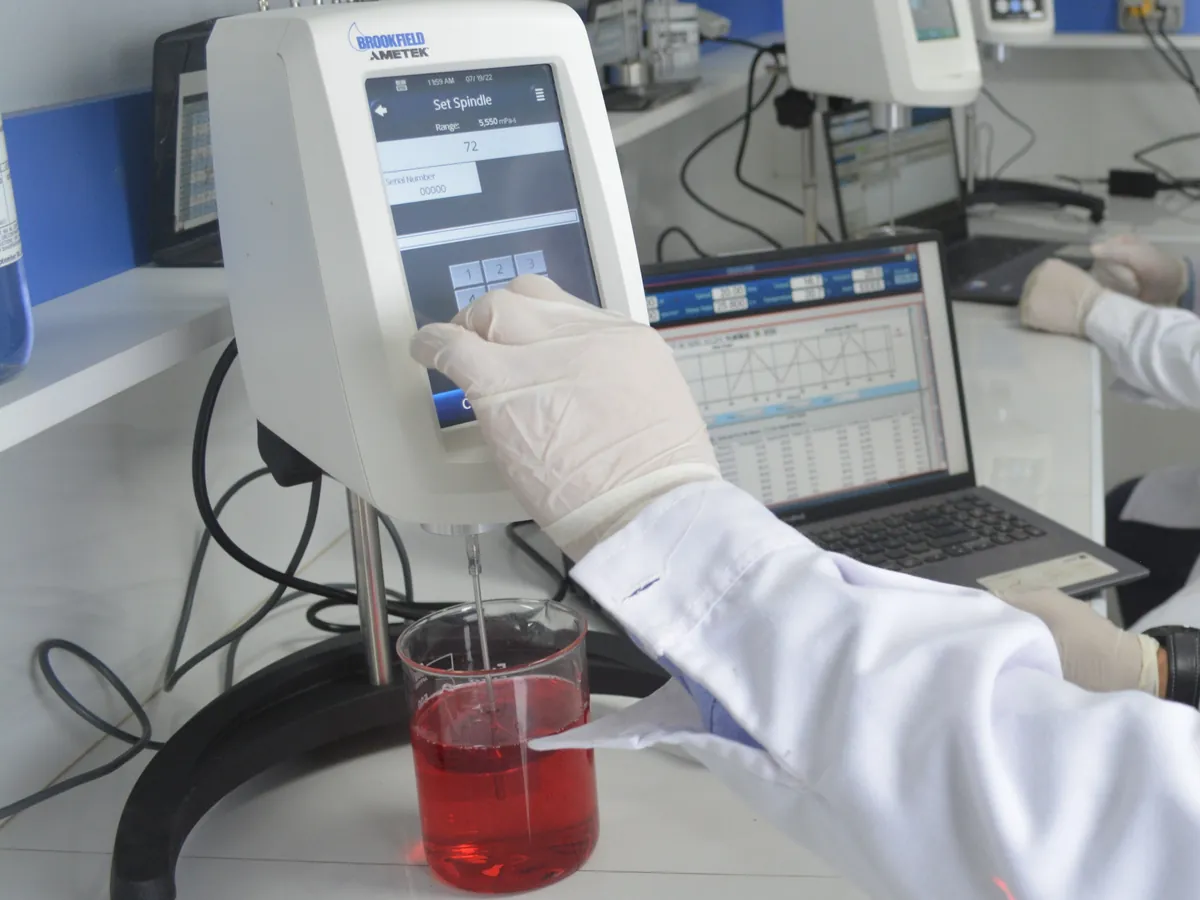
How Viscometer works
A rotational viscometer turns a spindle at a set speed in the sample. The liquid resists the motion, and a calibrated spring or electronic torque sensor measures the torque needed to keep the speed. Viscosity is calculated from the torque, the spindle geometry and the speed. A capillary viscometer instead measures the time a liquid takes to flow between two marks; kinematic viscosity equals the viscometer constant multiplied by the flow time.
The path of a sample
- 01
Condition the sample
The sample is brought to the stated temperature, usually 20 °C or 25 °C, in a water bath or jacket.
- 02
Select spindle and speed
A spindle and speed are chosen so the torque reading falls in the accurate part of the range.
- 03
Rotate
The motor turns the spindle at the set speed in the sample.
- 04
Measure torque
The liquid's resistance deflects a calibrated spring or loads a torque sensor; the percentage of full-scale torque is measured.
- 05
Calculate viscosity
The instrument converts % torque into viscosity using the spindle and speed factor (viscosity = % torque × full-scale range ÷ 100).
- 06
Record
The viscosity, % torque, spindle, speed, temperature and time are recorded.
Main parts and what they do
Motor and drive
Turns the spindle at a precise, selectable speed (rpm).
Torque sensor / calibrated spring
Measures the resistance of the liquid to rotation.
Spindles
Discs, cylinders or T-bars of different sizes. Small spindles for thick samples, large ones for thin samples.
Guard leg
Bracket that protects the spindle and forms part of the measuring geometry for some spindles.
Sample container / small sample adapter
Beaker of specified size, or a jacketed chamber for small volumes and controlled shear rate.
Temperature control
Circulating water bath, jacket or Peltier plate holding the sample at the set temperature, with a probe.
Stand and levelling
Holds the head vertically. The instrument must be level for correct readings.
Display and software
Shows viscosity, % torque, speed, spindle and temperature; records data.
Terms every analyst should know
Dynamic viscosity (η)
Shear stress divided by shear rate. Unit: Pa·s, or mPa·s in practice. 1 mPa·s = 1 centipoise (cP).
Kinematic viscosity (ν)
Dynamic viscosity divided by density. Unit: mm²/s (centistokes). Capillary viscometers measure this.
Newtonian and non-Newtonian
A Newtonian liquid (water, glycerol, simple syrups) has the same viscosity at every shear rate. Most suspensions, gels and creams are non-Newtonian: their viscosity changes with shear rate.
Shear-thinning
Viscosity falls as shear rate increases. Many suspensions pour more easily when shaken; this helps dosing.
Apparent viscosity
The viscosity of a non-Newtonian sample at one particular spindle, speed and time. It is only comparable when these conditions are the same.
% torque
The torque reading as a percentage of the instrument's maximum. Rotational viscometers are most reliable at moderate torque; very low readings carry large relative errors.
Keep every Viscometer in control: usage logs, calibration and maintenance schedules, and automatic blocking of overdue instruments.