Viscometer / rheometer
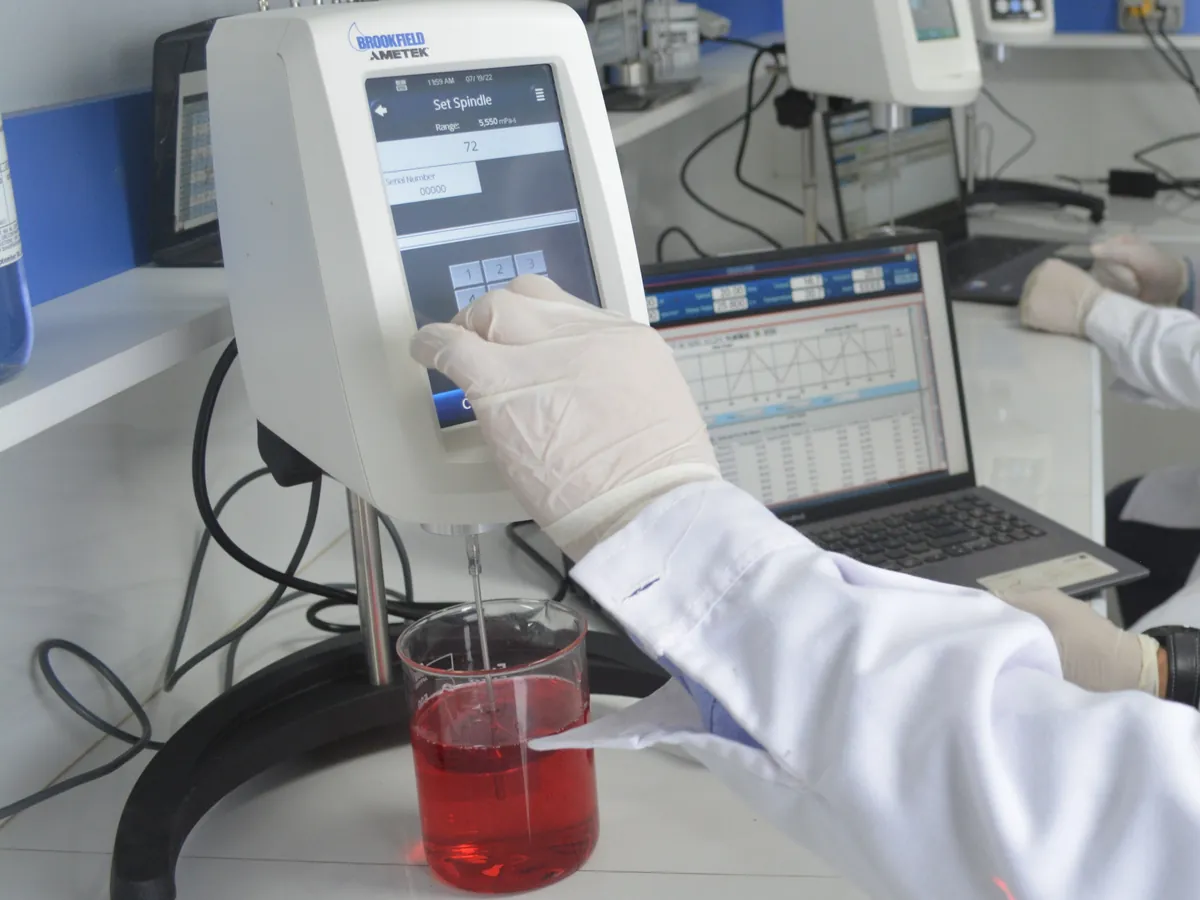
Measures how thick a liquid is, that is its resistance to flow (viscosity). Used for syrups, suspensions, gels, creams and polymer solutions.
- Pharmaceutical
- Cosmetics
- Food & beverage
- Paints & coatings
- Polymers
- Petrochemicals
Test your Viscometer knowledge
Multiple-choice questions
Pick an answer to see whether you are right and why.
Q1. 1 mPa·s is equal to:
basicQ2. Which factor has the biggest effect on the viscosity of a syrup during testing?
basicQ3. A rotational viscometer shows 4% torque. What should you do?
intermediateQ4. A suspension's viscosity falls as spindle speed increases. It is:
intermediateQ5. What type of material is used to calibrate a rotational viscometer?
intermediateQ6. Kinematic viscosity is:
advancedQ7. Why is the spindle immersed at an angle before attaching it?
basic
Viva questions
Think of your answer first, then open it to compare.
1. What is the difference between a Newtonian and a non-Newtonian liquid?
A Newtonian liquid has the same viscosity at every shear rate, for example water or glycerol. A non-Newtonian liquid's viscosity changes with shear rate and sometimes with time, for example suspensions, gels and creams.
2. Why must the spindle, speed and reading time be fixed in the method for a suspension?
The suspension is non-Newtonian, so its apparent viscosity depends on shear rate (set by spindle and speed) and on how long it has been sheared. Different conditions give different numbers, so results are only comparable under the same conditions.
3. When would you choose a capillary viscometer over a rotational one?
For thin, Newtonian liquids such as solvents or dilute polymer solutions, where high precision is needed (for example intrinsic viscosity of povidone). Capillary viscometers are not suitable for thick or non-Newtonian samples.
Keep every Viscometer in control: usage logs, calibration and maintenance schedules, and automatic blocking of overdue instruments.