Thin-Layer Chromatography (TLC)
Separates compounds as a solvent climbs up a thin layer of adsorbent on a glass, aluminium or plastic plate. Simple and cheap; used in pharma QC mainly for identification and limit tests for related substances.
- Pharmaceutical
- Herbal & natural products
- Chemicals
- Forensic
- Education
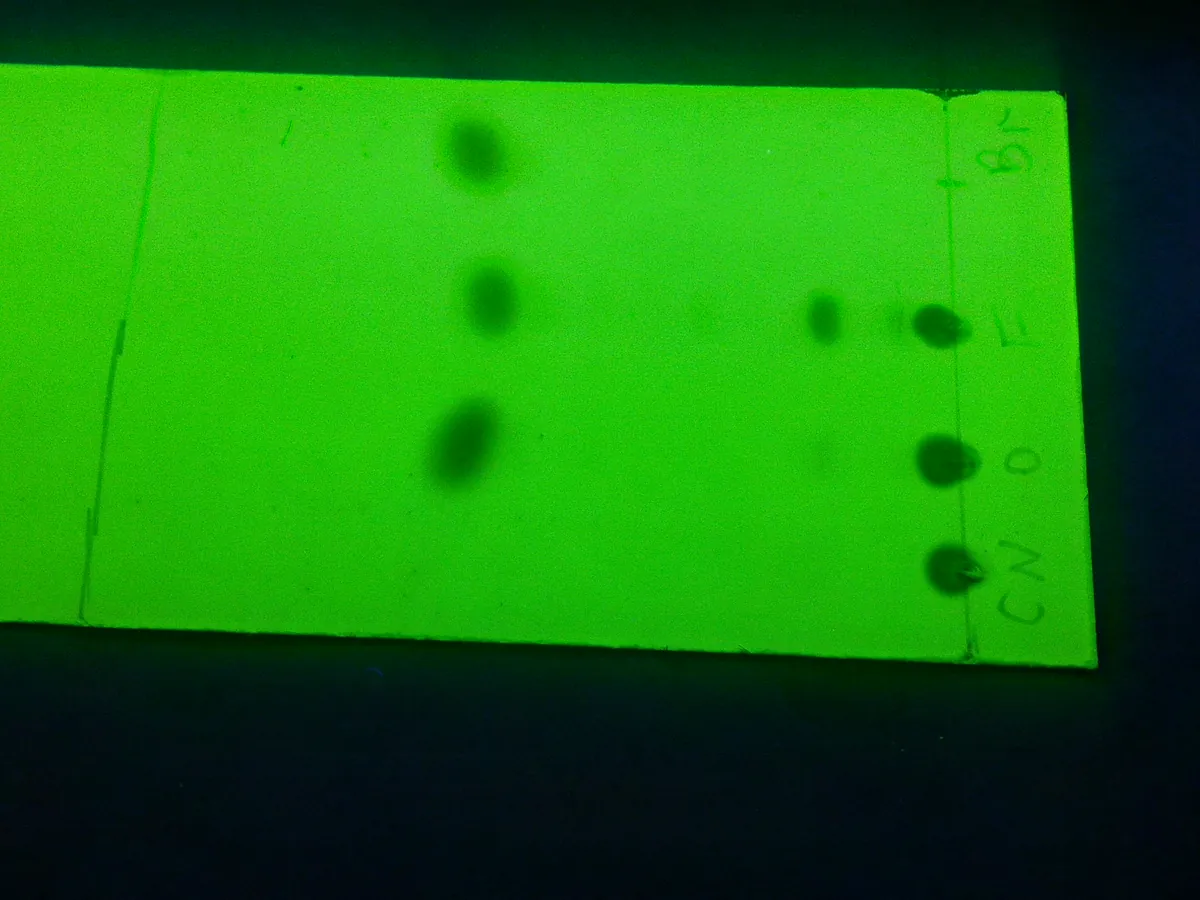
Test your TLC knowledge
Multiple-choice questions
Pick an answer to see whether you are right and why.
Q1. A spot moves 4.2 cm from the origin and the solvent front moves 8.0 cm. What is the Rf value?
basicQ2. Why is the starting line on a TLC plate drawn in pencil, not ink?
basicQ3. On a silica gel plate, which compound will usually have the lowest Rf?
intermediateQ4. What is the purpose of lining the TLC tank with filter paper and closing it before development?
intermediateQ5. On a silica gel 60 F254 plate viewed at 254 nm, a UV-absorbing compound appears as:
advanced
Viva questions
Think of your answer first, then open it to compare.
1. How do you calculate an Rf value, and why do you always run the reference standard on the same plate?
Rf = distance from the origin to the centre of the spot ÷ distance from the origin to the solvent front. For example, a spot at 3.1 cm with the front at 7.5 cm has Rf = 0.41. Rf values change with temperature, humidity, chamber saturation, plate batch and mobile phase age, so identity is confirmed by comparing the sample with a reference developed side by side on the same plate, not with a value from a book.
2. How is TLC used as a limit test for related substances?
The test solution is applied at a high concentration alongside a reference solution diluted to the impurity limit (for example 0.5% of the test concentration). After development and visualisation, any secondary spot in the test lane must not be more intense than the principal spot of the diluted reference. A system suitability requirement, such as the diluted reference being clearly visible or two spots being separated, must be met for the plate to be valid.
Keep every TLC in control: usage logs, calibration and maintenance schedules, and automatic blocking of overdue instruments.