Texture analyser
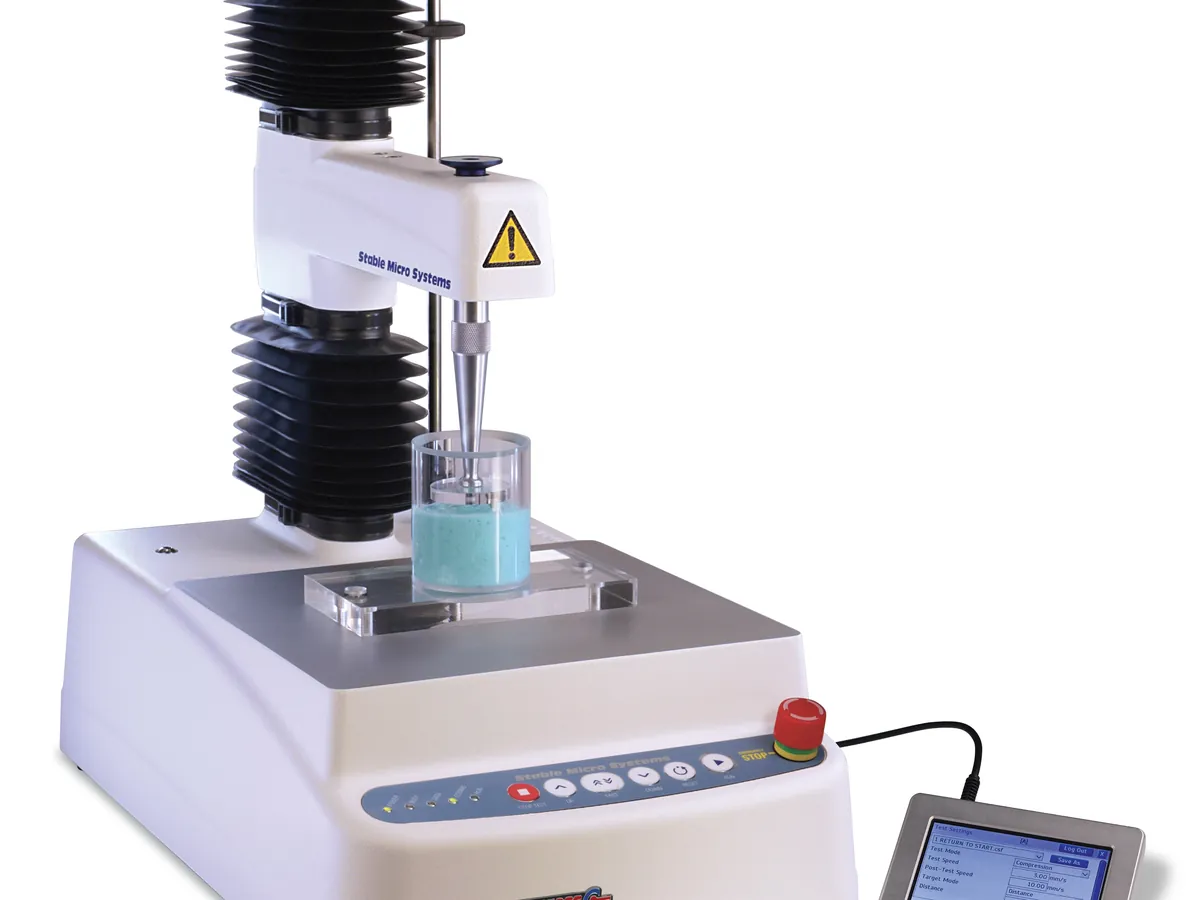
Moves a probe into, through or away from a sample at a controlled speed and records the force with a load cell. The force–distance curve gives firmness, spreadability, adhesiveness, hardness and break strength of creams, gels, lipsticks and powders.
- Cosmetics & personal care
- Food
- Pharmaceutical semi-solids
- Adhesives
- Packaging
Test your Texture analyser knowledge
Multiple-choice questions
Pick an answer to see whether you are right and why.
Q1. What does the load cell in a texture analyser measure?
basicQ2. In a cream penetration or spreadability test, firmness is usually reported as…
basicQ3. What does the negative peak during probe withdrawal indicate?
intermediateQ4. A certified 2000 g weight is placed on the platform. What force should the analyser read?
intermediateQ5. Why is a trigger force set before a test starts?
intermediateQ6. Firmness of the same cream falls each time it is refilled into the test cone. What is the most likely cause?
advancedQ7. Which parameter from the spreadability curve is usually linked to how much effort is needed to spread a cream?
advanced
Viva questions
Think of your answer first, then open it to compare.
1. Why must a texture method fix the probe, speed, temperature and sample preparation exactly?
Texture values are empirical: they depend on how the sample is deformed. A different probe, speed or temperature, or a different filling technique, gives a different number for the same product. Results are only comparable when every condition is the same.
2. How would you choose a load cell for a new cream method?
Run trial tests to see the peak force, then choose a load cell whose capacity is comfortably above it (so there is no risk of overload) but not so large that the forces measured are a tiny fraction of its range, where resolution and accuracy are poorer.
3. How is a texture analyser used in a cosmetic stability study?
Firmness, spreadability and adhesiveness are measured at time zero and at each pull point for samples stored at room temperature, 40–45 °C, in the fridge and after freeze–thaw cycles. A large change from the initial or reference sample, alongside changes in viscosity, appearance or microscopy, shows the structure of the product is breaking down.
Keep every Texture analyser in control: usage logs, calibration and maintenance schedules, and automatic blocking of overdue instruments.