pH meter
Measures how acidic or alkaline a solution is by measuring the small voltage produced by a glass electrode. Used for pH of products, buffers, mobile phases and water.
- Pharmaceutical
- Biotech
- Food & beverage
- Water treatment
- Chemicals
- Environmental
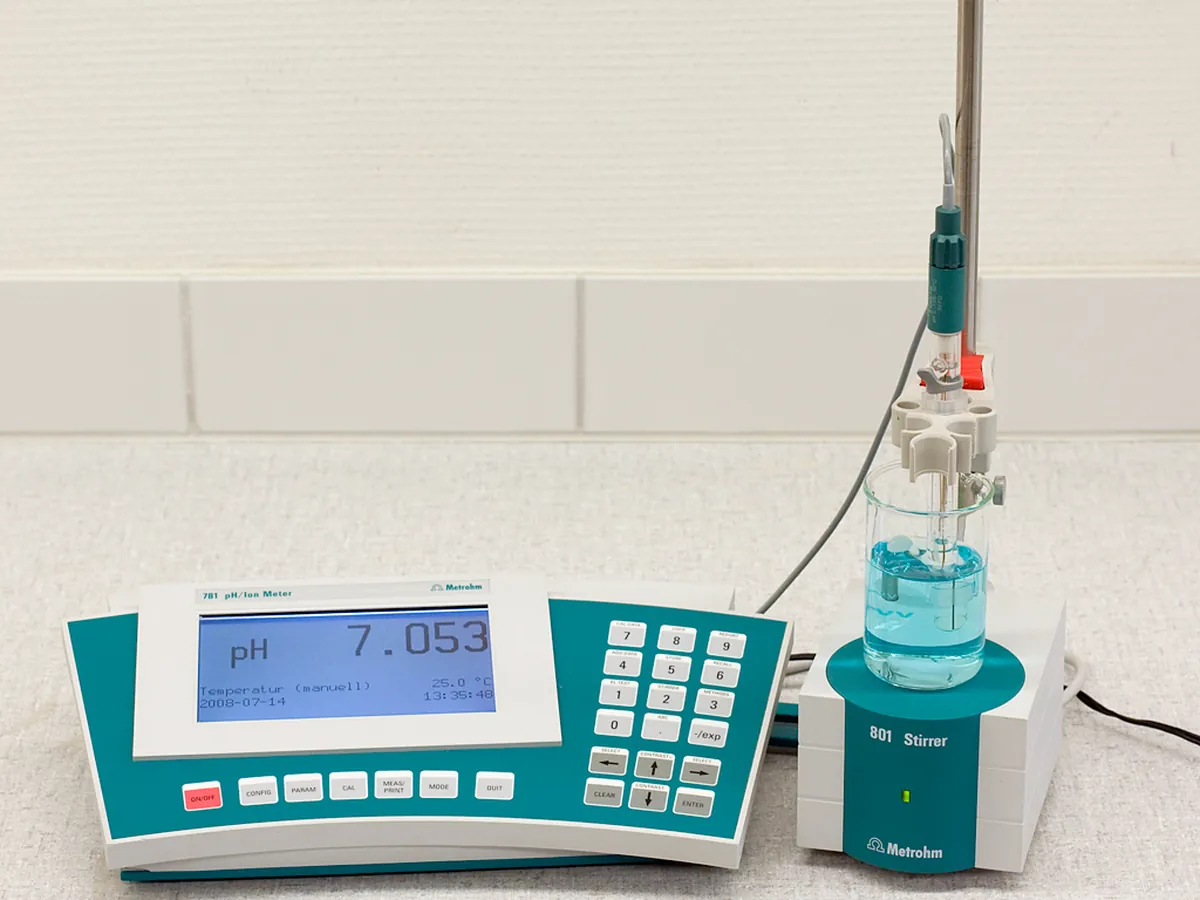
How pH meter works
pH is measured potentiometrically. A thin glass membrane develops a potential that depends on the hydrogen-ion activity on each side of it. The reference electrode provides a constant potential. The meter measures the difference between the two, which follows the Nernst equation: about −59.16 mV per pH unit at 25 °C. Calibration with buffers of known pH tells the meter the actual zero point (offset) and slope of the electrode.
The path of a sample
- 01
Sample contact
The glass bulb and the reference junction are immersed in the stirred solution.
- 02
Glass membrane
Hydrogen ions exchange at the hydrated glass surface, creating a potential that depends on pH.
- 03
Reference electrode
An Ag/AgCl reference in KCl electrolyte gives a stable potential through the liquid junction.
- 04
Voltage measurement
The meter measures the very small voltage difference with a high-impedance input.
- 05
Conversion
Using the calibration slope and offset and the measured temperature, the meter converts mV into pH.
Main parts and what they do
Glass pH electrode
Thin pH-sensitive glass bulb that develops a potential depending on hydrogen-ion activity.
Reference electrode
Usually Ag/AgCl in 3 M KCl; provides a constant reference potential through the liquid junction.
Combination electrode body
Holds glass and reference electrodes together, with a refill hole for the electrolyte.
Temperature sensor (ATC probe)
Measures sample temperature for automatic temperature compensation; may be built into the electrode.
Meter
High-impedance millivoltmeter with software that stores calibration data and converts mV to pH.
Electrode stand and stirrer
Hold the electrode steady and keep the solution gently and evenly mixed.
Storage solution
Usually 3 M KCl; keeps the glass hydrated and the junction open between uses.
Terms every analyst should know
pH
Minus the logarithm of the hydrogen-ion activity. pH 7 is neutral at 25 °C; each unit is a tenfold change.
Nernst slope
The theoretical change in voltage per pH unit: 59.16 mV at 25 °C. It increases with temperature.
Slope %
The electrode's actual slope as a percentage of the theoretical value. A healthy electrode is typically 95–105%.
Offset (asymmetry potential)
The voltage the electrode gives in pH 7 buffer. Ideally 0 mV; typically accepted within about ±30 mV.
Temperature compensation
Corrects the electrode slope for the sample temperature. It does not correct the real change of the sample's own pH with temperature.
Liquid junction
The porous contact between the reference electrolyte and the sample. A blocked junction gives slow, drifting readings.
Keep every pH meter in control: usage logs, calibration and maintenance schedules, and automatic blocking of overdue instruments.