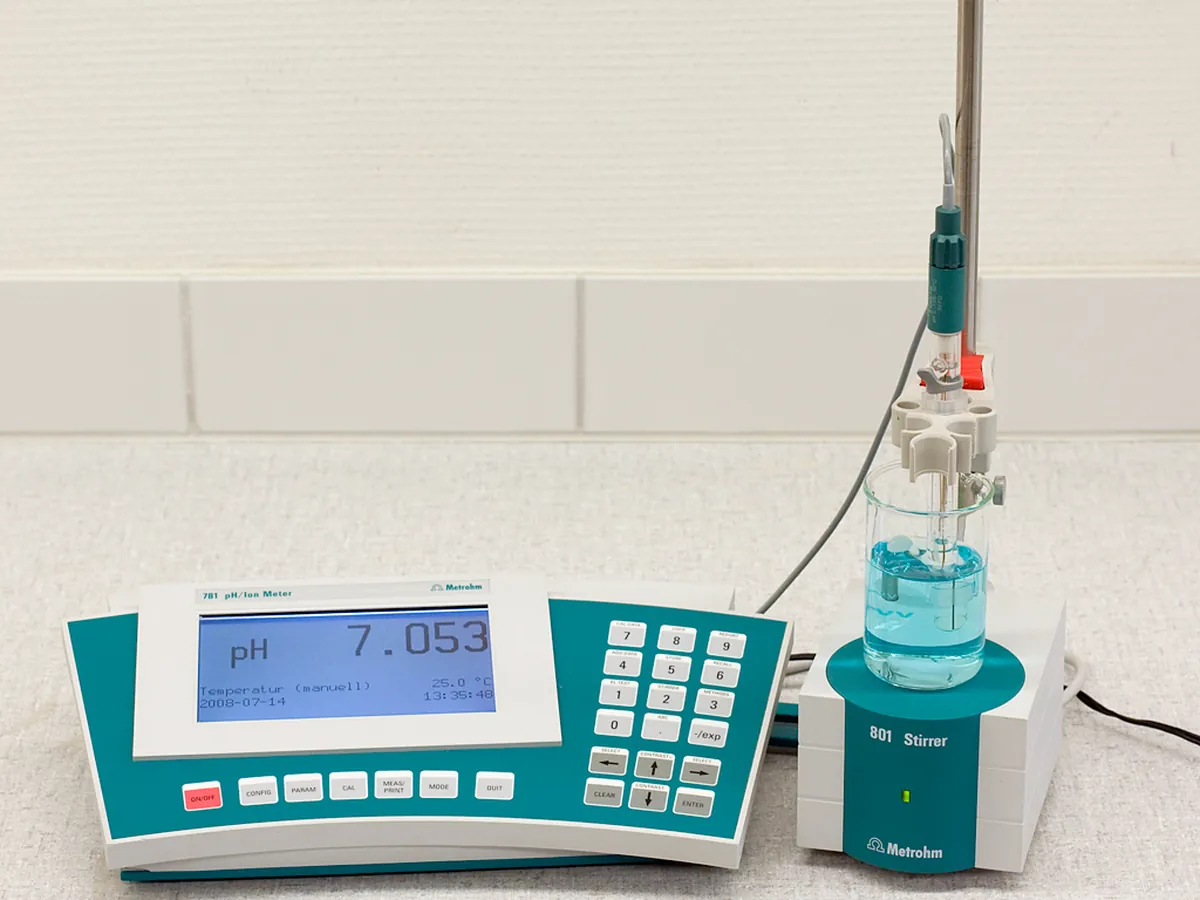
pH meter
Measures how acidic or alkaline a solution is by measuring the small voltage produced by a glass electrode. Used for pH of products, buffers, mobile phases and water.
- Pharmaceutical
- Biotech
- Food & beverage
- Water treatment
- Chemicals
- Environmental
Test your pH meter knowledge
Multiple-choice questions
Pick an answer to see whether you are right and why.
Q1. What is the theoretical Nernst slope of a pH electrode at 25 °C?
basicQ2. Where should a combination pH electrode be stored between uses?
basicQ3. For a sample with expected pH 5.5, which pair of buffers is most suitable?
basicQ4. After calibration the meter shows a slope of 91%. What does this most likely mean?
intermediateQ5. Electrode readings: pH 7.00 = 0 mV, pH 4.00 = +174 mV. What is the slope %?
intermediateQ6. What does automatic temperature compensation (ATC) correct for?
intermediateQ7. Readings in purified water are slow and drifting. The most likely reason is:
advancedQ8. Above about pH 12, a glass electrode tends to read low because of:
advanced
Viva questions
Think of your answer first, then open it to compare.
1. Why do we calibrate a pH meter with at least two buffers?
One buffer fixes the zero point (offset); a second buffer fixes the slope, which shows how many mV the electrode gives per pH unit. Two points define the line the meter uses, and the buffers should bracket the sample pH.
2. What are slope and offset, and what are typical limits?
Slope is the electrode's actual response per pH unit compared with the theoretical Nernst value, usually expressed as a percentage; typical limits are 95–105%. Offset (asymmetry potential) is the mV reading in pH 7 buffer; ideally 0 mV and typically accepted within about ±30 mV.
3. Why should you not wipe the glass bulb with tissue?
Rubbing can scratch the thin glass and build up static charge on it, which gives slow and unstable readings. The electrode should be rinsed and gently blotted only.
4. Why must buffers and samples be measured at the same temperature?
Both the electrode slope and the actual pH of buffers and samples change with temperature. ATC only corrects the electrode slope. If buffers and samples are at different temperatures, the result can be wrong, so they are measured at the same, recorded temperature (often 25 ± 2 °C).
Keep every pH meter in control: usage logs, calibration and maintenance schedules, and automatic blocking of overdue instruments.