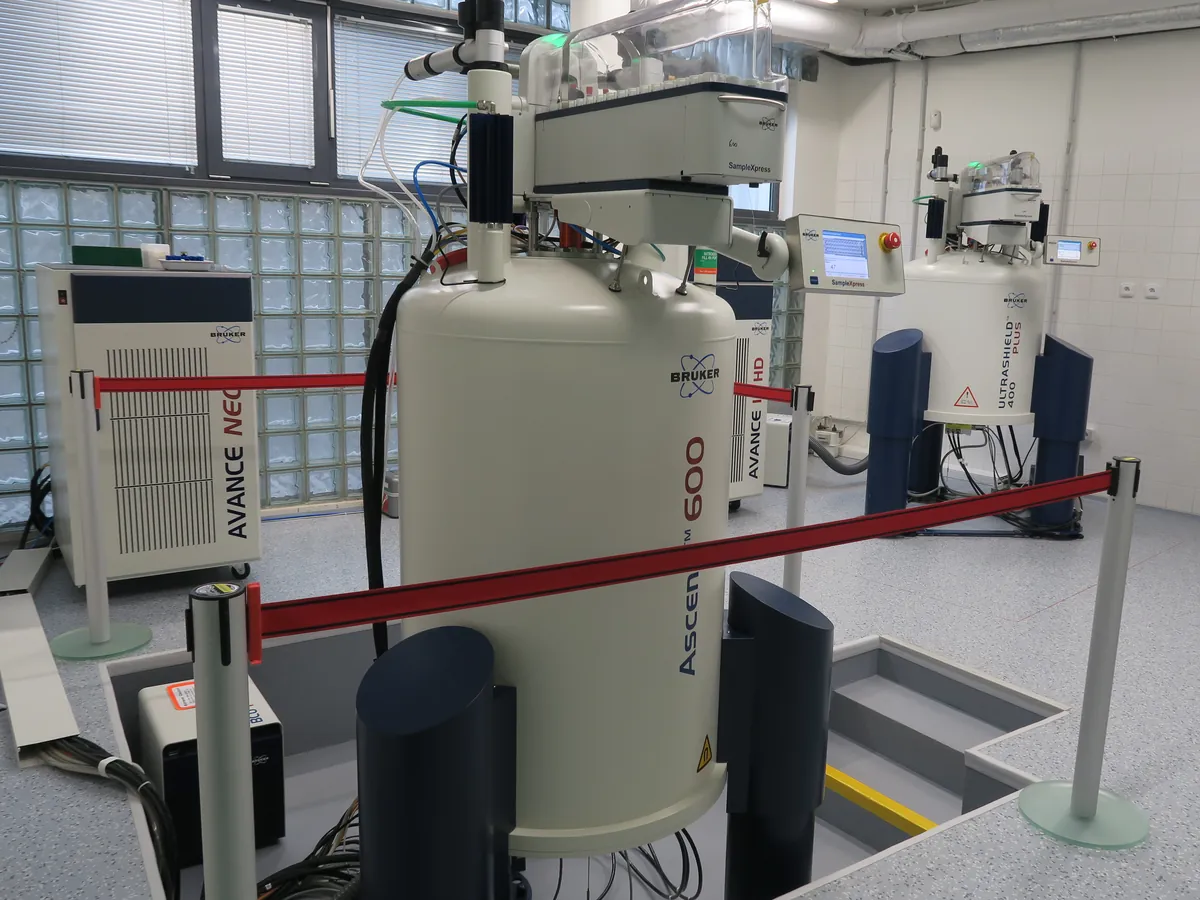
Nuclear magnetic resonance (NMR) spectrometer
Places a sample in a strong magnetic field and measures how atomic nuclei such as ¹H and ¹³C absorb radio waves. Gives detailed structural information and, with qNMR, absolute purity without a reference standard of the analyte.
- Pharmaceutical
- Biotech
- Chemicals
- Academia & research
- Food (authenticity)
- Petrochemical
Test your NMR knowledge
Multiple-choice questions
Pick an answer to see whether you are right and why.
Q1. Chemical shift in NMR is expressed in:
basicQ2. Why are NMR samples dissolved in deuterated solvents?
basicQ3. In a ¹H spectrum, the area (integral) of a signal is proportional to:
intermediateQ4. For quantitative NMR, the relaxation delay between scans should be:
intermediateQ5. Which 2D experiment shows which protons are coupled to each other?
intermediateQ6. What is the main advantage of qNMR for assigning the purity of a new in-house reference standard?
advancedQ7. Which item must NOT be taken inside the 5 gauss line of a superconducting NMR magnet?
basic
Viva questions
Think of your answer first, then open it to compare.
1. Work through a qNMR purity calculation: 20.00 mg paracetamol (M 151.16, CH₃ signal, 3 H) with 10.00 mg maleic acid (M 116.07, 2 H, purity 99.9%). The integral ratio analyte : standard is 2.297.
Purity = (Ix/Istd) × (Nstd/Nx) × (Mx/Mstd) × (mstd/mx) × Pstd = 2.297 × (2/3) × (151.16/116.07) × (10.00/20.00) × 99.9 = 2.297 × 0.6667 × 1.3023 × 0.5 × 99.9 = 99.6%. The method relies on accurate weighing (microbalance), full relaxation and well-separated signals.
2. How does NMR help in identifying an unknown impurity found by HPLC?
The impurity is isolated (preparative HPLC) or analysed by LC-NMR. ¹H and ¹³C spectra give the types of hydrogen and carbon; integrals give proton counts; coupling and 2D experiments (COSY, HSQC, HMBC) connect the atoms. Combined with the molecular mass from LC-MS, this gives the structure, which supports ICH Q3A/Q3B identification thresholds and toxicological assessment.
3. What are lock and shim, and why are they needed?
Lock uses the solvent's deuterium signal to continuously correct small drifts in the magnetic field, keeping signals at a constant frequency. Shimming adjusts small coils so that the field is uniform across the sample volume, giving sharp, symmetrical lines. Without them, peaks broaden and resolution and quantitation suffer.
Keep every NMR in control: usage logs, calibration and maintenance schedules, and automatic blocking of overdue instruments.