Spectroscopy
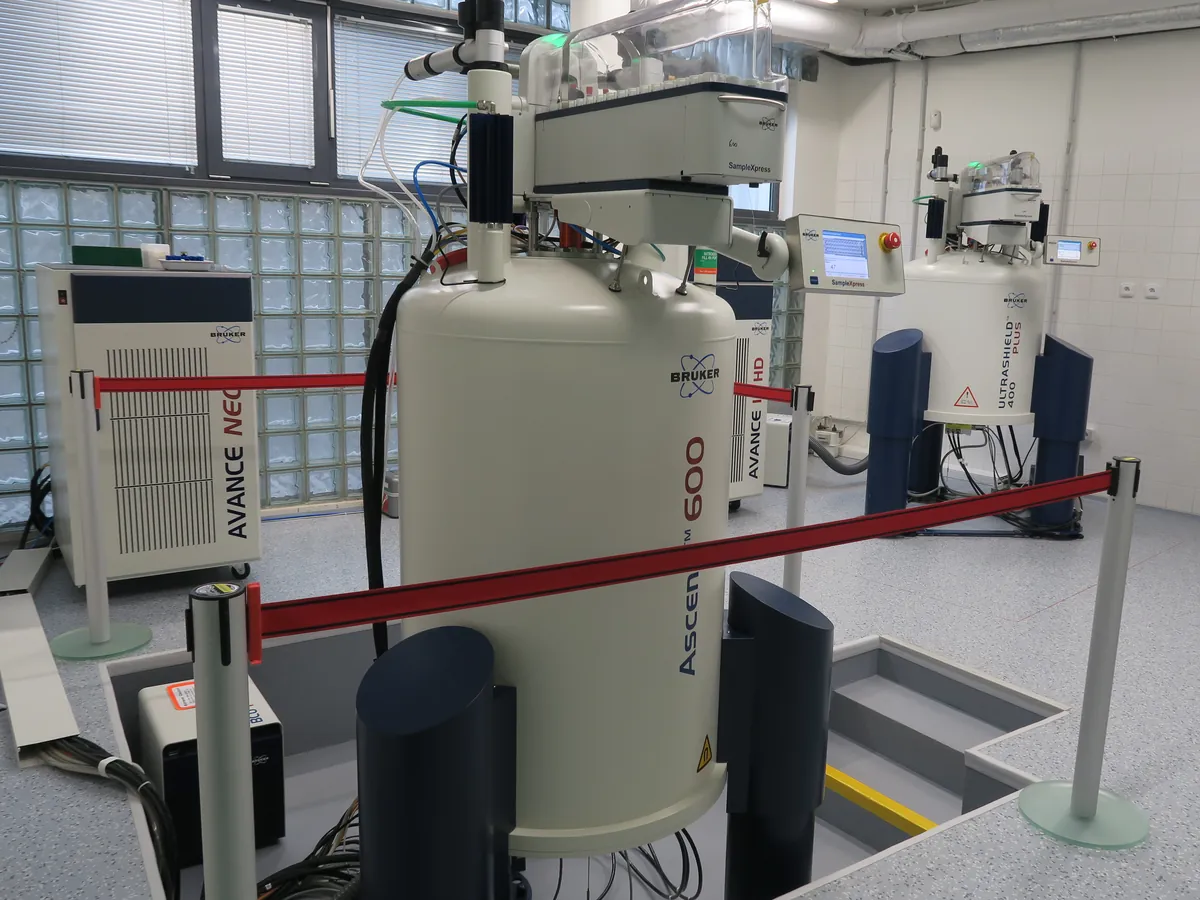
Nuclear magnetic resonance (NMR) spectrometer
Places a sample in a strong magnetic field and measures how atomic nuclei such as ¹H and ¹³C absorb radio waves. Gives detailed structural information and, with qNMR, absolute purity without a reference standard of the analyte.
- Pharmaceutical
- Biotech
- Chemicals
- Academia & research
- Food (authenticity)
- Petrochemical
Follow your site SOP
This is a typical operating sequence for learning. Your instrument model and approved SOP take precedence.
STAGE 1
Before you start
- 1Check you are trained and authorised for the NMR room and that the instrument's performance checks are current.
- 2Remove all magnetic items, credit cards, watches and phones before entering the 5 gauss line.
- 3Prepare the sample: dissolve the weighed material in the stated volume of deuterated solvent (often about 0.6 mL for a 5 mm tube) and filter if cloudy.
- People with pacemakers or metal implants must not enter the 5 gauss zone.
STAGE 2
Acquiring a spectrum
- 1Wipe the tube, fit the spinner and set the depth with the depth gauge.
- 2Insert the sample, then lock on the solvent and shim (automatic routines are normal).
- 3Tune and match the probe for the nucleus.
- 4Load the approved parameter set (pulse angle, relaxation delay, number of scans) and acquire.
- For qNMR use the validated parameters: 90° pulse, long relaxation delay and enough scans for a signal-to-noise of typically at least 150:1 on the signals used.
STAGE 3
Processing and reporting
- 1Fourier transform, then correct phase and baseline.
- 2Reference the spectrum (e.g. TMS at 0.00 ppm or the residual solvent signal).
- 3Integrate signals and assign them to the structure, or compare with the reference spectrum.
- 4For qNMR, integrate the chosen analyte and internal standard signals and calculate purity.
STAGE 4
Finishing
- 1Eject the sample and remove it from the spinner.
- 2Dispose of deuterated solvents as chemical waste; clean or discard tubes.
- 3Complete the instrument log, including any helium or nitrogen level readings required.
In LimsPulse · Calibration Management
Keep every NMR in control: usage logs, calibration and maintenance schedules, and automatic blocking of overdue instruments.