Nuclear magnetic resonance (NMR) spectrometer
Places a sample in a strong magnetic field and measures how atomic nuclei such as ¹H and ¹³C absorb radio waves. Gives detailed structural information and, with qNMR, absolute purity without a reference standard of the analyte.
- Pharmaceutical
- Biotech
- Chemicals
- Academia & research
- Food (authenticity)
- Petrochemical
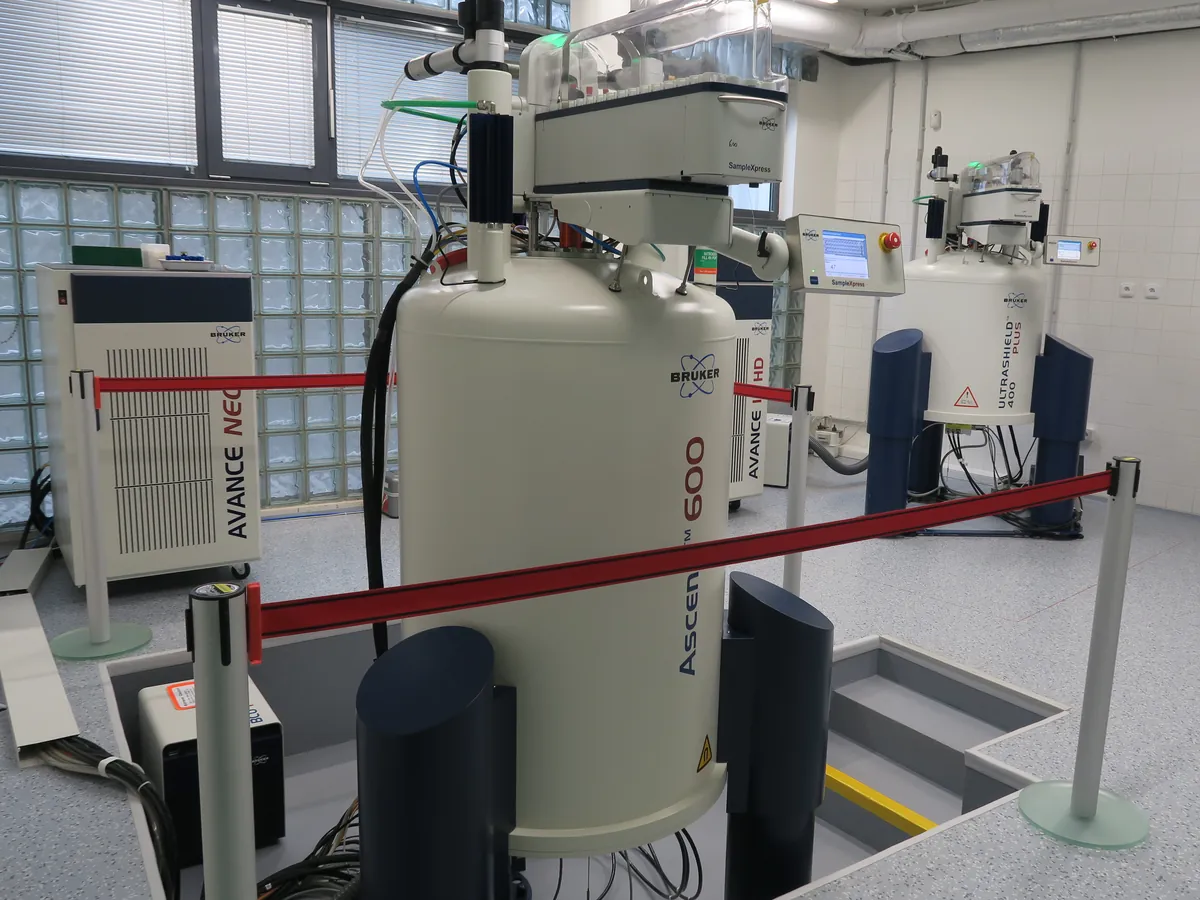
What is NMR?
Some atomic nuclei, such as ¹H, ¹³C, ¹⁹F and ³¹P, behave like tiny magnets. In a strong magnetic field they line up and can absorb radio-frequency energy at a precise frequency. The exact frequency depends on the chemical environment of each nucleus, so an NMR spectrum shows a separate signal for each type of hydrogen or carbon in the molecule.
From the position (chemical shift), area (integral) and splitting pattern of the signals, a chemist can work out how the atoms are connected. Two-dimensional experiments (COSY, HSQC, HMBC) link neighbouring atoms. This makes NMR the main tool for structure elucidation of new APIs, impurities and degradation products, and for confirming the structure of reference standards.
Because the area of an NMR signal is directly proportional to the number of nuclei producing it, NMR is also a primary quantitative method. In quantitative NMR (qNMR) the analyte is weighed together with a certified internal standard and purity is calculated from the signal ratio. Labs use qNMR to assign the purity of in-house reference standards and to assay materials where no reference standard exists. Most QC labs use NMR through a central analytical or R&D group; compact benchtop instruments are also used for identity testing.
Used for
- Structure elucidation and confirmation of APIs, intermediates and reference standards
- Identification and structure of unknown impurities and degradants (often after isolation or with LC-NMR)
- Quantitative NMR (qNMR) for purity assignment of reference standards
- Identity tests where a monograph specifies NMR (e.g. some heparins, polysaccharides and excipients)
- Residual solvent or counter-ion ratio and salt stoichiometry
- ¹⁹F and ³¹P NMR for fluorinated or phosphorus-containing drugs
- Solid-state NMR for polymorphs and amorphous content (specialist labs)
How it works
- 01
Sample in a deuterated solvent
A few milligrams are dissolved in a deuterated solvent (e.g. CDCl₃, DMSO-d₆, D₂O) in a precision NMR tube.
- 02
Lock and shim
The instrument locks onto the deuterium signal to keep the field stable and shims the field to make it uniform across the sample.
- 03
Tune and match
The probe is tuned to the nucleus being observed for maximum sensitivity.
- 04
RF pulse
A short radio-frequency pulse excites the nuclei.
- 05
FID acquisition
The receiver records the decaying signal as the nuclei relax; many scans are added to improve signal-to-noise.
- 06
Processing
Fourier transform, phase and baseline correction, referencing (e.g. TMS at 0 ppm) and integration give the final spectrum.
Advantages
- Gives detailed structural information that no other single technique provides
- Signal area is proportional to the number of nuclei, so qNMR needs no analyte reference standard
- Non-destructive; the sample can be recovered
- Highly specific and reproducible between instruments
- Can analyse mixtures and see several components at once
Limitations
- High purchase and running cost (superconducting magnet, liquid helium and nitrogen for high-field systems)
- Low sensitivity compared with MS or HPLC-UV; needs milligram amounts
- Needs deuterated solvents, which are expensive
- Interpretation needs skilled spectroscopists
- Strong magnetic field brings special safety controls
Keep every NMR in control: usage logs, calibration and maintenance schedules, and automatic blocking of overdue instruments.