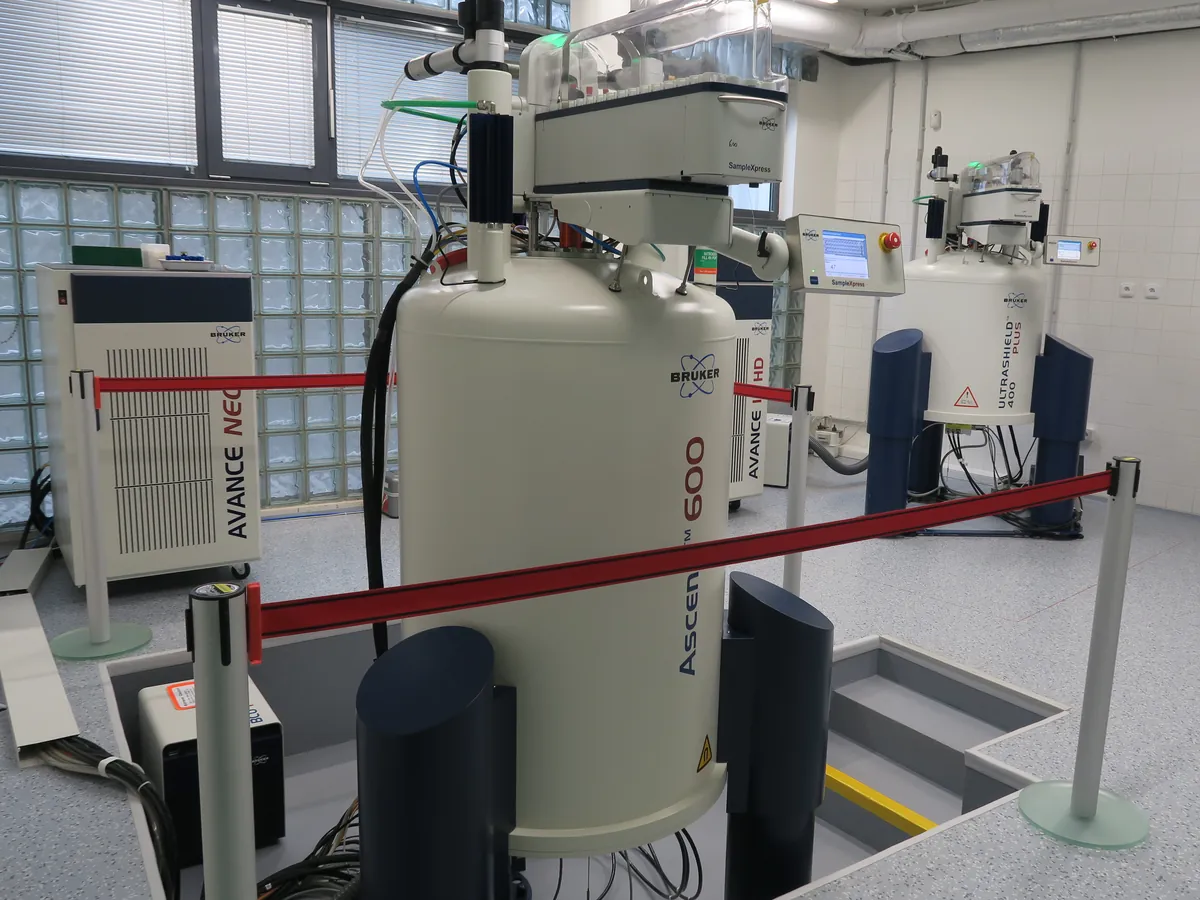
Nuclear magnetic resonance (NMR) spectrometer
Places a sample in a strong magnetic field and measures how atomic nuclei such as ¹H and ¹³C absorb radio waves. Gives detailed structural information and, with qNMR, absolute purity without a reference standard of the analyte.
- Pharmaceutical
- Biotech
- Chemicals
- Academia & research
- Food (authenticity)
- Petrochemical
NMR calibration procedures
NMR has no instrument calibration of its own in most labs. Its performance is controlled through qualification (below) and the system suitability or acceptance checks of each test that uses it.
Instrument qualification (DQ · IQ · OQ · PQ)
- 01
DQ — Design qualification
Defines field strength, probe types, nuclei, automation, site requirements (floor, cryogen supply, magnetic field footprint) and software compliance.
- 02
IQ — Installation qualification
Documents magnet installation and energisation, cryogen levels, field footprint survey, components, software and documentation.
- 03
OQ — Operational qualification
Tests line-shape, resolution, ¹H and ¹³C sensitivity (signal-to-noise on standard samples), pulse widths and variable temperature accuracy against vendor specifications.
- 04
PQ — Performance qualification
Shows routine fitness, for example by periodic line-shape and sensitivity tests and by qNMR of a known purity standard.
Keep every NMR in control: usage logs, calibration and maintenance schedules, and automatic blocking of overdue instruments.